

THIRUVANANTHAPURAM — In the dense, humid undergrowth of the Indian tropics, a silent and sophisticated biological calculation is taking place. For decades, the scientific community operated under the assumption that temperature was the primary "environmental switch" used by insects to time their developmental changes. However, groundbreaking new research from the Indian Institute of Science Education and Research (IISER) Thiruvananthapuram and Adam Mickiewicz University in Poland has upended this long-held paradigm.
The studies reveal that tropical butterflies possess an uncanny ability to read moisture levels and the nutritional integrity of their food sources to decide which "wardrobe" to wear for the coming season. This discovery not only reshapes our understanding of evolutionary biology but also raises critical questions about how species will navigate a world where climate change is making traditional seasonal cues increasingly unreliable.
Main Facts: A Biological Wardrobe Change
The research focuses on a phenomenon known as seasonal polyphenism. This is a biological mechanism where a single species can produce two or more distinct phenotypes (physical forms) from the same genetic blueprint, depending on the environmental conditions they encounter during development.
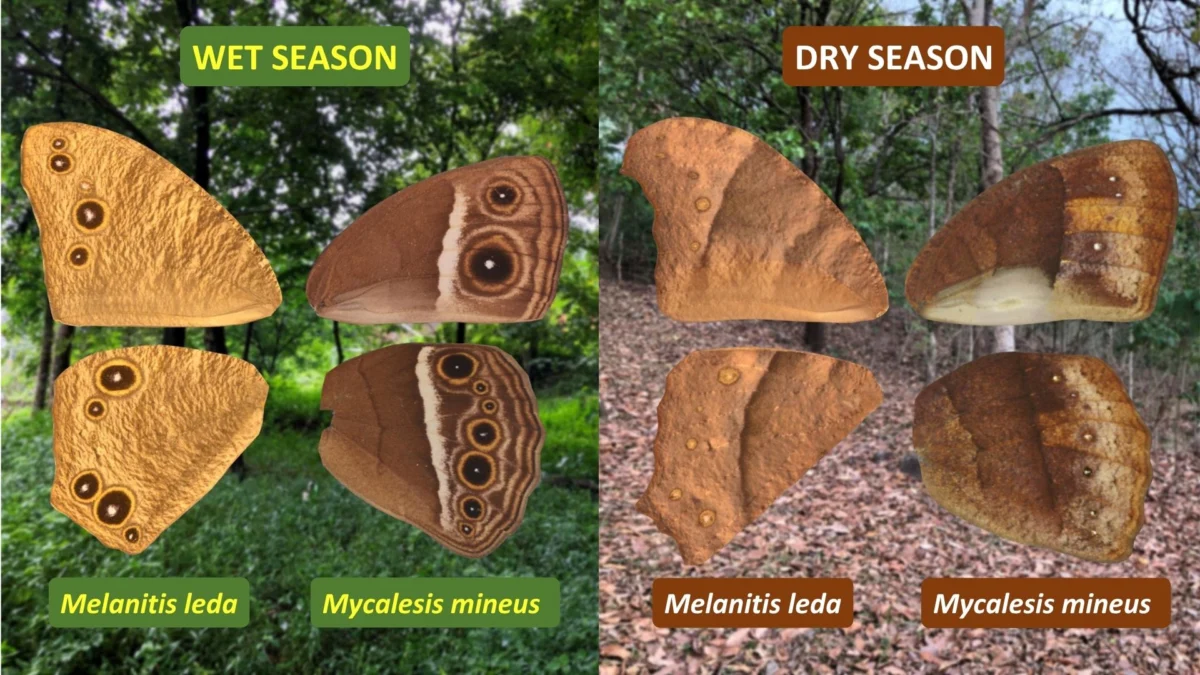
In the world of tropical butterflies, this change is most visible on their wings. The researchers focused on two specific species: Melanitis leda (the Common Evening Brown) and Mycalesis mineus (the Dark-branded Bushbrown).

The Two Faces of Survival
- The Wet-Season Form: Butterflies born during periods of high rainfall display large, vivid, target-like "eyespots" on the undersides of their wings. These markings serve a defensive purpose: they draw the attention of predators—such as birds and lizards—away from the butterfly’s vital organs and toward the expendable edges of the wings. A peck at an eyespot might tear the wing, but it allows the insect to escape with its life.
- The Dry-Season Form: As the rains cease and the landscape turns brown, these same species emerge with almost no eyespots. Instead, their wings take on a dull, mottled, "dead-leaf" appearance. This camouflage allows them to disappear against the parched vegetation, avoiding detection entirely by blending into the background.
The core of the discovery lies in how these butterflies know which form to adopt. Since a butterfly’s lifespan is short, the decision must be made while it is still a caterpillar or a pupa. The caterpillar must essentially "predict" what the world will look like weeks into the future.
Chronology of the Research: From Field to Laboratory
The journey toward this discovery began with a challenge to established scientific dogma. Historically, most research on seasonal polyphenism was conducted on African butterfly species. In those regions, the transition from the wet to the dry season is accompanied by a significant drop in temperature. Consequently, researchers concluded that temperature was the universal trigger for eyespot development.
However, the team at IISER Thiruvananthapuram, led by researchers including Dr. Tarunkishwor Yumnam, noted that this model did not fit the reality of southern India. In many tropical zones, temperatures remain relatively stable throughout the year, yet the butterflies still successfully switch their phenotypes. This suggested that another, more reliable cue was at play.
Phase 1: Field Sampling in Tamil Nadu
The research team began by collecting specimens of the Dark-branded Bushbrown and the Common Evening Brown from various climatic zones across the state of Tamil Nadu. These zones ranged from areas with distinct temperature shifts to regions where the only significant seasonal change was the arrival or departure of the monsoon.

Phase 2: Controlled Lab Environments
To isolate the variables, the scientists brought these specimens into highly controlled laboratory chambers. Here, they could manipulate air temperature and humidity independently—something that rarely happens in nature. By exposing different groups of caterpillars to varying combinations of high/low humidity and high/low temperature, they could observe which factor actually triggered the change in wing patterns.
Phase 3: Stage-Specific Swapping
In a follow-up study, the team sought to identify the exact moment a butterfly "commits" to its seasonal form. They swapped caterpillars between high-humidity and low-humidity environments at various stages of their growth. This allowed them to pinpoint the "sensitive period"—the window of time where the environment dictates the butterfly’s adult appearance.
Supporting Data: Two Species, Two Different Sensors
The data revealed a fascinating example of convergent evolution. While both species use humidity cues, they have evolved entirely different biological mechanisms to detect them.
1. The Direct Moisture Sensor (Mycalesis mineus)
The Dark-branded Bushbrown was found to act as a direct sensor of atmospheric moisture. The research showed that the critical window for this species occurs just before the caterpillar forms its pupa—specifically during the wandering larval and prepupal stages.

- The Reaction: If the air is dry during this stage, the caterpillar’s physiology reacts by shutting down the pathways that lead to eyespot development.
- The Result: It emerges from the chrysalis as a camouflaged "dead leaf," perfectly timed for the dry season.
2. The Indirect Nutritional Sensor (Melanitis leda)
In contrast, the Common Evening Brown butterfly ignores the air moisture entirely. Instead, it uses its food as a proxy for the season.
- The Mechanism: During the wet season, the grasses these caterpillars eat are lush and rich in nitrogen. As the dry season approaches, the plants become stressed, and their chemical composition changes.
- The Result: The caterpillar senses the declining nutritional quality of the host plant. This serves as a "biological alarm bell," signaling that the environment is drying out and it is time to develop the dry-season camouflage.
This finding is particularly significant because these two species are separated by approximately 50 million years of evolution. Despite this vast distance in their family trees, they arrived at the same ecological solution—using humidity-related cues—via different biological paths.
Official Responses: Insights from the Lead Researchers
The implications of these findings suggest a level of environmental "intelligence" in insects that was previously underestimated. Dr. Tarunkishwor Yumnam, the lead author of one of the studies, emphasizes that this flexibility is a survival strategy against the uncertainty of nature.
"The contrasting mechanisms that we found in these two butterflies reflect their distant evolutionary relationship," Dr. Yumnam stated. "On the other hand, they both independently converged to use humidity, likely because of the shared environmental similarities."

Dr. Yumnam further highlighted how this multi-cue system provides a buffer against environmental volatility. "Animals relying on a single environmental parameter, such as temperature, face a high uncertainty with the changing global climate. By using multiple cues or cues that are more consistently linked to seasonal rainfall, like humidity and host plant quality, these butterflies may be better prepared to cope with or adapt to climate change."
However, the research team remains cautious. They noted that because the experiments were conducted over a single generation in a lab setting, they cannot yet rule out maternal effects. This is a process where the mother butterfly might pass down epigenetic instructions to her offspring based on the conditions she experienced, effectively "pre-programming" them for the coming season. The team acknowledges that future genomic data will be required to confirm the precise genetic switches involved.
Implications: Conservation in a Changing Climate
The discovery has profound implications for conservation biology, particularly in the context of the global climate crisis.
Predicting Vulnerability
If a species relies solely on a single cue, like temperature, and that cue becomes decoupled from the actual season (e.g., a "false spring" or an unseasonably warm winter), the animal may emerge with the wrong camouflage. A "wet-season" butterfly emerging in a "dry-season" landscape would be a bright, conspicuous target for predators, leading to a rapid population decline.

By understanding that these butterflies use humidity and plant quality, conservationists can better predict which populations are most at risk. In regions where monsoon patterns are shifting or where droughts are affecting the nutritional value of native grasses, these butterflies may struggle to "read" the seasons correctly.
Rethinking Evolutionary Biology
The study also suggests that science may have only scratched the surface of how animals perceive their world. "Our study also highlights that animals showing different seasonal phenotypes may be relying on multiple environmental parameters that science has not uncovered yet," Dr. Yumnam concluded.
As we move forward, the ability to identify these "hidden sensors" will be crucial for protecting biodiversity. The Common Evening Brown and the Dark-branded Bushbrown serve as reminders that even the smallest creatures have developed incredibly complex tools to navigate the challenges of life on a changing planet. Their "wardrobe change" is not just a matter of aesthetics; it is a finely tuned masterclass in evolutionary survival.
