

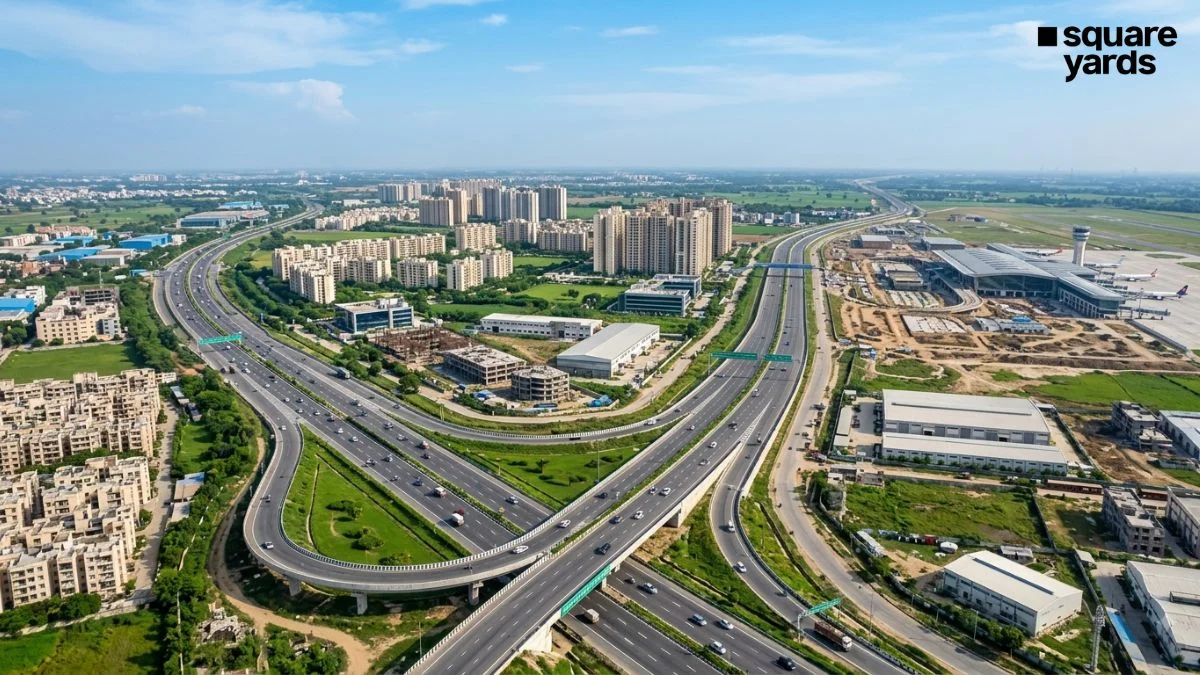
LUCKNOW/GREATER NOIDA — In a move that signals the next evolutionary phase of the National Capital Region’s (NCR) expansion, the Uttar Pradesh Cabinet, chaired by Chief Minister Yogi Adityanath, has formally approved the construction of the ₹8,585-crore Jewar-Ganga Link Expressway. This 74.5-kilometer greenfield project is designed to bridge the Noida International Airport (NIA) in Jewar directly with the ambitious Ganga Expressway via Bulandshahr.
The approval marks a pivotal shift in the regional development strategy, moving beyond the localized "airport-centric" growth model toward a comprehensive "connectivity-led" regional economic framework. As the Yamuna Expressway corridor witnesses a historic surge in real estate valuation—with prices nearly tripling over the last five years—this new corridor is expected to unlock the industrial and residential potential of the hinterlands of Western Uttar Pradesh.
1. Main Facts: The Architecture of a New Economic Arterial
The Jewar-Ganga Link Expressway is not merely a road project; it is a strategic multi-modal conduit intended to integrate the upcoming global aviation hub at Jewar with the heart of Uttar Pradesh.
Technical Specifications and Route
The proposed corridor is a six-lane, access-controlled greenfield expressway. Spanning 74.5 kilometers, it will originate from the periphery of the Noida International Airport and traverse through critical junctions in Bulandshahr before terminating at an interchange on the Ganga Expressway. The project carries an estimated capital outlay of ₹8,585 crore, covering land acquisition, civil construction, and environmental mitigation.
Strategic Objectives
The primary objective is to provide seamless, high-speed transit for cargo and passengers coming from eastern and central Uttar Pradesh (via the Ganga Expressway) to the Noida International Airport. By bypassing congested local highways, the expressway will reduce travel time significantly, effectively making the NIA the primary gateway for a population base of over 50 million people across dozens of districts.
The Shift in Market Focus
For years, the investment thesis for the Yamuna Expressway was predicated on the "proximity to the airport." However, the cabinet’s approval of this link shifts the focus toward "broader regional accessibility." The project ensures that the economic influence of the airport is not restricted to Gautam Buddha Nagar but extends deep into the agrarian and industrial belts of Western UP, fostering a new "Golden Triangle" of growth between Noida, Meerut, and Bulandshahr.
2. Chronology: From Concept to Cabinet Approval
The trajectory of the Jewar-Ganga Link Expressway is intertwined with the broader vision of making Uttar Pradesh a trillion-dollar economy.
- 2019–2020: The Foundation Phase: Following the finalization of the Noida International Airport project, the Yamuna Expressway Industrial Development Authority (YEIDA) identified the need for a secondary high-speed link to prevent the existing Yamuna Expressway from reaching saturation.
- 2021–2022: Integration with PM Gati Shakti: The project was integrated into the PM Gati Shakti National Master Plan, emphasizing the need for multi-modal connectivity. Preliminary surveys identified the Bulandshahr route as the most viable path for connecting the airport to the 594-km Ganga Expressway (Meerut to Prayagraj).
- 2023: Feasibility and DPR: Detailed Project Reports (DPR) were commissioned to evaluate the environmental impact and land acquisition requirements. The focus remained on creating a "greenfield" path to avoid the legal and logistical hurdles of widening existing state highways.
- August 2024: Cabinet Sanction: The Uttar Pradesh Cabinet officially greenlights the ₹8,585-crore budget. This approval sets the stage for the bidding process and land notification, coinciding with the nearing completion of the first phase of the Noida International Airport.
3. Supporting Data: The Real Estate Re-Rating
The impact of infrastructure announcements on the Yamuna Expressway corridor is already visible in the data. Research by Square Yards highlights a massive "re-rating" of the residential and commercial markets in the region.
The Threefold Price Surge
According to Square Yards Data Intelligence, the corridor has seen an unprecedented appreciation in property values:
- Apartment Prices: Average rates rose from approximately ₹3,200 per square foot (psf) in 2020 to nearly ₹9,600 psf in 2025. This represents a 200% increase in just five years.
- Plot Prices: The demand for land has been even more aggressive, with prices jumping from ₹1,100 psf to approximately ₹2,500 psf in the same period.
Micro-Market Performance (2025–2026)
While the entire corridor has benefited, certain sectors are emerging as leaders:
| Sector / Micro-Market | Price (Sept 2025) | Price (March 2026) | 6-Month Growth |
|---|---|---|---|
| Sector 25 | ₹7,550 psf | ₹9,000 psf | ~19% |
| Sector 22A | ₹9,150 psf | ₹9,850 psf | ~7.6% |
| Sector 27 (Premium) | ₹11,550 psf | ₹11,000 psf | -4.7% (Consolidation) |
| Sector 23D | ₹7,300 psf | ₹7,650 psf | ~4.8% |
| Gaur Yamuna City | ₹6,000 psf | ₹6,550 psf | ~9.1% |
| Jewar (Land/Plots) | — | ₹2,200 psf | Steady |
Sector 25 has recorded the strongest recent momentum, likely due to its strategic positioning relative to the proposed interchanges and upcoming commercial hubs. Conversely, Sector 27, which sits at the premium end of the market, is experiencing a period of consolidation as investors wait for the next set of physical infrastructure milestones.
Rental Yield Analysis
Despite the capital appreciation, the market remains investment-heavy rather than end-user-driven. Square Yards data indicates that rental yields along the Yamuna Expressway hover around 2.23%. This low yield suggests that the corridor is currently a "capital-appreciation play," where buyers are banking on future value rather than immediate rental income.
4. Official Responses and Policy Vision
Government officials and industry stakeholders view the Jewar-Ganga Link as the "final piece of the puzzle" for Western UP’s connectivity.
The Government’s Stance
Senior officials from the Uttar Pradesh government have emphasized that this expressway is a "growth multiplier." A spokesperson for the Chief Minister’s office stated:
"The Jewar-Ganga Link Expressway is more than a road; it is an industrial corridor. By linking the airport to the Ganga Expressway, we are ensuring that a farmer in Prayagraj or a manufacturer in Bulandshahr has a direct, high-speed link to global markets via the Jewar airport."
YEIDA’s Urban Planning
The Yamuna Expressway Industrial Development Authority (YEIDA) has already begun aligning its Master Plan 2041 with the new expressway route. YEIDA officials noted that the authority is planning specialized "Industrial Clusters" along the Bulandshahr link, focusing on electronics manufacturing, data centers, and logistics.
Industry Experts
Real estate analysts suggest that the "speculative phase" of the Yamuna Expressway is ending. "The first wave of growth was about the idea of an airport," says a lead researcher at Square Yards. "The second wave, triggered by the Jewar-Ganga Link, will be about utility. Investors are now looking at how easily a logistics firm can move goods from the airport to the rest of the state."
5. Implications: A Multi-Sectoral Transformation
The ₹8,585-crore investment will have far-reaching consequences across real estate, industry, and social infrastructure.
From Speculation to Employment-Led Demand
Historically, the Yamuna Expressway was criticized for being a "ghost stretch" of vacant high-rises. The new link changes this narrative by facilitating industrial growth. As the expressway improves connectivity to the Ganga Expressway, the region becomes an ideal location for:
- Logistics and Warehousing: Serving as a trans-shipment hub between Delhi-NCR and the rest of UP.
- Manufacturing: The proximity to both the airport and a high-speed road network will attract "Just-in-Time" manufacturing units.
- Employee Housing: Improved accessibility will encourage people working in the airport ecosystem to settle in more affordable micro-markets like Gaur Yamuna City or the newly developing sectors in Bulandshahr.
Enhancing the "Aerotropolis" Concept
The Noida International Airport is being developed as an "Aerotropolis"—a city where the layout, infrastructure, and economy are centered around the airport. The Jewar-Ganga Link expands the boundaries of this Aerotropolis. It allows the airport to function as a multi-modal hub, integrating air, road (Yamuna and Ganga Expressways), and rail (the proposed High-Speed Rail link).
Long-term Appreciation Outlook
While the "easy money" in real estate—buying land cheap and waiting for an announcement—has largely been made, the Jewar-Ganga Link provides a new runway for growth. Future appreciation will be highly localized. Areas near the expressway interchanges will likely see higher commercial value, while sectors with established amenities (like Sector 22A and 25) will attract premium residential interest.
Socio-Economic Upliftment of Bulandshahr
Bulandshahr, traditionally an agrarian and small-scale industrial district, stands to gain the most. The expressway will likely lead to the urbanization of the Bulandshahr-Jewar border, creating thousands of jobs in the construction, hospitality, and logistics sectors.
Conclusion: The Road Ahead
The UP Cabinet’s approval of the Jewar-Ganga Link Expressway is a definitive statement of intent. By committing ₹8,585 crore to this 74.5-km stretch, the government is ensuring that the Noida International Airport does not operate in a vacuum.
For investors, the data is clear: the Yamuna Expressway corridor has matured. The transition from a ₹3,200 psf market to a nearly ₹10,000 psf market reflects deep-seated confidence in the region’s infrastructure. However, as the focus shifts to the Jewar-Ganga Link, the winners of the next decade will be those who prioritize connectivity, economic activity, and project execution over simple proximity. As the first flights prepare to take off from Jewar in the coming year, the ground beneath the expressway is already moving toward a high-growth future.
