

Introduction: The Rising Prominence of Navi Mumbai’s Property Market
Navi Mumbai, once envisioned as a satellite township to relieve the congestion of Mumbai, has evolved into a premier real estate powerhouse in its own right. With the completion of the Atal Setu (MTHL) and the nearing operationalization of the Navi Mumbai International Airport, nodes such as Vashi, Nerul, Kharghar, Panvel, and Ulwe have seen unprecedented demand. However, for any prospective homebuyer, the "negotiated price" is only part of the financial equation.
In the 2026 fiscal year, government mandates—specifically stamp duty and registration fees—remain the most significant statutory overheads in any property transaction. These charges, which typically add between 7% and 8% to the total acquisition cost, are vital for the legal validation of property ownership. This report provides an exhaustive analysis of the current 2026 rates, the legal frameworks governing these taxes, and the procedural nuances that every investor must master.
1. Main Facts: The 2026 Statutory Framework
As of 2026, Navi Mumbai operates under the tax jurisdiction of the Maharashtra state government. While many buyers assume a flat rate across the Mumbai Metropolitan Region (MMR), Navi Mumbai features a unique composition of taxes due to its dual governance by municipal corporations and planning authorities like CIDCO.
The Component Breakdown
The total "Stamp Duty" in Navi Mumbai is not a single tax but a composite of three distinct levies:
- Base Stamp Duty (5%): The core tax levied under the Maharashtra Stamp Act, 1958.
- Metro Cess (1%): A surcharge introduced to fund massive transit infrastructure projects, including the Navi Mumbai Metro and various link roads.
- Local Body Tax (LBT) / Municipal Surcharge (1%): An additional levy applicable within the jurisdictions of the Navi Mumbai Municipal Corporation (NMMC) and the Panvel Municipal Corporation (PMC).
Current Rate Table (2026)
| Buyer Category | Base Duty | Metro Cess | Local Body Tax | Total Stamp Duty | Registration Fee |
|---|---|---|---|---|---|
| Male | 5% | 1% | 1% | 7% | 1% (Cap: ₹30,000) |
| Female (Sole) | 4% | 1% | 1% | 6% | 1% (Cap: ₹30,000) |
| Joint (Male & Female) | 5% | 1% | 1% | 7% | 1% (Cap: ₹30,000) |
| Joint (Two Women) | 4% | 1% | 1% | 6% | 1% (Cap: ₹30,000) |
Key Takeaway: The registration fee is distinct from stamp duty. While stamp duty is a tax on the transaction document, the registration fee (capped at ₹30,000 for properties valued above ₹30 lakh) is the service charge for the government to maintain the record of the deed.
2. Chronology: Legislative Evolution and 2026 Policy Shifts
The landscape of property taxation in Maharashtra has undergone several pivotal shifts leading up to 2026. Understanding this timeline is essential for recognizing why current rates are structured the way they are.

- 1958 & 1908: The bedrock of these charges was formed with the Maharashtra Stamp Act and the Registration Act, ensuring that only registered documents hold weight in a court of law.
- The Post-Pandemic Era: The government briefly slashed rates to stimulate the economy, but by 2023-2024, rates were restored to the 5% base to fund infrastructure.
- The 2026 Landmark Change: Historically, women who claimed the 1% stamp duty concession were barred from selling the property to a male buyer for 15 years. In a major policy shift in early 2026, the Maharashtra government removed this 15-year resale lock-in. This has significantly boosted the liquidity of female-owned assets.
- Annual Ready Reckoner Adjustments: On April 1, 2026, the state government implemented a revised Ready Reckoner (RR) rate, seeing an average hike of 5-7% across Navi Mumbai’s developing nodes. This effectively increased the "minimum taxable value" of properties, even if market prices remained stable.
3. Supporting Data: Calculating the Financial Impact
To illustrate the impact of these charges, we examine two of Navi Mumbai’s most popular investment hubs: Vashi (an established node) and Kharghar (a high-growth node).
Case Study A: The Mid-Segment Purchase in Kharghar
- Agreement Value: ₹80,00,000
- Ready Reckoner Value: ₹75,00,000
- Taxable Base: ₹80,00,000 (The higher of the two)
For a Male Buyer:
- Stamp Duty (7%): ₹5,60,000
- Registration (Capped): ₹30,000
- Total Outgo: ₹5,90,000
For a Female Buyer:
- Stamp Duty (6%): ₹4,80,000
- Registration (Capped): ₹30,000
- Total Outgo: ₹5,10,000 (Saving: ₹80,000)
Case Study B: The Luxury Segment in Vashi
- Agreement Value: ₹2,50,00,000
- Ready Reckoner Value: ₹2,60,00,000
- Taxable Base: ₹2,60,00,000 (The government charges duty on the RR rate if it exceeds the agreement value).
For a Male Buyer:
- Stamp Duty (7%): ₹18,20,000
- Registration (Capped): ₹30,000
- Total Outgo: ₹18,50,000
4. Official Responses and Procedural Mechanics
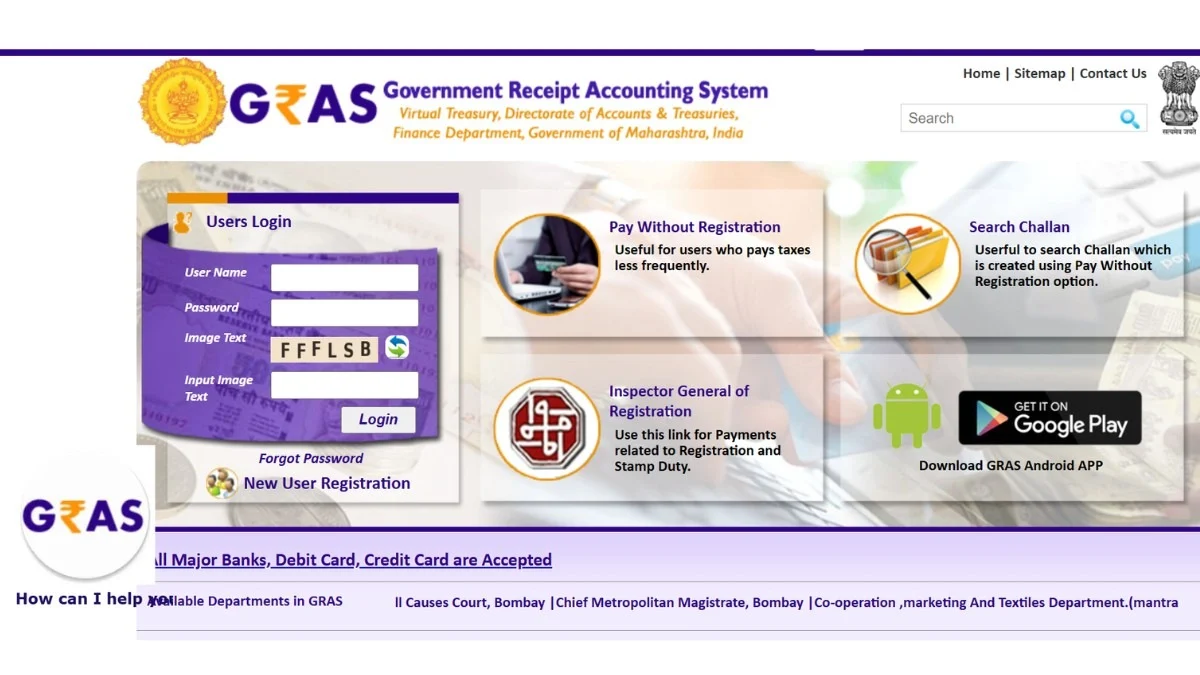
The process of paying these dues is digitized through the Government Receipt Accounting System (GRAS). However, Navi Mumbai presents a unique administrative challenge regarding district selection that often confuses first-time buyers.
The District Dilemma
Navi Mumbai is geographically split between two administrative districts. Selecting the wrong one on the GRAS portal can lead to payment rejection and delays in registration.

- Thane District: Must be selected for properties in Vashi, Nerul, Belapur, Sanpada, Airoli, and Koparkhairane.
- Raigad District: Must be selected for properties in Kharghar, Panvel, Ulwe, Taloja, and Dronagiri.
The Registration Process (Step-by-Step)
- Preparation: Draft the Sale Deed and verify the current RR Rate on the IGR Maharashtra portal.
- Payment: Use the GRAS portal to pay Stamp Duty and Registration fees via net banking or RTGS.
- Appointment: Visit the e-Step-in module on the IGR website to book a time slot at the specific Sub-Registrar Office (SRO).
- Verification: Buyer, Seller, and two witnesses must visit the SRO with Aadhaar cards and PAN cards for biometric verification.
5. Implications: Beyond the Initial Transaction
The payment of stamp duty has long-term implications for tax planning and future transfers.
Tax Benefits under Section 80C
Under the current Income Tax regime, homebuyers can claim a deduction of up to ₹1.5 lakh for expenses incurred on stamp duty and registration. However, this is only applicable:
- In the year the payment is actually made.
- For residential properties, not commercial.
- If the buyer opts for the Old Tax Regime.
The "Resale Flat" Nuance
While the stamp duty rates for resale flats are identical to new constructions, the economic implications differ.
- GST Exemption: Resale properties with a valid Occupancy Certificate (OC) do not attract GST, unlike under-construction units which carry a 1% or 5% GST.
- Transfer Fees: In Navi Mumbai, resale buyers must budget for an NMMC Transfer Fee (approx. 0.20% of the value) and Society Transfer Charges, which are often capped at ₹25,000 by state cooperative laws but can vary in practice.
The Ready Reckoner Trap
The government’s use of the RR Rate as a "floor price" for taxation can create a "tax trap." If a buyer manages to negotiate a price significantly lower than the RR Rate (more than a 10% gap), both the buyer and seller may be liable for additional income tax under Section 56(2)(x) of the Income Tax Act, as the difference is treated as "Income from Other Sources."
6. Comparison: Navi Mumbai vs. Other Regions
For investors choosing between different Maharashtra markets, the tax structure reflects the local infrastructure needs.
| Region | Male Rate | Female Rate | Notes |
|---|---|---|---|
| Navi Mumbai | 7% | 6% | Includes 1% LBT and 1% Metro Cess. |
| Mumbai City | 6% | 5% | No LBT, only Metro Cess. |
| Pune | 7% | 6% | Similar to Navi Mumbai due to LBT/Metro Cess. |
| Rest of Maharashtra | 5-6% | 4-5% | Varies based on municipal status. |
7. Frequently Asked Questions (FAQ)
Q1: Is Navi Mumbai stamp duty 7% or 6%?
For male buyers in major nodes like Vashi and Kharghar, it is 7% (5% base + 1% Metro Cess + 1% LBT). If the property is in a node not covered by a municipal corporation surcharge, it may be 6%, but this is rare in 2026.
Q2: Does the 1% concession for women still exist?
Yes. Women pay a 4% base rate instead of 5%, resulting in a total of 6% in most Navi Mumbai nodes. The 2026 update also allows them to sell the property without a 15-year waiting period.
Q3: What happens if I pay the stamp duty but the deal falls through?
You can apply for a refund through the IGR Maharashtra portal. If approved, the government typically refunds the amount after deducting a small processing fee (usually 1%), provided the application is made within six months.
Q4: Are gift deeds cheaper than sale deeds?
Yes. A gift deed to a close family member (spouse, child, sibling) attracts a nominal stamp duty of only ₹200 for residential or agricultural property in Maharashtra.
Conclusion: Strategic Planning for 2026
The 2026 real estate market in Navi Mumbai offers immense potential, but the statutory costs are a non-negotiable reality. By understanding the 7% (male) and 6% (female) benchmarks, utilizing the registration fee cap, and correctly identifying the administrative district (Thane vs. Raigad), buyers can avoid costly delays.
The removal of the 15-year resale restriction for women stands as the most progressive change of the year, encouraging more female homeownership and increasing market fluidity. As infrastructure continues to bridge the gap between Mumbai and Navi Mumbai, these taxes remain a critical contribution to the region’s world-class urban evolution. Always consult the latest Ready Reckoner rates on the official IGR portal before finalizing any financial commitment.
