

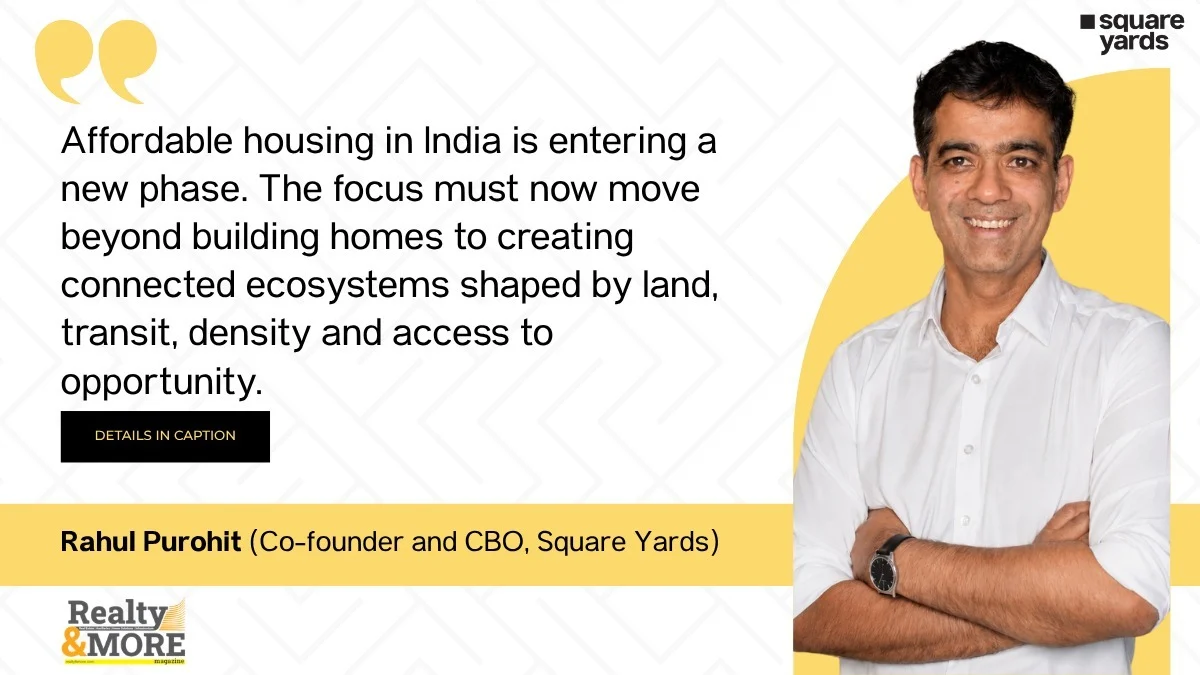
NEW DELHI – India’s urban landscape is undergoing a fundamental transformation. For over a decade, the national discourse on affordable housing was dominated by the singular goal of "delivery"—the physical construction of four walls and a roof for the millions of families entering the middle class or migrating from rural areas. However, as of August 2026, the strategy has evolved. The focus has shifted from the mere provision of shelter to the creation of a comprehensive, sustainable ecosystem where housing is integrated with mobility, finance, and long-term urban viability.
The recent National Conference on Affordable Housing Reforms has signaled that the next phase of India’s urban journey—spearheaded by the Pradhan Mantri Awas Yojana-Urban (PMAY-U) 2.0—will be defined not just by how many homes are built, but by where they are built and how they are financed.
Main Facts: A Holistic Approach to Urban Living
The traditional model of affordable housing often relegated low-income projects to the peripheries of cities, where land was cheap but infrastructure was non-existent. The 2026 reforms aim to dismantle this "peripheralization" of the poor. The core of the new strategy rests on the realization that "affordability" is a function of two costs: the price of the property and the cost of living (primarily commuting).
Key Pillars of the 2026 Reforms:
- Land Optimization: Recognizing land as the most significant barrier, the government is moving toward a mandate where at least 10% of residential land in planned urban areas must be reserved for affordable housing zones.
- Density and Vertical Growth: To combat land scarcity, the permissible Floor Area Ratio (FAR) is being significantly increased, reaching up to 500 in specific transit-oriented zones.
- Transit-Oriented Development (TOD): By aligning housing with mass transit (Metro, RRTS, and Railway corridors), the government aims to reduce the "hidden cost" of affordable housing—commuting time and expenses.
- PMAY-U 2.0: This second iteration of the flagship scheme targets an additional one crore (10 million) urban families, utilizing a mix of technology-enabled construction and diversified financing models.
- The Rental Market: For the first time, rental housing is being treated as a critical pillar of the housing ecosystem, aimed at the "floating" migrant population that does not necessarily wish to purchase property.
Chronology: The Evolution of India’s Housing Policy
The journey to the current 2026 policy framework has been a decade-long evolution, marked by learning from past inefficiencies and adapting to rapid urbanization.
- 2015: The Launch of PMAY-U: The Pradhan Mantri Awas Yojana-Urban was launched with the ambitious goal of "Housing for All." The initial focus was on four verticals: In-situ Slum Redevelopment (ISSR), Credit Linked Subsidy Scheme (CLSS), Affordable Housing in Partnership (AHP), and Beneficiary-led Construction (BLC).
- 2020–2022: The Pandemic Pivot: The COVID-19 pandemic highlighted the vulnerability of urban migrants. This led to the introduction of Affordable Rental Housing Complexes (ARHCs) as a sub-scheme, marking the first major shift toward rental solutions.
- 2024: The PMAY-U 2.0 Announcement: Building on the success of the first phase, which sanctioned over 1.18 crore houses, the government announced a second phase with a focus on "liveability" and modern construction technologies.
- August 2026: The National Conference on Affordable Housing Reforms: This landmark conference consolidated various regional strategies into a unified national reform agenda. It introduced the specific targets for land reservation, FAR increases, and the integration of Transit-Oriented Development (TOD) as a mandatory urban planning tool.
Supporting Data: The Mechanics of Affordability
To understand the scale of the challenge and the proposed solutions, one must look at the data driving these policy shifts.
The Delhi TOD Model
Delhi’s Transit-Oriented Development Regulations 2026 serve as a blueprint for other Indian metros. The framework opens approximately 207 square kilometers of land around high-speed transit corridors.
- High Density: Qualifying plots can see an FAR of up to 500, a dramatic increase from traditional limits.
- Residential Mandate: At least 65% of the permissible FAR in these zones is earmarked for residential use.
- Unit Size: To ensure these units remain "affordable," the policy focuses on homes of up to 100 square meters of built-up area.
Land and Cost Reduction
Land costs in tier-1 Indian cities often account for 50% to 70% of the total project cost. The 2026 reform package proposes:
- Land Pooling and TDR: Mechanisms like Transferable Development Rights (TDR) allow the government to acquire land for infrastructure without heavy cash outlays, while land pooling allows owners to become partners in development.
- Fiscal Incentives: Potential exemptions on land-use charges and stamp duty for affordable projects could reduce development costs by an estimated 10-15%, a saving that can be passed on to the buyer.
PMAY-U 2.0 Targets
The second phase is not just a continuation but an expansion.
- Scale: Targeting 10 million additional families.
- Finance: Expanding access to institutional finance for the informal sector, which has traditionally been excluded from the mortgage market due to a lack of formal income documentation.
Official Responses: Aligning Policy with Reality
Government officials and urban planners have emphasized that the 2026 reforms are a response to the "maturity" of the Indian real estate market.
A senior official from the Ministry of Housing and Urban Affairs (MoHUA) stated during the conference: "We have moved beyond the stage of just counting houses. The question now is: Can a worker reach their factory in 20 minutes? Can a child walk to school safely? If the answer is no, then the house is not truly affordable, regardless of the price."
State governments have also voiced their support, particularly regarding the flexibility of the new FAR regulations. Planning authorities in states like Maharashtra and Karnataka are reportedly looking to replicate Delhi’s TOD model to revitalize aging industrial corridors and turn them into high-density residential hubs.
Furthermore, the emphasis on Land Banks has been hailed by industry bodies like CREDAI (Confederation of Real Estate Developers’ Associations of India). Developers argue that the creation of dedicated land banks for affordable housing will reduce the "speculative premium" on land, making it easier for private players to enter the low-margin affordable housing segment.
Implications: A Future Defined by Mobility and Sustainability
The shift in policy has profound implications for the economy, the real estate sector, and the social fabric of Indian cities.
1. Economic Growth and Employment
The real estate sector is the second-largest employer in India. By shifting toward high-density, technology-enabled construction (such as pre-cast and 3D printing encouraged under PMAY-U 2.0), the government is fostering a more skilled labor force. The focus on 10 million new homes will provide a sustained demand for steel, cement, and over 200 allied industries.
2. Redefining "Location Value"
For decades, the value of a property was determined by its proximity to the "City Center." The 2026 TOD regulations flip this script. Value will now be concentrated along "Transit Ribbons." This will lead to a polycentric urban structure where multiple hubs of activity exist along metro lines, reducing the pressure on traditional central business districts.
3. Social Inclusion and the Rental Revolution
By integrating affordable housing into high-value transit zones, the government is actively fighting urban segregation. When a high-income luxury apartment and an affordable housing unit share the same transit corridor, the "spatial divide" between classes shrinks. Additionally, the formalization of the rental market will provide social security to the millions of "circular migrants" who move between cities for work.
4. Environmental Sustainability
High-density vertical growth is inherently more sustainable than urban sprawl. By concentrating the population around transit hubs, cities can reduce their carbon footprint, preserve surrounding agricultural land, and make public utilities like water and waste management more efficient.
5. Challenges Ahead: Implementation and Finance
Despite the optimistic framework, challenges remain. The success of land pooling depends on the cooperation of thousands of small landowners. Moreover, while FAR increases are a boon, they require a massive upgrade in "under-the-ground" infrastructure—sewage, water lines, and electricity grids—to support the increased density. Financing for the informal sector also remains a hurdle, requiring innovative credit-scoring models that look beyond traditional payslips.
Conclusion: The Road to Liveable Affordability
The 2026 National Conference on Affordable Housing Reforms has set a clear trajectory: the future of Indian housing is vertical, transit-oriented, and ecosystem-driven. For the real estate sector, the message is that the era of "build it and they will come" (regardless of location) is over.
The success of this new phase will be measured not by the number of keys handed over, but by the vibrancy of the neighborhoods created. If India can successfully align land availability, development density, and public transport, it will achieve more than just "Housing for All"—it will create a blueprint for sustainable urbanization in the Global South. The goal is a city where housing is not a burden to be managed, but a foundation upon which economic mobility and a high quality of life are built.
