

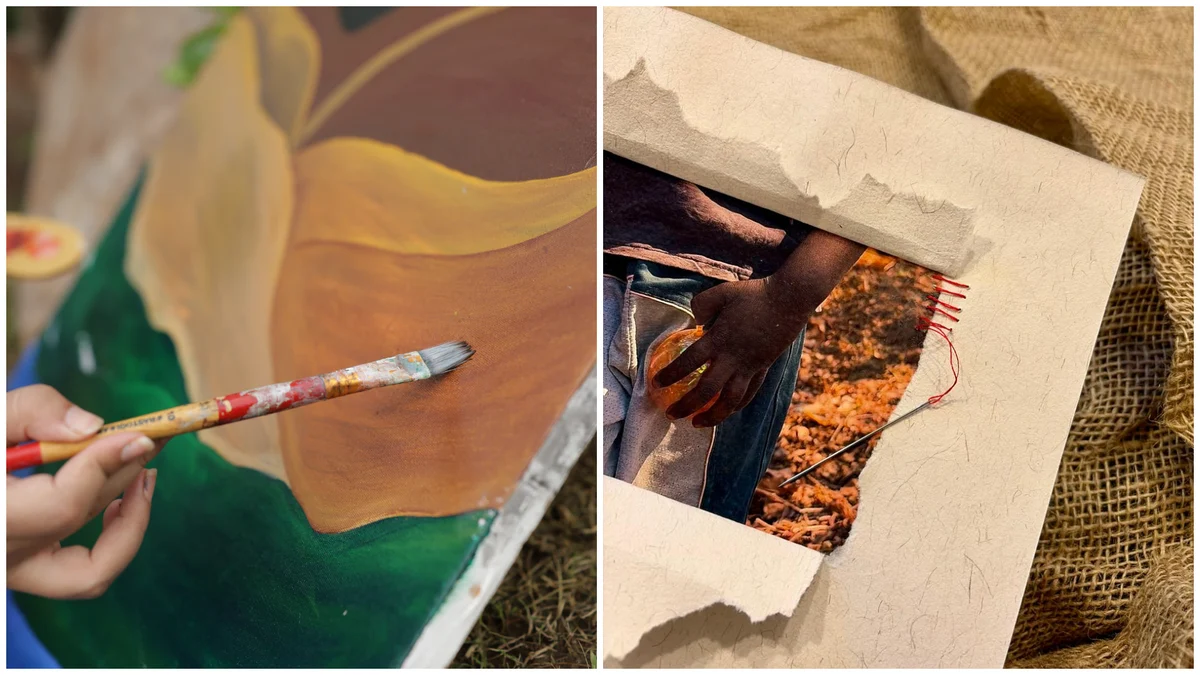
New Delhi, India – July 30, 2026 – In a powerful testament to the enduring impact of investigative journalism, independent reporter Jigyasa Mishra has unveiled "The Screaming Canvases," an exhibition at Bikaner House that transcends traditional reporting. Opening its doors today, the exhibition transforms Mishra’s harrowing eight-year exposé of human trafficking, bonded labour, and child exploitation across India into a collection of potent paintings, photographs, and immersive installations. This is not merely an art show; it is a continuation of a vital conversation, giving voice to the voiceless long after the ink on her reports has dried.
Mishra, known for her unflinching dedication to uncovering the grim realities faced by marginalized communities, has meticulously documented stories of profound suffering. The exhibition brings these narratives into stark visual relief: a school bag, heavy with bricks, symbolizing the stolen childhood of a young bonded laborer; a mother’s grief, palpable in the depiction of lingering lactation after the forced burial of her newborn; and the tragic consequence of seeking knowledge, represented by a burnt book, a punishment for a 12-year-old who dared to read a poem. These are not abstract concepts; they are the raw, unvarnished truths Mishra has unearthed from the dusty paths of brick kilns, the hidden corners of trafficking-prone villages, the shadowed alleyways of brothels, and the remote, often forgotten, settlements of India.
"The Screaming Canvases" features a curated selection of 40 works, each a direct outgrowth of Mishra’s extensive field research, intimate interviews, and the lived experiences she has witnessed firsthand. The exhibition is a powerful demonstration of how reportage can evolve into visual testimony, offering a different, perhaps more immediate, form of engagement for the audience.
From Byline to Brushstroke: A Journalist’s Artistic Evolution
Jigyasa Mishra’s journey into visual storytelling is deeply rooted in her upbringing. Her father, Jaishankar Mishra, is an esteemed artist and professor of Fine Arts, while her mother, Chandana, is a renowned Madhubani artist. "I painted before I learnt to read and write," Jigyasa reveals, underscoring a lifelong connection to the visual arts. However, for years, her primary medium remained the written word.
Her transition towards visual journalism was significantly influenced by her work with the People’s Archive of Rural India (PARI). The organization’s strong emphasis on visual storytelling encouraged Mishra to integrate sketching and illustration into her reporting process. What began as supplementary visual aids gradually blossomed into independent artistic expressions. "I realized photographs, illustrations, and installations are also forms of journalism," she emphasizes. "Storytelling doesn’t have to remain confined to text." This realization has empowered her to extend the lifespan of her stories, allowing them to resonate with audiences long after their initial publication.
The exhibition serves as a testament to this philosophy. Mishra believes in the power of art to simplify complex issues and to bring to the forefront the stories of individuals who are often rendered invisible by mainstream discourse. "I don’t believe in writing about an issue today and forgetting it tomorrow while chasing another story. Art allows me to continue telling those stories. It simplifies even the most complex issues while creating conversations around people who are often invisible," she states.
Unveiling the Harsh Realities: A Glimpse into the Exhibited Works
The collection on display is a visceral exploration of the human cost of systemic failures and societal indifference. Each piece is a narrative in itself, demanding reflection and empathy.
The Burden of Childhood: An Installation of Bricks and Books
One of the most profoundly moving works is an installation featuring an ordinary school bag, its weight amplified by the bricks concealed within. This piece powerfully encapsulates the story of a 12-year-old boy who, along with his parents, was trafficked to a brick kiln. His brief respite from grueling labor – pausing to share a poem from a salvaged book with his younger sister – led to a brutal reprisal. The contractor’s rage manifested in a savage beating and the destruction of the book, symbolizing the crushing of hope and the denial of basic human rights, including the right to education. The bricks within the bag are not just physical weight; they represent the heavy burden of labor and the shattered dreams of a child.
Lactation and Loss: Paintings of Exploited Motherhood

A series of acrylic paintings delves into the tragic experiences of women trafficked to brick kilns during their pregnancies. These women, often denied adequate medical care and forced to continue strenuous labor until the very end of their pregnancies, face unimaginable hardship. One particularly poignant painting is inspired by the testimony of a woman who had escaped bonded labor in Rajasthan. When Mishra met her, the woman was grappling with the recent, agonizing loss of her six-day-old infant, whom she had been forced to bury within the confines of the brick kiln. Her narrative, as depicted by Mishra, speaks of the relentless physical and emotional pain of lactation, a constant, cruel reminder of the child she would never hold again. This work highlights the deep intersection of exploitation, forced labor, and the profound trauma of lost motherhood.
The Trafficking Route: A Visual Odyssey of Despair
Another striking artwork, titled "The Trafficking Route," draws inspiration from survivors of human trafficking from the Sundarbans region. This piece utilizes bands of color to visually narrate a journey from environmental disaster to human exploitation. The use of blue signifies the devastating floodwaters that have consumed homes and livelihoods, forcing displacement. Green represents the fragile, yet resilient, landscape left behind. Ochre denotes the harsh realities of brick kilns in Rajasthan, a common destination for trafficked individuals, where exploitation often leads to forced marriages and further subjugation. Finally, black symbolizes the subsequent invisibility and captivity that defines the lives of many victims. The artwork serves as a stark reminder of how climate change and economic vulnerability can become potent drivers of human trafficking.
Portraits of Resilience: Photographs of the Unseen
Mishra’s photographic contributions to the exhibition offer intimate glimpses into the lives of those she has encountered. These are not staged portraits; they are candid captures that convey the resilience, dignity, and underlying humanity of individuals often reduced to statistics. Her lens focuses on the subtle expressions, the weathered hands, and the determined gazes that speak volumes about their struggles and their enduring spirit. Works like "The Rescued 12" offer a powerful visual record of individuals who have managed to escape the clutches of exploitation, serving as beacons of hope.
A Personal Commitment: Journalism as a Mother’s Mission
Mishra’s dedication to her work is deeply personal. Even during her own pregnancy, she continued to travel to remote villages and brick kilns, driven by an unyielding commitment to her journalistic mission. Subsequently, she often brought her infant son along on her assignments. "I wanted him to see the realities that exist outside our own lives," she explains. "We are privileged enough to tell these stories." This profound personal commitment imbues her art with an authenticity and depth that resonates powerfully with viewers. It highlights her belief that understanding and empathy are crucial to driving change.
Implications and the Path Forward: Art as a Catalyst for Change
"The Screaming Canvases" is more than an exhibition; it is a call to action. By transforming hard-hitting journalistic narratives into accessible and emotionally resonant art, Jigyasa Mishra aims to foster deeper public engagement with the critical issues of human trafficking, bonded labor, and child exploitation. The exhibition challenges viewers to move beyond passive consumption of news and to actively engage with the human stories behind the headlines.
The implications of such an artistic approach are far-reaching. Art has a unique capacity to bypass intellectual defenses and appeal directly to emotions, fostering empathy and understanding in ways that traditional reporting sometimes struggles to achieve. By presenting these narratives visually, Mishra is not only raising awareness but also creating a space for dialogue and introspection.
The exhibition’s run at Bikaner House, from July 30th to August 2nd, provides a crucial window for the public to confront these uncomfortable truths. It offers an opportunity for policymakers, activists, and ordinary citizens alike to be reminded of the ongoing struggles faced by vulnerable populations across India. The "screaming canvases" are, in essence, the unheeded cries of those who have been marginalized and exploited, amplified through the powerful medium of art.
As the exhibition concludes, the hope is that the visceral impact of Mishra’s work will translate into sustained action. The transformation of journalism into art serves as a potent reminder that the pursuit of justice and human dignity is an ongoing process, one that requires continuous effort, unwavering empathy, and a willingness to confront the most difficult realities of our society. Jigyasa Mishra’s exhibition is a testament to the enduring power of storytelling and its capacity to ignite change, one canvas at a time.
