

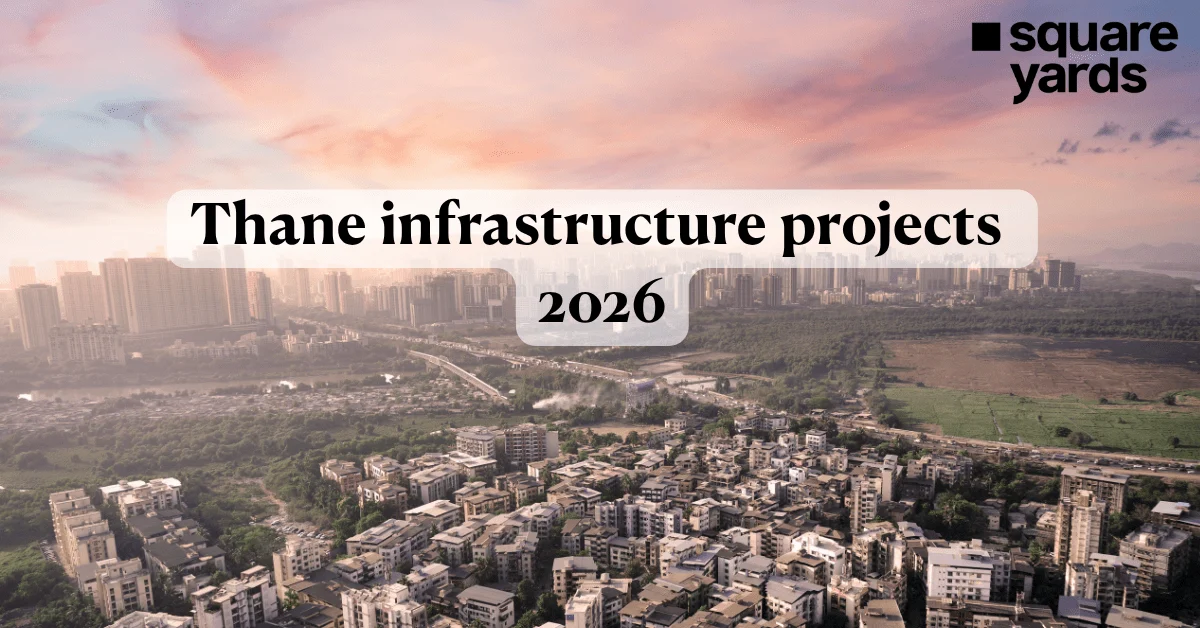
For decades, the city of Thane was perceived through a singular lens: a secondary residential alternative to the cramped quarters of Mumbai. However, the narrative of this "City of Lakes" is undergoing a radical transformation. Driven by a massive infusion of capital into multi-modal infrastructure, Thane is shedding its "satellite town" tag to emerge as one of the Mumbai Metropolitan Region’s (MMR) most strategically connected urban powerhouses.
The evolution is not merely cosmetic. A sophisticated "mobility stack" comprising metro rail, subterranean tunnels, coastal roads, inland waterways, and high-speed rail is reshaping the city’s geography. As these projects move from blueprints to reality, Thane is transitioning from a passive residential destination into a mobility-led economic hub, fundamentally altering the dynamics of property investment and urban living in the region.
I. Main Facts: The Infrastructure-Led Real Estate Surge
Thane’s real estate market is currently buoyed by over half a dozen mega-projects that aim to bridge the gap between residential affordability and commercial accessibility. The core of this transformation lies in Multi-Modal Connectivity.
Unlike previous decades where growth was tethered to the Central Railway local trains, the new Thane is being built on a foundation of diverse transport layers. Key projects like Metro Line 4, the Thane-Borivali Twin Tunnel, and the Thane Coastal Road are designed to slash travel times by up to 70%.
According to recent market analytics, areas with high proximity to these upcoming transit nodes have seen a steady property price appreciation of 8-12% annually, even during broader market stagnations. The primary driver is the shift in homebuyer demographics; the city is no longer just attracting budget-conscious families but is now a preferred destination for high-net-worth individuals (HNIs) and corporate professionals seeking a "live-work-play" ecosystem.
II. Chronology: From Residential Suburb to Economic Epicenter
To understand Thane’s current trajectory, one must look at its developmental timeline:
- 1990s – Early 2000s (The Residential Genesis): Thane functioned as a dormitory town for Mumbai. The focus was on basic housing and the expansion of the Ghodbunder Road as a bypass.
- 2010 – 2018 (The Commercial Pivot): The emergence of IT parks and corporate hubs in Wagle Estate and Ghodbunder Road began. Thane started retaining its workforce rather than just exporting it to Mumbai.
- 2019 – 2024 (The Infrastructure Explosion): This period marked the commencement of the "Multi-Modal Stack." Construction began on Metro Line 4, and the Mumbai Trans Harbour Link (Atal Setu) was completed, providing an indirect but vital boost to Thane’s regional accessibility.
- 2025 – 2030 (The Maturity Phase): The anticipated completion of the Thane-Borivali Twin Tunnel and the Navi Mumbai International Airport (NMIA) is expected to turn Thane into a central node connecting the Western Suburbs, Navi Mumbai, and the Mumbai mainland.
III. The Mobility Stack: A Deep Dive into Key Projects
1. Metro Line 4 (Wadala-Kasarvadavali)
Spanning 32.3 km, this corridor is the "green artery" of Thane. By connecting Wadala in South-Central Mumbai to Kasarvadavali in Thane West, it provides a direct alternative to the perennially congested Eastern Express Highway (EEH).
- Mobility Impact: It integrates with the suburban rail and other metro lines (Line 5 and Line 6), creating a seamless transit web.
- Real Estate Implication: It has unlocked the potential of the "Ghodbunder North" corridor, making areas like Kasarvadavali and Waghbil accessible for daily Mumbai commuters.
2. Thane-Borivali Twin Tunnel
Perhaps the most ambitious engineering feat in the region, this 11.8 km tunnel will cut through the Sanjay Gandhi National Park.
- Mobility Impact: It reduces the 90-minute arduous journey via Ghodbunder Road to a mere 15–20 minute drive.
- Real Estate Implication: This project effectively merges the property markets of the Western Suburbs and Thane. It allows professionals working in the Borivali-Kandivali belt to consider Thane’s luxury townships as viable housing options.
3. Thane Coastal Road & Ghodbunder Expansion
The proposed 13.45-km Coastal Road from Gaimukh to Kharegaon is designed to act as a pressure-release valve for the city’s internal traffic.
- Mobility Impact: It provides a high-speed bypass for north-south movement, bypassing the internal city bottlenecks.
- Real Estate Implication: Areas like Balkum and Kolshet, which were previously considered "interior" pockets, are now being rebranded as "premium waterfront" localities.
4. The Water Metro: A New Dimension
Thane is set to leverage its 30-km long coastline through the Water Metro. Connecting Gaimukh, Kolshet, and Kalwa to Navi Mumbai and Kalyan, this ferry-based system adds a layer of redundancy and aesthetic appeal to the city’s transit options.
5. Regional Connectors: Atal Setu and NMIA
While not located within Thane city limits, the Atal Setu (MTHL) and the Navi Mumbai International Airport are critical to its growth. The improved road network allows Thane residents to reach the new airport in under 45-50 minutes, making the city a strategic base for logistics businesses and frequent international travelers.
IV. Supporting Data: Micro-Market Price Insights
Data from Square Yards Research indicates a widening price bracket in Thane, reflecting the diverse range of inventory—from affordable housing to ultra-luxury penthouses.
| Locality Name | Average Price (Per Sq. Ft. in INR) | Key Growth Driver |
|---|---|---|
| Majiwada | 14,500 – 25,000 | Proximity to EEH and Metro 4 Interchange |
| Kapur Bawdi | 20,500 – 25,000 | Central Hub; Retail and Healthcare Density |
| Manpada | 16,500 – 26,000 | Luxury Integrated Townships |
| Kolshet | 17,000 – 22,000 | Waterfront Development & Coastal Road |
| Balkum | 15,500 – 23,000 | Upcoming Transit Connectivity |
| Waghbil | 14,500 – 22,000 | Metro Line 4 Proximity |
| Kasarvadavali | 11,000 – 17,000 | Entry-level Luxury & Metro Terminus |
| Kalwa | 15,000 – 23,500 | Airoli-Kalwa Rail Link & Industrial Hubs |
| Patlipada | 14,500 – 37,000 | High-end Gated Communities (Hiranandani Estate) |
Analysis: The high upper-limit in Patlipada (Rs 37,000/sq. ft.) showcases the emergence of a "luxury corridor" that rivals some of the prime markets in Mumbai’s western suburbs.
V. Official Perspectives and Governance
Urban planners and state authorities, including the MMRDA (Mumbai Metropolitan Region Development Authority) and the Thane Municipal Corporation (TMC), have emphasized a "Transit-Oriented Development" (TOD) model for Thane.
According to strategic documents from the MMRDA, the goal is to increase the public transport share to 70% of all commutes by 2030. Officials have noted that the integration of the Mumbai-Ahmedabad Bullet Train (with a major station near Thane) will further catalyze commercial interest, potentially turning the city into a regional headquarters for Japanese and Indian tech firms.
"Thane is being redesigned as a polycentric city," says a senior urban consultant. "The focus is no longer just on moving people to Mumbai, but on creating a self-sustaining ecosystem where one can live in Kolshet, work in Wagle Estate, and travel to Ahmedabad or South Mumbai within minutes."
VI. Socio-Economic Implications: The Future of Thane
The massive infrastructure overhaul carries profound implications for the city’s future:
1. The "Walk-to-Work" Evolution
As infrastructure improves, corporate entities are increasingly relocating to Thane to escape the exorbitant rentals of BKC and Lower Parel. This is creating a localized economy, reducing the "brain drain" where talented residents spend hours commuting away from the city.
2. Appreciation and Investment Yields
For investors, Thane offers a unique proposition: capital appreciation driven by infrastructure and rental yields supported by a growing corporate workforce. The "yield-on-cost" for early investors in areas like Ghodbunder Road has outperformed several South Mumbai markets over the last five years.
3. Lifestyle Transformation
The shift is not just economic; it’s social. The influx of premium developers (Godrej, Lodha, Oberoi, Hiranandani) has brought with it world-class social infrastructure—international schools, multi-specialty hospitals, and luxury malls like Viviana and Korum. Thane is becoming a lifestyle choice, not a compromise.
4. Environmental Challenges
However, the rapid development of tunnels and coastal roads poses environmental questions regarding the preservation of the Sanjay Gandhi National Park and the Thane Creek Flamingo Sanctuary. The success of Thane’s metamorphosis will depend on how the city balances this "grey" infrastructure with its "green" and "blue" assets.
Conclusion
Thane’s journey from a quiet satellite town to a multi-modal mobility hub is a blueprint for urban renewal in India. By diversifying its transit layers—moving beyond the limitations of the suburban rail—the city has unlocked billions in real estate value. As the Metro Line 4 begins operations and the Twin Tunnel breaks ground, the distinction between "Mumbai" and "Thane" will continue to blur, cementing Thane’s position as the most strategically connected and economically vibrant node of the Mumbai Metropolitan Region. For the homebuyer and the investor alike, the message is clear: Thane is no longer just a place to live; it is a place to grow.
