

SCIENCE
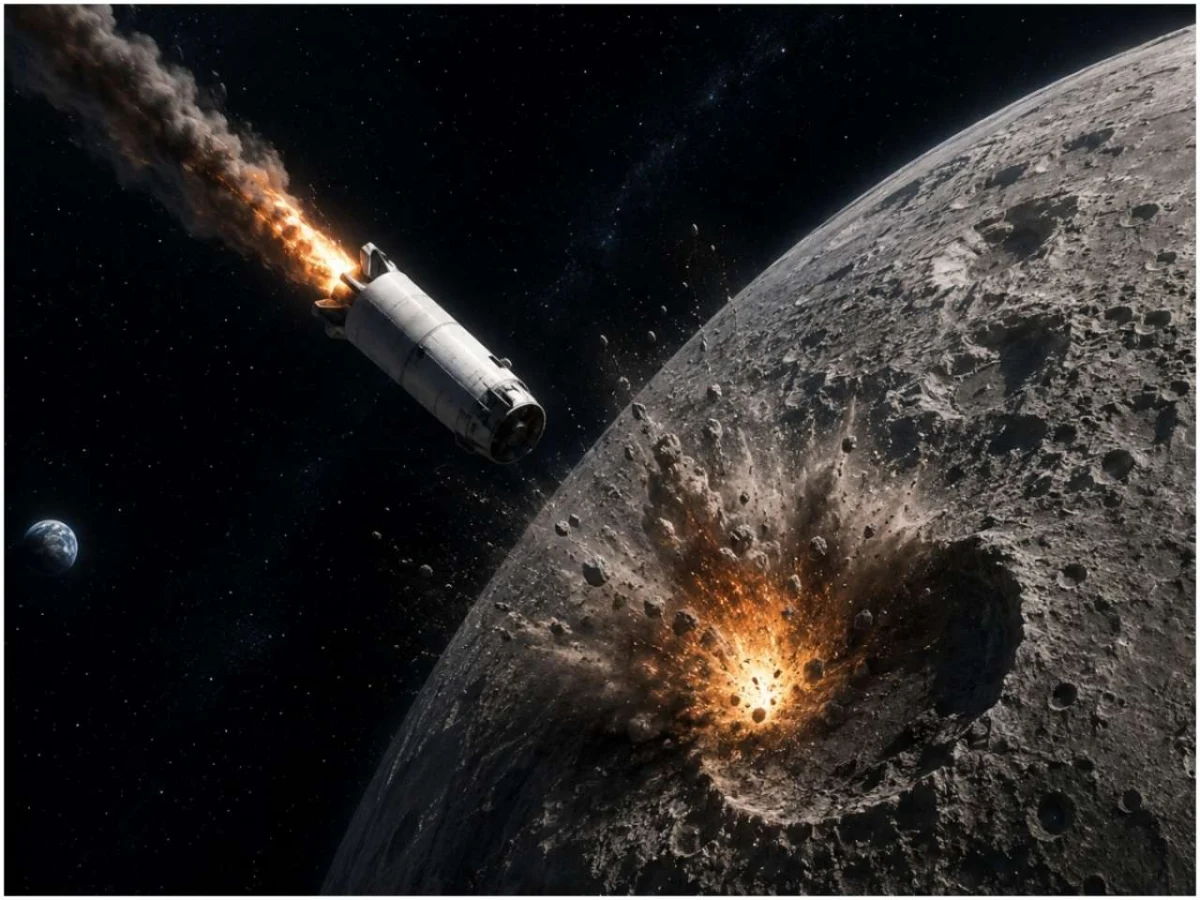
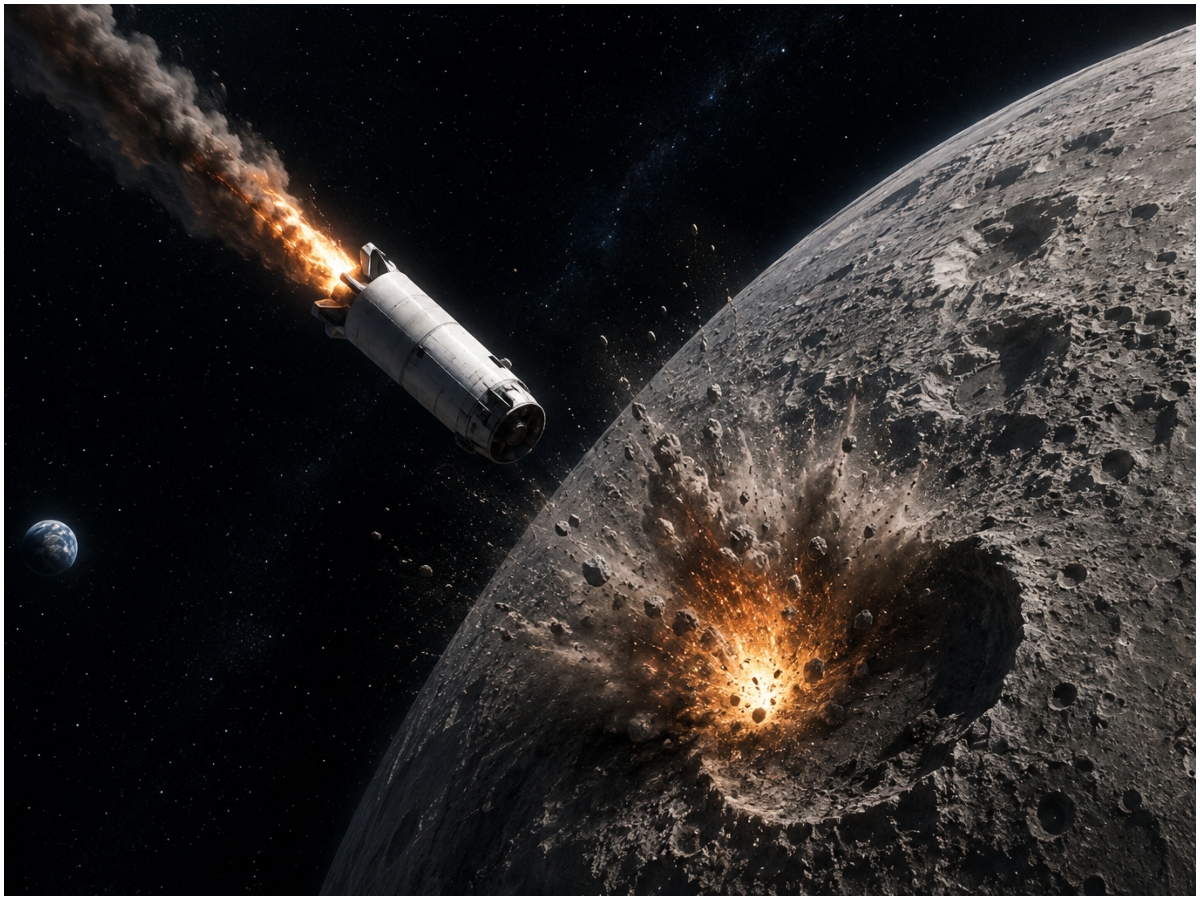
A discarded upper stage of a SpaceX Falcon 9 rocket, which has been an uncontrolled celestial wanderer for over a year, has made an unexpected and dramatic impact with the lunar surface. The school bus-sized fragment, weighing approximately 4,000 kilograms, collided with the Moon at a blistering speed of nearly 8,700 kilometers per hour (5,400 mph) on Wednesday, August 5, 2026, around 12:30 PM IST. This marks a significant and largely unprecedented event in the history of space exploration, sparking renewed conversations about the proliferation and tracking of space debris beyond Earth’s immediate orbit.
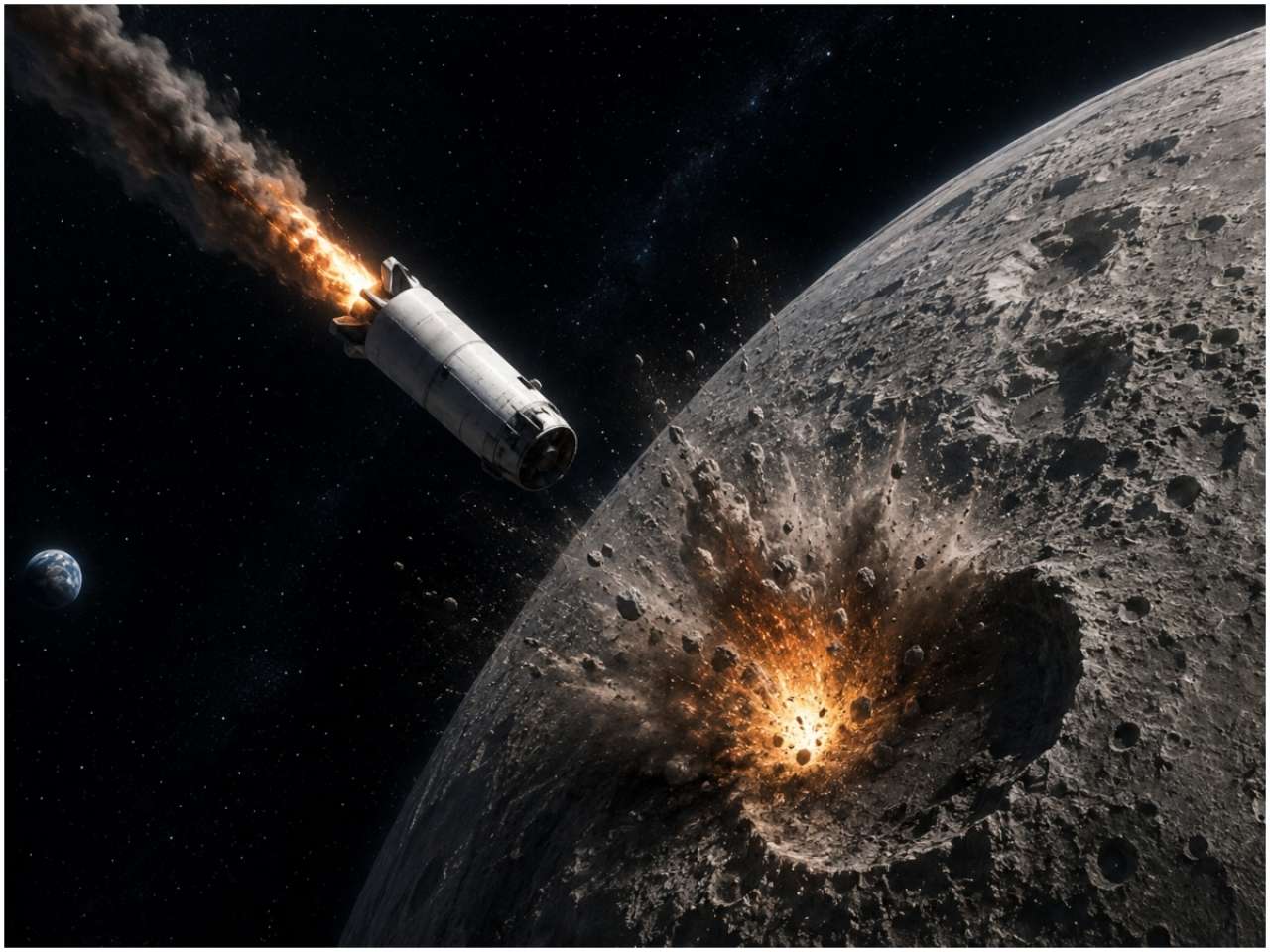
The accidental collision is believed to have occurred within the Einstein Crater, an ancient and expansive impact basin located along the Moon’s western edge. This region, often shrouded in shadow and difficult to observe directly from Earth, poses challenges for immediate visual confirmation of the impact site. While confirmation from lunar orbiters is anticipated to take some time, the incident has already captured global attention, highlighting the unpredictable trajectories of objects launched into deep space and the growing environmental concerns surrounding human activities in the cosmos.
This particular Falcon 9 upper stage was launched in January 2025, tasked with deploying Firefly Aerospace’s lunar lander on a trajectory towards the Moon. Following its mission, instead of executing a controlled re-entry into Earth’s atmosphere or being placed into a stable graveyard orbit, the booster entered a chaotic, elliptical path influenced by the gravitational pull of both the Earth and the Moon, as well as the subtle but persistent forces of solar radiation pressure. Its year-long journey through the vacuum of space culminated in this high-velocity lunar embrace, turning a piece of spent rocketry into an inadvertent lunar explorer.
)
The event, while accidental, provides a unique opportunity for scientific observation. The impact is expected to have created a new crater on the lunar surface, potentially excavating subsurface material that could offer valuable insights into the Moon’s geological composition. As the scientific community awaits photographic evidence from missions like NASA’s Lunar Reconnaissance Orbiter (LRO), the incident serves as a stark reminder of humanity’s ever-increasing footprint in space and the complex challenges associated with managing the remnants of our ambitious endeavors.
Main Facts: A Celestial Collision Unfolds
The core facts surrounding Wednesday’s lunar impact paint a vivid picture of an unplanned celestial event. At approximately 12:30 PM IST on August 5, 2026, a spent second stage of a SpaceX Falcon 9 rocket slammed into the Moon. The impact speed was estimated to be a staggering 8,690 km/h (5,400 mph), a velocity that ensures significant kinetic energy transfer upon contact. The object itself was a substantial piece of hardware, roughly the size of a school bus and weighing around 4,000 kilograms. This massive projectile struck the lunar surface within the Einstein Crater, a geologically interesting but challenging-to-observe region on the Moon’s far western limb.

This particular rocket stage had been adrift in cis-lunar space for nearly a year since its launch in January 2025. Its primary mission involved propelling Firefly Aerospace’s lunar lander towards its destination. Once its propellants were exhausted and its payload delivered, the stage, instead of being deorbited back into Earth’s atmosphere for controlled destruction, found itself on an unpredictable trajectory. Experts had been tracking its path for months, predicting its eventual demise on the lunar surface.
The collision, while not posing any direct threat to Earth or ongoing lunar missions due to the Moon’s vastness and lack of atmosphere, is significant for several reasons. It represents the first known instance of an accidental, uncontrolled impact of a modern, identifiable piece of space junk with the Moon that has been publicly tracked and predicted. While other deliberate impacts have occurred (such as the Apollo S-IVB stages or the LCROSS mission), and previous accidental crashes of older, untraceable debris might have happened, this incident stands out due to the precise identification and tracking of the object prior to impact. The event underscores the unpredictable nature of objects left in deep space orbits and raises important questions about the long-term environmental stewardship of the cosmos.
)
Chronology: The Journey of a Wayward Rocket Stage
The path of the Falcon 9 upper stage from its triumphant launch to its lunar demise is a compelling narrative of orbital mechanics, gravitational forces, and the unforeseen consequences of space operations.
The Initial Launch and Deployment: January 2025
The journey began in January 2025, when a SpaceX Falcon 9 rocket roared to life, ascending from its launchpad with a critical mission: to deliver Firefly Aerospace’s lunar lander onto a translunar injection trajectory. The Falcon 9, a two-stage-to-orbit medium-lift launch vehicle, is renowned for its reusability, particularly its first stage. However, the upper stage, or second stage, typically performs the final burns to place payloads into their desired orbits. For missions requiring high-energy trajectories, such as those heading to the Moon or beyond, this upper stage expends nearly all its propellant to achieve the necessary velocity, pushing it out of Earth’s immediate gravitational influence.
)
In this instance, after successfully deploying the Firefly lander, the Falcon 9’s second stage was left with insufficient fuel to perform a controlled deorbit burn back into Earth’s atmosphere, nor was it equipped or planned to enter a stable "graveyard orbit" around the Moon or Earth. Such deep-space missions often necessitate a "burn-to-depletion" strategy, leaving the upper stage on a trajectory that can be difficult to predict over extended periods.
The Unintended Trajectory: From Earth Orbit to Lunar Path
The reason this particular rocket part did not return to Earth, unlike many other Falcon 9 upper stages used for lower Earth orbit missions, lies in the fundamental physics of its mission profile. Missions to the Moon or beyond require an "escape velocity" from Earth’s gravity well, or at least a highly elliptical orbit that carries them far from Earth. This extra thrust, while essential for payload delivery, also prevents the upper stage from naturally falling back into Earth’s atmosphere where it would typically burn up harmlessly.
)
Once left adrift, the object entered a complex dance governed by the gravitational tug-of-war between the Earth, the Moon, and the Sun. Its trajectory was not a simple ellipse but a chaotic orbit, constantly perturbed by these celestial bodies. Over the course of nearly a year, these subtle gravitational nudges, combined with the minute but persistent pressure from solar radiation, gradually altered the rocket stage’s path. These forces are akin to a slow, invisible hand guiding the object, pushing it away from stable orbits and eventually placing it on an unavoidable collision course with the Moon. Julianna Scheiman, SpaceX director of NASA science and Dragon programs, succinctly captured this phenomenon, stating that "a mixture of solar activity and gravity forces have put it on a path toward the moon."
Tracking the Impending Collision
The story of the Falcon 9’s lunar impact is also a testament to the dedication of amateur astronomers and professional space debris trackers. For months leading up to the collision, independent researchers like Bill Gray, creator of the Project Pluto software, had been meticulously tracking the object. Initially identified as "WE0913A," Gray’s calculations, corroborated by other tracking groups, accurately predicted the date and approximate location of the impact.
)
The ability to track such a small, distant object (relative to the Moon) for so long is a remarkable feat of orbital mechanics and observational astronomy. These predictions provided a crucial window for the scientific community to prepare for potential observation, although the challenges of observing an impact on the Moon’s far side, or within a specific crater, remain significant. The confirmation of the impact, therefore, will likely rely on post-impact imaging from lunar orbiters, searching for the tell-tale signature of a fresh crater.
Supporting Data: The Growing Problem of Space Debris
The accidental lunar impact of the Falcon 9 upper stage serves as a potent reminder of the escalating issue of space debris, a problem that extends far beyond Earth’s crowded orbital highways.
)
Anatomy of Space Junk: What Floats Above Us?
Space debris, or "space junk," encompasses a vast array of defunct objects in orbit around Earth and, increasingly, in deeper space. This includes:
- Defunct satellites: Satellites that have reached the end of their operational life, either due to technical failure or mission completion.
- Spent rocket stages: Upper stages of launch vehicles, like the Falcon 9 in question, that have delivered their payloads and are left to drift.
- Mission-related debris: Objects like lens caps, adapter rings, bolts, and other small items jettisoned during spacecraft operations.
- Fragmentation debris: The most concerning category, resulting from explosions or collisions of existing objects, creating thousands of smaller, high-velocity fragments.
Currently, over 30,000 pieces of space debris larger than 10 centimeters are actively tracked by global surveillance networks. However, estimates suggest there are millions of smaller, untracked objects – ranging from paint flakes to millimeter-sized fragments – all traveling at orbital velocities of tens of thousands of kilometers per hour. While most of this debris resides in Earth’s various orbital regimes (Low Earth Orbit, Medium Earth Orbit, Geostationary Earth Orbit), the Falcon 9 incident underscores that objects can escape these zones and become hazards in cis-lunar and even interplanetary space.
)
Historical Context of Lunar Impacts
Impacts on the Moon, whether deliberate or accidental, are not entirely new phenomena, though large-scale accidental impacts of identifiable objects remain rare.
-
Deliberate Impacts: Historically, several missions have intentionally crashed objects into the Moon for scientific purposes. During the Apollo program, the third stages (S-IVB) of Saturn V rockets were intentionally guided to impact the Moon to generate seismic waves, allowing seismometers left by astronauts to study the Moon’s internal structure. More recently, missions like NASA’s Lunar Crater Observation and Sensing Satellite (LCROSS) in 2009 and the GRAIL mission in 2012 deliberately crashed into lunar craters to analyze the resulting plumes for water ice and other volatile compounds. India’s Chandrayaan-1 mission also deployed its Moon Impact Probe (MIP) in 2008, which intentionally crashed to gather data. These deliberate impacts are carefully planned, controlled, and executed for specific scientific gains.
)
-
Accidental Impacts: Accidental lunar impacts, especially from modern, trackable objects, are far less common. The original article mentions "China’s rocket, which crashed in March 2022 after completing a lunar test mission," and "India’s Chandrayaan-2 lander mission also crashed in 2019." The reference to "China’s rocket" in March 2022 likely pertains to the Chang’e 5-T1 mission booster, which was tracked and ultimately impacted the Moon around that time, demonstrating the challenges of debris tracking in deep space. The Chandrayaan-2 lander’s crash in 2019 was a failed soft landing attempt, making it an unintentional impact but part of a mission operation rather than a derelict rocket stage. The SpaceX Falcon 9 impact thus represents a distinct category: an uncontrolled, long-duration drifting object from an earlier mission finally meeting its end on the lunar surface.
The Physics of a Lunar Collision
The physics behind an impact at 8,700 km/h are formidable. The kinetic energy of the 4,000 kg Falcon 9 upper stage is equivalent to several tons of TNT. This immense energy is instantly converted upon impact, creating a significant shockwave and excavating lunar regolith.
)
The impact is expected to create a new crater, potentially tens of meters in diameter. The exact size and depth will depend on factors such as the angle of impact, the local geology of the Einstein Crater, and the precise composition of the rocket stage itself. The sudden decompression and heating of any residual gases or propellants within the stage could also contribute to the explosive force. Scientists are particularly interested in the possibility that the impact could expose subsurface material, offering a rare opportunity to study layers of the Moon that are otherwise inaccessible. Analyzing the ejecta plume (if observable) or the spectral signature of the freshly exposed material could yield valuable data about the Moon’s composition and geological history.
Official Responses and Scientific Inquiry
The unexpected lunar impact has elicited responses from the involved parties and the broader scientific community, highlighting both the accidental nature of the event and the scientific opportunities it presents.
)
SpaceX’s Stance: An Unintended Consequence
SpaceX, the manufacturer and operator of the Falcon 9 rocket, has maintained that the collision was accidental and an unintended consequence of a mission designed to deliver a payload into deep space. Julianna Scheiman, SpaceX director of NASA science and Dragon programs, articulated the company’s understanding of the event, stating, "What has happened is essentially a mixture of solar activity and gravity forces have put it on a path toward the moon." This statement underscores the complex and often unpredictable nature of orbital mechanics, particularly when dealing with objects in chaotic, multi-body gravitational environments.
The company emphasized that while upper stages for missions in Low Earth Orbit are typically designed to perform a controlled deorbit burn, missions requiring significant thrust to send payloads to the Moon or beyond often leave their upper stages on trajectories that are not immediately deorbited. There are currently no universal international regulations or standard operating procedures for the long-term management of spent rocket stages on translunar or interplanetary trajectories. This incident brings to light the need for such considerations as more missions venture beyond Earth’s immediate vicinity.
)
Astronomical Observation and Confirmation
The scientific community, particularly astronomers and planetary scientists, had been tracking the impending impact with keen interest. However, direct observation of the impact event itself presented significant challenges. The Einstein Crater is located along the Moon’s western limb, which can be difficult to observe from Earth depending on the Moon’s phase and libration. Furthermore, the impact would have occurred on a relatively small scale from Earth’s perspective, making direct telescopic observation of the flash or plume extremely difficult, especially without precise knowledge of the exact impact time and location.
The primary method for confirming the impact and studying its effects will likely come from lunar orbiters. NASA’s Lunar Reconnaissance Orbiter (LRO), equipped with high-resolution cameras, is a prime candidate. The LRO regularly images the lunar surface and, once its orbit brings it over the Einstein Crater, it will be tasked with searching for a fresh impact crater. By comparing pre-impact imagery with new scans, scientists can identify the precise location, size, and characteristics of the new crater. This visual confirmation is crucial for validating the predictions and for initiating further scientific analysis. Spectroscopic analysis of any residual ejecta that might have been temporarily lofted above the lunar surface could also provide clues about the composition of the Moon’s subsurface.
)
Regulatory and Policy Implications
The Falcon 9 lunar impact reignites important discussions about the regulatory framework governing space activities, particularly concerning space debris beyond Earth orbit. While significant efforts have been made to develop guidelines for debris mitigation in Earth orbit (e.g., deorbiting within 25 years), there is a distinct lack of comprehensive international regulations for objects launched into deep space.
This incident highlights a "tragedy of the commons" scenario, where individual nations or private entities pursue their missions, but the collective byproduct (space debris) becomes a shared, unregulated problem. Questions arise regarding responsibility and accountability for objects that pose potential hazards to future missions or scientific endeavors. The event may prompt calls for stricter international guidelines that mandate end-of-life disposal plans for all space objects, including upper stages on translunar injection trajectories. Concepts like "graveyard orbits" for distant objects, or even active debris removal technologies, might need to be extended to the cis-lunar environment to ensure the long-term sustainability and safety of space exploration.
)
Implications: What Does This Mean for Space Exploration?
The accidental lunar impact of the SpaceX Falcon 9 upper stage, while seemingly a singular event, carries broader implications for humanity’s ongoing venture into space, touching upon environmental stewardship, the challenge of space debris, and the future of responsible space operations.
Environmental Impact on the Moon
While the Moon lacks an atmosphere to burn up incoming objects, it is constantly bombarded by micro-meteorites, making it a naturally cratered body. The impact of a 4,000 kg object at high velocity is, however, a macro-impact compared to the constant rain of dust.
)
- Micro-impacts vs. Macro-impacts: The Moon’s surface is a dynamic environment, continually shaped by impacts. However, the Falcon 9 impact represents a significant, identifiable event that will leave a distinct, human-made signature. While the Moon is vast and can easily absorb such an impact without any widespread "environmental damage" in the terrestrial sense, it raises a philosophical question about preserving the pristine nature of celestial bodies.
- Potential for Contamination: The rocket stage is made of various metals, composites, and potentially contains residual propellants. While the vacuum of space and the impact itself would likely sterilize most biological contaminants, the introduction of terrestrial materials onto a celestial body is a form of contamination. For scientists studying the Moon’s pristine environment or searching for indigenous resources, such contamination, even if localized, is a factor to consider.
- Scientific Disruption: The Einstein Crater is a specific geological feature. If future lunar missions, robotic or crewed, were planned for this specific region to conduct delicate scientific experiments or establish bases, the presence of a new, relatively large impact crater and its associated ejecta field could pose a localized disruption or an additional variable to account for.
The Broader Space Debris Challenge
The Falcon 9 incident serves as a stark reminder that the problem of space debris is not confined to Earth’s orbit. While the "Kessler Syndrome" – a theoretical scenario where the density of objects in LEO becomes so high that collisions generate more debris, leading to a cascading chain reaction – is a primary concern for Earth-orbiting assets, the Moon is not immune to becoming a receptacle for our space junk.
- Beyond Earth: As more nations and private companies launch missions to the Moon, Mars, and beyond, the volume of derelict hardware in deep space will inevitably increase. Each spent upper stage, defunct probe, or discarded component has the potential to become an uncontrolled projectile. While the vastness of space makes the probability of collision seem low, the increasing frequency of launches and the longevity of these objects in orbit mean that the risk, however small, is not zero.
- Mitigation Strategies: This event strengthens the argument for developing and implementing robust mitigation strategies for all space missions. This includes designing spacecraft and rocket stages for "demise" (burning up completely upon re-entry), implementing active debris removal technologies for existing junk, and ensuring that all missions, especially those beyond Earth orbit, have a clear and implementable end-of-life disposal plan. Reusability, like that pioneered by SpaceX’s Falcon 9 first stage, significantly reduces the amount of new debris, but the upper stages still present a challenge for deep-space missions.
The Future of Responsible Space Operations
The accidental lunar impact underscores the critical need for a more comprehensive and internationally coordinated approach to space traffic management and debris mitigation. The current regulatory landscape, largely developed for Earth-centric operations, is ill-equipped to handle the complexities of cis-lunar space and beyond.
- Calls for Stricter International Guidelines: There is an urgent call for international bodies like the United Nations Committee on the Peaceful Uses of Outer Space (COPUOS) to develop and enforce stricter guidelines for deep-space missions. These guidelines could include requirements for controlled disposal, such as sending spent stages into stable "graveyard orbits" around the Sun or Moon, or implementing technologies for self-disposal.
- Designing for End-of-Life: The incident reinforces the importance of designing missions with their end-of-life in mind from the outset. This "design for demise" philosophy should extend to all components, ensuring that they do not become long-term hazards.
- Innovation vs. Sustainability: The event highlights the delicate balance between rapid innovation in space exploration and the imperative for long-term sustainability. As humanity pushes further into the cosmos, the responsibility to protect these new frontiers from our own waste becomes increasingly vital. The Falcon 9’s lunar crash is a tangible reminder that every launch, every mission, carries a lasting impact, not just on our understanding of space, but on the space environment itself.
