

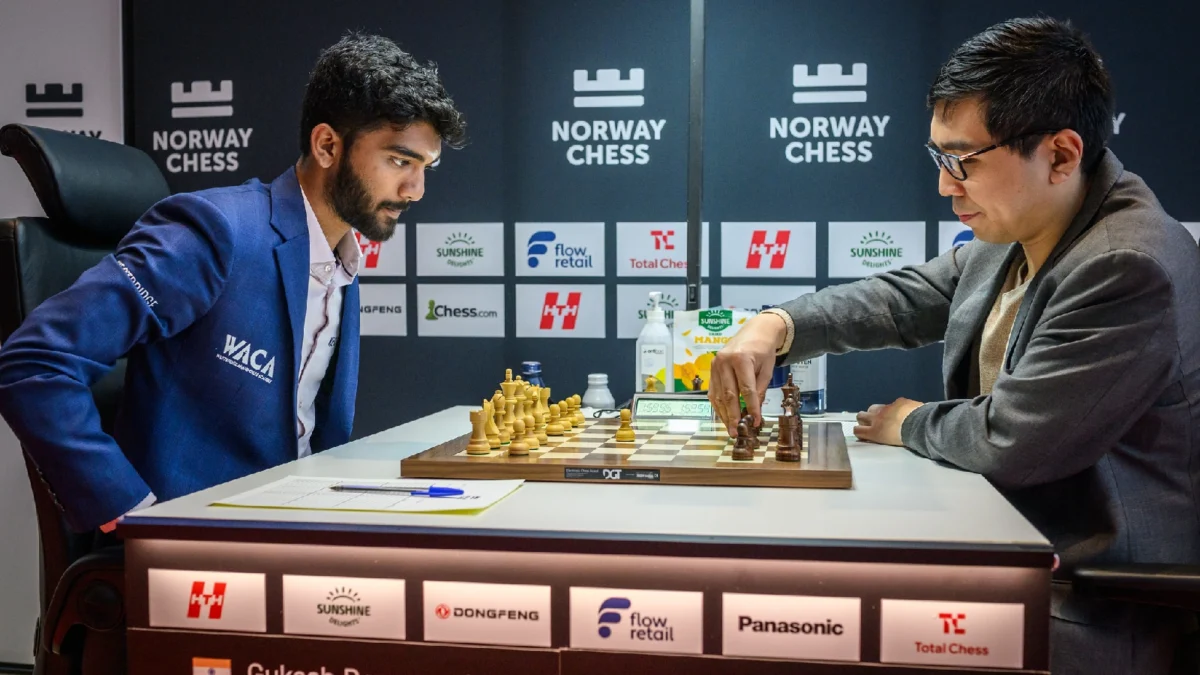
Stavanger, Norway – June 2, 2026 – World Champion D Gukesh, the prodigious Indian grandmaster, found himself in a challenging position at the prestigious Norway Chess tournament, slipping to the last spot in the open standings after a captivating yet frustrating Round 7 encounter. His game against American Grandmaster Wesley So culminated in a classical draw under peculiar circumstances, followed by a hard-fought Armageddon victory for Gukesh. The result, while denying Gukesh a crucial classical win, allowed Wesley So to consolidate his lead at the top of the table.
Meanwhile, in the Norway Chess Women’s section, India’s Divya Deshmukh continued her impressive debut, securing second place despite also drawing her classical game against compatriot Koneru Humpy. The tournament, known for its unique scoring system and star-studded lineup, is proving to be a true test of nerve and skill for the world’s elite chess players.
A Strategic Enigma: The Gukesh-So Classical Encounter
The seventh round of Norway Chess delivered high drama, particularly in the clash between the reigning World Champion, D Gukesh, and the formidable Wesley So. Gukesh, who recently celebrated his 20th birthday, entered the game with the weight of expectation, eager to convert promising positions into full points. What unfolded, however, was a testament to the unpredictable nature of elite chess and the immense pressure exerted by the tournament’s unique format.
From the outset, the game, which opened with the classic Italian Game, saw Gukesh seize a significant advantage. By the 11th move, Wesley So found himself a pawn down, a deficit that typically spells severe trouble at this level. Gukesh, known for his aggressive yet precise play, meticulously built on this material advantage, maintaining an edge on the board for the vast majority of the classical encounter. Observers and commentators noted Gukesh’s strong positional play, seemingly steering the game towards a decisive victory.
However, as the game approached the crucial 40th move mark – often a psychological turning point where players gain extra time on their clocks – a twist emerged. Gukesh, despite his strong position, was critically low on time, with barely a minute remaining on his clock. This severe time pressure meant that for the remainder of the game, he would have to rely solely on the 10-second increments per move, a notoriously challenging scenario even for the most seasoned grandmasters. It was at this juncture that Wesley So, remarkably, offered a draw. Gukesh, facing an impossible time scramble to convert his winning position, accepted.
The decision by So to offer a draw, rather than push for a win against a time-strapped opponent, raised eyebrows and sparked debate among chess enthusiasts and pundits. While conventional wisdom suggests pressing an advantage against a player in severe time trouble, So’s choice could be interpreted as a strategic gamble: securing a guaranteed half-point in classical chess, thereby avoiding any potential last-minute blunders or a miraculous save from Gukesh, and then facing the Armageddon tie-break with fresh resolve. For Gukesh, it was a moment of mixed emotions – relief at escaping a potential time-out loss, but profound frustration at failing to convert a seemingly winning position into a full classical point.
Unpacking Round 7: A Chronological Account of Key Battles
Round 7 at Norway Chess provided a series of intense classical battles, each contributing to the shifting dynamics of the tournament standings.
Gukesh vs. So: A Pawn Down, Time-Pressed Draw
The Gukesh-So game stood out for its dramatic trajectory. The Italian Game, typically a solid and strategic opening, saw Gukesh (playing white) quickly gain an initiative. By move 11, Wesley So, with the black pieces, had conceded a pawn, setting the stage for Gukesh to exploit his material advantage. For over 20 moves, Gukesh meticulously tried to convert this edge. His pieces were active, his pawn structure superior, and his king safety seemingly uncompromised. The engine evaluations consistently favored Gukesh, often indicating a significant advantage that should, in theory, lead to a win.
However, the clock became Gukesh’s invisible opponent. As the game progressed into the middle and endgame phases, Gukesh’s time management faltered. His deep calculations, while accurate, consumed precious minutes, leaving him with a perilous amount of time as the 40th move approached. The psychological burden of time pressure is immense; even a world champion can falter under such circumstances, either by making quick, suboptimal moves or by running out of time altogether.
Wesley So, a master of positional play and resilience, undoubtedly sensed Gukesh’s predicament. While his position was objectively worse, the threat of Gukesh collapsing under time pressure was a tangible one. So’s draw offer on the 40th move, therefore, can be viewed as a shrewd tactical decision. It guaranteed him a half-point in classical chess, preventing a potential full-point loss and ensuring he maintained his lead. For Gukesh, accepting the draw was the pragmatic choice, safeguarding him from a zero-point classical score due to a time-out.
Following the classical draw, the players proceeded to the Armageddon tie-break, a format where White gets more time but Black wins with a draw. Gukesh, playing with renewed focus, managed to defeat So in the Armageddon, securing 1.5 points (0.5 for classical draw, 1 for Armageddon win) compared to So’s 1 point (0.5 for classical draw, 0 for Armageddon loss). This Armageddon victory, while not the classical win Gukesh sought, was crucial for his tournament standing and morale.
Praggnanandhaa’s Triumph and Carlsen’s Stagnation
Elsewhere in the open section, fellow Indian prodigy R Praggnanandhaa delivered a strong performance, defeating French Grandmaster Alireza Firouzja in their classical battle. This win was vital for Praggnanandhaa, helping him climb the standings and reaffirm his position among the world’s elite. Firouzja, a dynamic and often unpredictable player, found himself outmaneuvered by Praggnanandhaa’s solid and strategic play.
Five-time World Champion Magnus Carlsen, meanwhile, continued to navigate a somewhat inconsistent tournament. Despite his immense talent and experience, Carlsen has faced stiff competition and has not yet dominated as he often does. His game in Round 7 also ended in a classical draw, adding to his collection of half-points. Carlsen’s performance thus far highlights the incredibly high level of competition at Norway Chess, where every player is capable of challenging the best. Vincent Keymer, the young German grandmaster, also fought valiantly in his respective classical game, further underscoring the tight nature of the tournament.
Supporting Data and Current Standings: A Tight Race to the Top
The Norway Chess tournament employs a unique scoring system designed to maximize excitement and discourage quick draws. A classical win earns 3 points, a classical draw leads to an Armageddon tie-break where the winner gets 1.5 points and the loser 1 point. A classical loss results in 0 points. This system ensures that every game has significant stakes.
The Open Section: Every Point Counts
After seven grueling rounds, the standings in the open section remain incredibly close, demonstrating the fierce competition.
- Wesley So (USA): 12.5 points
- Magnus Carlsen (NOR): 11.5 points
- R Praggnanandhaa (IND): 10.5 points
- Vincent Keymer (GER): 9.5 points
- Alireza Firouzja (FRA): 9 points
- D Gukesh (IND): 8 points
Despite Gukesh being in the last position, the gap to the top is surprisingly narrow, with only 4.5 points separating him from leader Wesley So. This proximity means that a strong finish in the remaining rounds could still see significant shifts in the leaderboard. So’s lead, fortified by his recent classical wins against Carlsen and Praggnanandhaa and his strategic draw against Gukesh, is a testament to his consistent play and tactical acumen. His ability to navigate complex positions and secure crucial points has put him in a strong position. Carlsen and Praggnanandhaa are hot on his heels, ensuring that the final rounds will be nothing short of thrilling.
The Women’s Tournament: Debutants Shine Bright
The inaugural Norway Chess Women’s tournament has also delivered compelling chess, with several rising stars making their mark. India’s Divya Deshmukh, making her debut at this elite event, has proven herself a formidable competitor.
- Bibisara Assaubayeva (KAZ): 13 points
- Divya Deshmukh (IND): 10.5 points
- Ju Wenjun (CHN): 9.5 points
- Lei Tingjie (CHN): 9 points
- Anna Muzychuk (UKR): 8.5 points
- Koneru Humpy (IND): 6.5 points
Deshmukh finds herself in an excellent second spot, just 2.5 points behind the Kazakh prodigy Bibisara Assaubayeva, who is also making her debut and leading the field with remarkable confidence. Assaubayeva’s aggressive and creative style has paid dividends, allowing her to establish a clear lead.
Deshmukh’s Round 7 game against fellow Indian Grandmaster Koneru Humpy, an experienced veteran of the circuit, also ended in a classical draw. Deshmukh, playing with the black pieces, held a significant edge as early as the 19th move, indicating her strong preparation and tactical prowess. However, Humpy’s defensive skills allowed her to hold the draw, denying Deshmukh a full classical point. Humpy, unfortunately, remains at the bottom of the women’s standings after seven rounds, struggling to find her rhythm in this highly competitive environment. Despite the draw, Deshmukh’s overall performance in her debut tournament has been highly commendable, showcasing her potential to become a consistent force at the highest level.
Expert Perspectives and Implications: The Mental Game at Elite Level
The outcomes of Round 7, particularly the Gukesh-So game, underscore the intricate blend of skill, strategy, and psychology that defines elite-level chess.
The Psychology of Time Pressure and Draw Offers
The scenario in the Gukesh-So game serves as a vivid illustration of the psychological warfare inherent in chess. For Gukesh, the inability to convert a clear advantage due to time constraints is undoubtedly a bitter pill to swallow. Grandmasters dedicate countless hours to perfecting their game, and seeing a winning position slip away due to time pressure can be mentally taxing. However, his subsequent victory in the Armageddon tie-break provides a crucial psychological boost, demonstrating his resilience and ability to bounce back under pressure. It signals that despite the classical setback, his form and fighting spirit remain intact.
From Wesley So’s perspective, his draw offer was a calculated risk. While pressing for a win against a time-strapped opponent is tempting, it also carries the risk of committing a blunder under pressure or allowing the opponent to find a miraculous defense. By offering and securing a classical draw, So guaranteed himself a point, maintained his lead, and avoided the potential pitfalls of a protracted endgame. This decision reflects a seasoned grandmaster’s pragmatic approach to tournament play, prioritizing consistent scoring over high-risk gambits, especially when leading the field.
Chess commentators have weighed in, with many acknowledging the difficulty of Gukesh’s situation. "It’s incredibly tough to play perfectly when you have less than a minute on the clock," one expert noted. "So’s offer, while perhaps surprising to some, was a very rational move to secure points and manage risk." For Gukesh, the implication is a valuable lesson in time management, a crucial skill that even world champions must constantly refine.
India’s Rising Stars on the Global Stage
The performances of D Gukesh, R Praggnanandhaa, and Divya Deshmukh at Norway Chess further solidify India’s position as a burgeoning powerhouse in global chess. The sheer number of young, immensely talented Indian players competing and excelling at the highest levels is unprecedented. Gukesh, as the reigning World Champion, carries the torch, but Praggnanandhaa’s consistent strong performances and Deshmukh’s impressive debut indicate a deep pool of talent.
These tournaments are not just about winning; they are about gaining invaluable experience against the very best. For these young players, navigating the pressures of an elite super-tournament, managing time, recovering from setbacks, and consistently performing at a high level are critical steps in their development. Their presence at events like Norway Chess is an official response from the chess world itself, acknowledging the undeniable impact of Indian chess on the global landscape. The implications for the future of Indian chess are immense, promising a sustained period of dominance and excitement.
Looking Ahead: The Road to the Final Rounds
With only a few rounds remaining, the Norway Chess tournament is poised for a thrilling conclusion in both the open and women’s sections. The tight standings ensure that every single game will be fiercely contested, with the potential for dramatic shifts in the leaderboard.
Pressure Mounts as the Tournament Nears Climax
For D Gukesh, the task now is to rebound strongly. Despite being in last place, the narrow point difference means that two or three strong classical wins could propel him back into contention for a top finish. His Armageddon victory against So shows he has the fighting spirit and the skill to overcome adversity. He will need to refine his time management and capitalize on any advantages he gains. The pressure on him, as World Champion, to perform consistently is immense, but it is precisely in these high-stakes situations that champions are forged.
Wesley So, while leading, cannot afford to relax. The chasing pack, including Magnus Carlsen and R Praggnanandhaa, are formidable opponents who will relentlessly pursue him. Each classical game from here on will be a potential swing in the standings, making the Armageddon tie-breaks even more critical.
In the women’s section, Bibisara Assaubayeva will be looking to maintain her lead, while Divya Deshmukh will be pushing hard to close the gap. Her strong performance in her debut is already a significant achievement, but a podium finish would be an even greater statement. The competition among the top players, including the Chinese World Champion Ju Wenjun, promises an exciting fight for the top spots.
The unique format of Norway Chess, with its blend of classical and Armageddon games, ensures that every round is filled with tension and potential upsets. As the tournament heads into its final stages, the anticipation for dramatic finishes, strategic masterstrokes, and displays of incredible resilience from the world’s best chess players is palpable. The implications of these results will reverberate through the chess world, influencing rankings, future invitations, and the narratives of these elite athletes for months to come. The stage is set for an unforgettable climax.
