

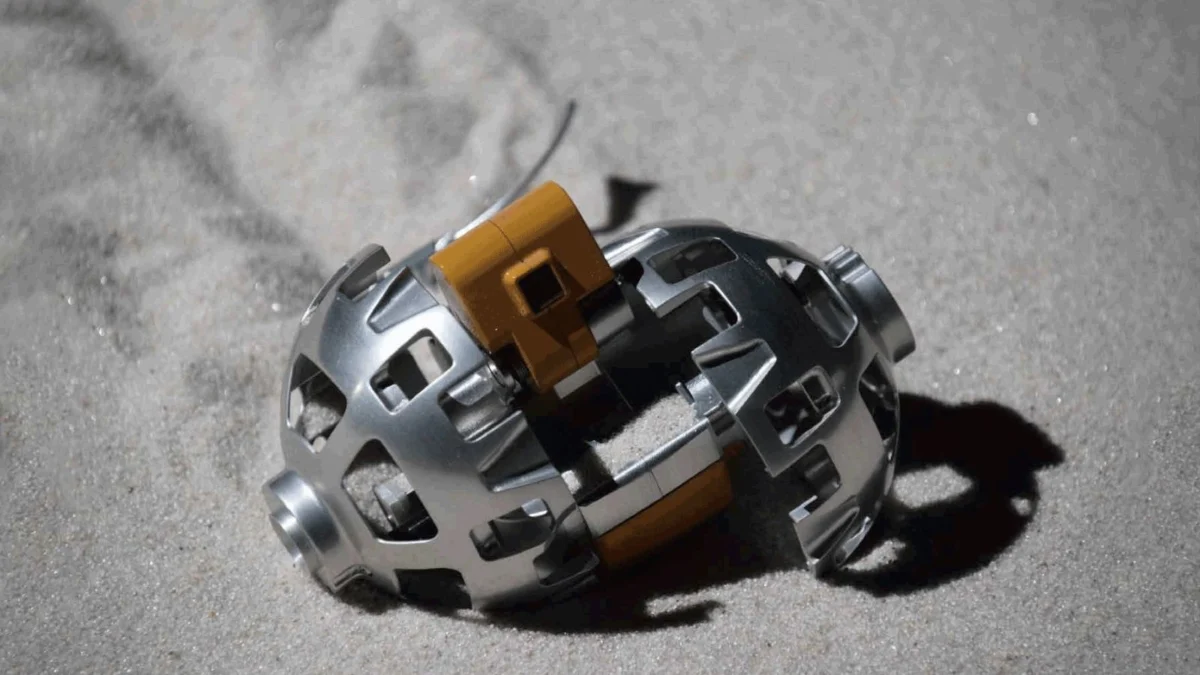
The silence of the lunar surface is rarely interrupted, but in January 2024, a tiny, spherical object no larger than a grapefruit began a transformation that would change the course of Japanese space history. While the primary "Smart Lander for Investigating Moon" (SLIM) spacecraft sat in an unintended and precarious position, its tiny companion—the Palm-Sized Lunar Excursion Vehicle 2 (LEV-2)—was busy proving that size is no barrier to monumental achievement.
New research recently published in the prestigious journal Science Robotics has shed light on the technical brilliance of this miniature explorer. Often compared to the fictional BB-8 droid from the Star Wars franchise, the LEV-2 (popularly known as SORA-Q) has been hailed as a masterclass in collaborative engineering, involving toy manufacturers, academic researchers, and national space agencies. This article explores the full scope of the mission, the technical specifications of the rover, and the profound implications its success has for the future of interplanetary exploration.
Main Facts: The "Moon Sniper" and Its Miniature Scouts
On January 20, 2024, Japan officially became the fifth nation to achieve a soft landing on the lunar surface, joining the ranks of the United States, the Soviet Union, China, and India. The mission, led by the Japan Aerospace Exploration Agency (JAXA), utilized the SLIM lander, nicknamed the "Moon Sniper" for its goal of achieving unprecedented landing precision—landing within 100 meters of its target, rather than the usual several-kilometer range.
While the landing was technically successful, it was fraught with complications. During the final descent, one of the lander’s two main engines failed, causing it to drift and eventually land in an "nose-down" orientation. This left the spacecraft’s solar panels facing away from the sun, severely limiting its operational lifespan.
However, before the main lander settled into its awkward position, it successfully deployed two tiny probes:
- LEV-1: A hopping robot designed to move across the lunar surface and act as a communication relay.
- LEV-2 (SORA-Q): A 250-gram shape-shifting rover developed through a unique partnership between JAXA, toy manufacturer Takara Tomy, Sony Group Corporation, and Doshisha University.
Despite the primary lander’s power struggles, LEV-2 functioned perfectly. It autonomously transformed from its spherical travel mode into a wheeled vehicle, navigated the regolith, and captured the now-iconic "selfie" of the SLIM lander. This single image provided the ground crew with the definitive evidence they needed to understand why the lander was failing to generate power.
Chronology: From Launch to the "Science Robotics" Revelation
The journey of the LEV-2 is a timeline of precision and rapid problem-solving:
September 2023: Launch
The SLIM mission launched aboard an H-IIA rocket from the Tanegashima Space Center. Tucked inside the lander were the two LEV units, representing a new philosophy in space exploration: the use of low-cost, expendable secondary payloads to mitigate mission risk.
January 20, 2024: The Descent and Deployment
As SLIM descended toward the Shioli Crater, it encountered a major mechanical failure at an altitude of approximately 50 meters. Despite the loss of an engine, the autonomous systems attempted to compensate. Seconds before touchdown, the lander ejected LEV-1 and LEV-2 as planned.
The 100-Minute Mission
While the SLIM lander struggled to stay "alive" on its remaining battery power, LEV-2 sprang into action. Within minutes of touching the lunar dust, the sphere split in two, using its outer shells as eccentric wheels. It navigated the uneven terrain for approximately 100 minutes. During this window, it used its onboard AI-driven cameras to identify the SLIM lander, position itself for an optimal shot, and transmit the data to LEV-1, which then beamed it back to Earth.
February – May 2024: Data Analysis
Engineers spent months analyzing the telemetry and imagery provided by the small rover. The data confirmed that SLIM had landed within 55 meters of its target—a resounding success for the "pinpoint landing" technology—but also detailed the exact mechanical stress the lander endured during its "tumble."
June 2024: Scientific Recognition
The publication of the study in Science Robotics served as the final validation of the mission. The paper detailed how the LEV-2’s autonomous navigation and shape-shifting mechanisms performed in the vacuum and low gravity of the moon, proving that consumer-grade technology (like that used in toys and cameras) could be ruggedized for space.
Supporting Data: The Engineering Behind the Shape-Shifter
The LEV-2 is a marvel of miniaturization. To understand its success, one must look at the specific data points and engineering choices that allowed a "toy" to perform like a scientific instrument.
1. Design and Locomotion
- Dimensions: Approximately 80mm in diameter (spherical mode).
- Mass: 250 grams.
- Transformation: The rover utilizes a "shape-adaptive" system. In its spherical state, it is protected during deployment. Once on the ground, the two halves of the sphere shift outward to act as wheels, while a stabilizer "tail" prevents the body from spinning uncontrollably.
- Gait: The wheels are not perfectly round; they are eccentric (off-center), which allows the rover to "crawl" or "paddle" through the loose lunar regolith, a method inspired by the movement of sea turtles.
2. Autonomous Intelligence
Because the distance between Earth and the Moon creates a communication lag, LEV-2 could not be "driven" in real-time. It relied on:
- Onboard Image Processing: The rover used Sony’s sensing technology to identify the lander and determine its own orientation without human intervention.
- Autonomous Navigation: It was programmed to move away from the lander, turn back, and find the best angle for photography.
3. Power and Communication
LEV-2 did not have a large battery or a high-gain antenna. It operated on primary battery cells designed for a short, high-impact burst of activity. Its data was transmitted via a Bluetooth-like short-range link to LEV-1, which possessed the larger transmitter required to reach Earth-based receiving stations.
Official Responses: A Collaborative Triumph
The success of LEV-2 has drawn praise from various sectors, highlighting the importance of cross-industry collaboration.
JAXA (Japan Aerospace Exploration Agency):
In a statement following the publication of the Science Robotics paper, JAXA officials noted, "The LEV-2 mission has demonstrated that small, autonomous robots can significantly expand the capabilities of planetary explorers. The image captured by SORA-Q was not just a photo; it was a vital diagnostic tool that allowed our engineers to understand the lander’s state in real-time."
Takara Tomy (Toy Manufacturer):
A spokesperson for the company expressed pride in the "toy-grade" origins of the tech: "Our expertise in creating compact, transformable mechanisms for children’s toys was applied to the harshest environment imaginable. This proves that play and science are driven by the same spirit of curiosity and innovation."
The Scientific Community:
Dr. Kintaro Toyama, a researcher involved in the project, emphasized the autonomy: "The fact that a 250-gram robot could autonomously decide how to move and what to photograph on another world is a paradigm shift. We are moving away from monolithic, expensive rovers toward agile, distributed systems."
Implications: The Future of Lunar and Martian Exploration
The success of LEV-2 marks a turning point in how space agencies approach planetary missions. Several key implications emerge from this mission:
1. The Rise of "Swarm" Robotics
Instead of sending a single, multi-billion dollar rover like NASA’s Curiosity or Perseverance, future missions may deploy "swarms" of hundreds of LEV-style robots. If one fails, the mission continues. These swarms could map caves, search for water ice in permanently shadowed regions, or act as a communication network across vast distances.
2. Cost-Effective Exploration
By using off-the-shelf components and collaborating with commercial toy and electronics companies, the cost of secondary payloads is drastically reduced. This "democratization" of space hardware allows smaller nations and even universities to participate in deep-space exploration.
3. Risk Mitigation for Human Missions
In the context of the NASA-led Artemis program, which seeks to return humans to the moon, tiny rovers like LEV-2 could be used as "scouts." Before an astronaut steps into a crater or a lava tube, a shape-shifting robot could be tossed in to assess the stability of the ground and the radiation levels.
4. Technological Cross-Pollination
The LEV-2 mission proves that technologies developed for the consumer market—AI for face detection in cameras, transformable joints in toys, and high-energy-density batteries in smartphones—are now robust enough for space. This creates a feedback loop where space-tested innovations return to improve consumer products on Earth.
Conclusion
The SLIM mission will be remembered for its "pinpoint" accuracy, but the LEV-2 will be remembered for its pluck. By capturing the image of its "mother ship" lying upside down on the lunar regolith, the tiny rover did more than just solve a technical mystery; it captured the imagination of a global audience. As humanity looks toward Mars and beyond, the lessons learned from this palm-sized hero will undoubtedly serve as the blueprint for the next generation of explorers—proving once and for all that in the vastness of space, even the smallest gear can turn the wheels of progress.
