

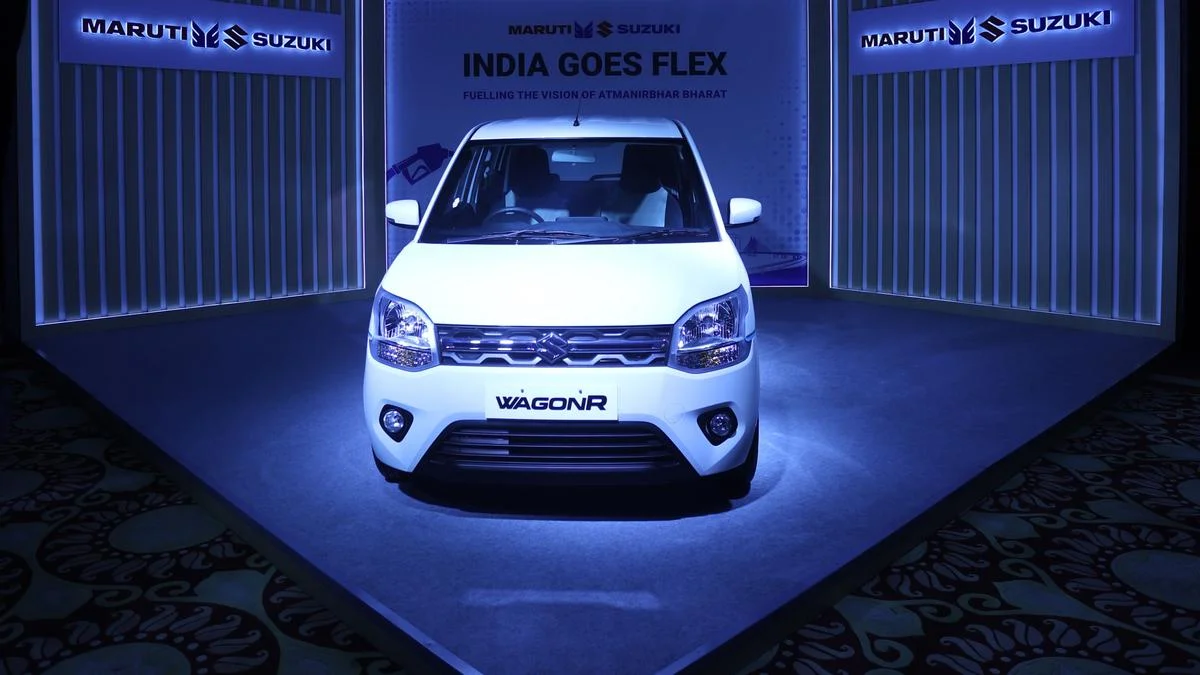
The Indian automotive landscape is currently undergoing a seismic shift, driven by a dual mandate: the urgent need to decarbonize the transport sector and the strategic imperative to reduce a staggering reliance on imported crude oil. While the global narrative has leaned heavily toward battery electric vehicles (BEVs), India’s path to sustainable mobility is increasingly looking like a multi-modal tapestry. At the center of this transition is the recent unveiling of the Maruti Suzuki Wagon R Flex Fuel prototype—a vehicle that represents far more than a simple engineering update. It is a signal of intent from India’s largest carmaker that the internal combustion engine (ICE) still has a vital, albeit greener, role to play in the nation’s future.
Main Facts: Engineering the Future of the ‘Tall Boy’
The Maruti Suzuki Wagon R has long been a staple of Indian roads, lauded for its practicality and "tall boy" design. However, the Flex-Fuel variant is a departure from its predecessors. Engineered specifically to address the nuances of high-ethanol blends, this vehicle is designed to operate on any ethanol-petrol mix ranging from E20 (20% ethanol) to E100 (100% ethanol).
Technical Specifications and Innovations
The heart of the Wagon R Flex Fuel is its modified 1.2-liter, four-cylinder engine. Unlike standard petrol engines, which can suffer from corrosion and performance degradation when exposed to high levels of ethanol, Maruti Suzuki’s engineers have overhauled the entire fuel system.
- Advanced Engine Control Unit (ECU): The vehicle features a sophisticated ECU equipped with specialized sensors that detect the ethanol-to-petrol ratio in real-time. It automatically adjusts ignition timing and fuel injection parameters to ensure optimal combustion, regardless of whether the tank is filled with E20 or pure E100.
- Material Durability: Ethanol is hygroscopic (absorbs water) and can be corrosive to certain metals and rubbers. To counter this, Maruti Suzuki has utilized ethanol-compatible materials for the fuel pump, fuel injectors, and fuel tank. The valves and valve seats have also been reinforced to withstand the different combustion temperatures associated with ethanol.
- Cold Start Capability: One of the traditional drawbacks of high-ethanol fuel is difficulty in starting the engine in cold weather. The Wagon R Flex Fuel incorporates a heated fuel system or modified spray patterns to ensure reliable ignition even in India’s northern winter climates.
Market Positioning
By choosing the Wagon R—a mass-market bestseller—rather than a niche luxury model, Maruti Suzuki is positioning flex-fuel technology as a mainstream solution. With an expected price bracket of INR 7.50 to 8.00 lakh, the vehicle aims to remain accessible to the middle-class Indian consumer, providing a bridge between traditional fossil fuels and expensive electric alternatives.
Chronology: India’s Journey Toward Biofuel Integration
The development of the Wagon R Flex Fuel does not exist in a vacuum; it is the culmination of decades of evolving policy and industrial readiness.
- 2003: The Inception: The Government of India launched the Ethanol Blended Petrol (EBP) Programme, initially targeting a modest 5% blending in select states.
- 2018: National Policy on Biofuels: A pivotal moment occurred with the notification of this policy, which aimed to reach 20% ethanol blending (E20) by 2030.
- 2021: Accelerating the Timeline: Recognizing the rapid rise in crude oil prices and the climate crisis, the Prime Minister moved the E20 target forward by five years, from 2030 to 2025-26.
- 2023: The E20 Rollout: E20 fuel began appearing at select petrol pumps across India. During this period, Maruti Suzuki and other manufacturers began ensuring their entire lineups were "E20 material compliant."
- 2024: The Prototype Showcase: Maruti Suzuki showcased the Wagon R Flex Fuel at various industry forums, including the Bharat Mobility Global Expo, signaling that the technology had moved from the laboratory to a production-ready state.
- Present Day: The focus has shifted toward building the "E100" infrastructure, with the government and OMCs (Oil Marketing Companies) working to ensure that high-blend ethanol is as available as standard petrol.
Supporting Data: The Socio-Economic Impact of Ethanol
The push for flex-fuel vehicles is backed by compelling data regarding India’s energy security and its agricultural economy.

Energy Security and the Import Bill
India currently imports over 85% of its crude oil requirements. In the 2022-2023 fiscal year, the nation’s oil import bill exceeded $160 billion. According to government estimates, achieving the E20 blending target alone could save the country approximately $4 billion (INR 30,000 crore) annually in foreign exchange. Scaling this to E85 or E100 through flex-fuel vehicles would multiply these savings exponentially.
Agricultural Synergy
Unlike crude oil, ethanol is domestically produced. India is the world’s second-largest producer of sugar, and the transition to ethanol provides a secondary revenue stream for sugarcane farmers.
- Feedstock Diversification: While sugarcane remains the primary source, the government is increasingly encouraging ethanol production from "B-heavy" molasses, broken rice, maize, and even agricultural waste.
- Rural Wealth: By diverting surplus grain and sugar toward fuel, the government can stabilize crop prices, ensuring that the wealth generated by the transport sector is redistributed to the rural heartland rather than flowing to oil-exporting nations.
Environmental Metrics
From a "well-to-wheel" perspective, ethanol offers a significant reduction in greenhouse gas emissions. While tailpipe CO2 emissions are still present, the carbon emitted by the vehicle is largely offset by the carbon dioxide absorbed by the crops (sugarcane/corn) during their growth phase. Studies suggest that E85 fuels can reduce net carbon emissions by as much as 40% to 50% compared to unblended gasoline.
Official Responses: Policy and Corporate Synergy
The rollout of flex-fuel technology is a collaborative effort between the Ministry of Road Transport and Highways (MoRTH), the Ministry of Petroleum and Natural Gas (MoPNG), and the automotive industry.
The Government’s Stance
Nitin Gadkari, the Union Minister for Road Transport and Highways, has been a vocal proponent of flex-fuel engines. In various addresses, he has emphasized that "Flex-fuel is the future for India," urging manufacturers to bring the technology to market quickly. The government has also hinted at potential GST (Goods and Services Tax) incentives for flex-fuel vehicles, similar to those enjoyed by EVs, to encourage consumer adoption.
Maruti Suzuki’s Vision
Hisashi Takeuchi, Managing Director and CEO of Maruti Suzuki India, has consistently stated that the company’s "Move to Zero" strategy involves multiple technologies. "For a country as diverse as India, one technology will not be enough," Takeuchi noted during a recent industry event. "We are working on EVs, hybrids, CNG, and flex-fuel to ensure we provide the most appropriate solution for every consumer segment."

The company’s decision to use the Wagon R as the flex-fuel pioneer is a calculated move to demonstrate that "green" does not have to mean "premium." It aligns with the corporate philosophy of providing "Joy of Mobility" to the masses while adhering to the government’s Atmanirbhar Bharat (Self-Reliant India) mission.
Implications: Challenges and the Road Ahead
While the technology is ready, the path to widespread adoption of flex-fuel vehicles in India is fraught with logistical and psychological hurdles.
The Infrastructure Gap
The primary challenge is the availability of high-blend ethanol. Currently, the distribution network for E100 is in its infancy. For a consumer to buy a Wagon R Flex Fuel, they need the assurance that they can find ethanol at a regular petrol pump. Without a nationwide "Ethanol Corridor," the vehicle remains a glorified E20 car.
Consumer Awareness and Trust
There is a lingering skepticism among Indian motorists regarding ethanol. Concerns about lower fuel efficiency (ethanol has lower energy density than petrol) and potential long-term damage to the engine are common.
- The Efficiency Trade-off: Ethanol typically results in a 15-25% drop in fuel economy compared to pure petrol. For the technology to succeed, the price of ethanol at the pump must be significantly lower than petrol to compensate for the lower mileage.
- The Maintenance Question: Consumers need to be educated on the fact that these are purpose-built engines, not retrofitted ones, and that their durability is at par with traditional petrol engines.
The Parallel Path Strategy
The most significant implication of the Wagon R Flex Fuel is the validation of the "Parallel Path" strategy. It suggests that the internal combustion engine is not dead but is instead evolving. For India, this is a pragmatic approach. While the EV charging infrastructure takes years to mature, ethanol can utilize the existing 70,000+ fuel stations across the country with minimal modifications to storage tanks.
Conclusion: A Milestone in Indian Mobility
The Maruti Suzuki Wagon R Flex Fuel is more than a car; it is a proof of concept for a sustainable, self-reliant India. It bridges the gap between the agricultural sector and the high-tech automotive industry, turning the nation’s farmers into energy providers.

However, the success of this initiative will not be determined by Maruti Suzuki alone. It will require the government to maintain a stable pricing policy for ethanol, the oil companies to rapidly expand the distribution of E85 and E100, and the public to embrace a new way of fueling their lives. As the Wagon R Flex Fuel prepares for its commercial debut, it stands as a testament to Indian engineering’s ability to adapt, innovate, and lead the way toward a cleaner, more secure future.
Expected Price: INR 7.50 – 8.00 lakh
Engine: 1.2L Flex-Fuel Compatible
Compatibility: E20 to E100
Motorscribes, in association with The Hindu, brings you the latest in cars and bikes. Follow them on Instagram @motorscribes
