

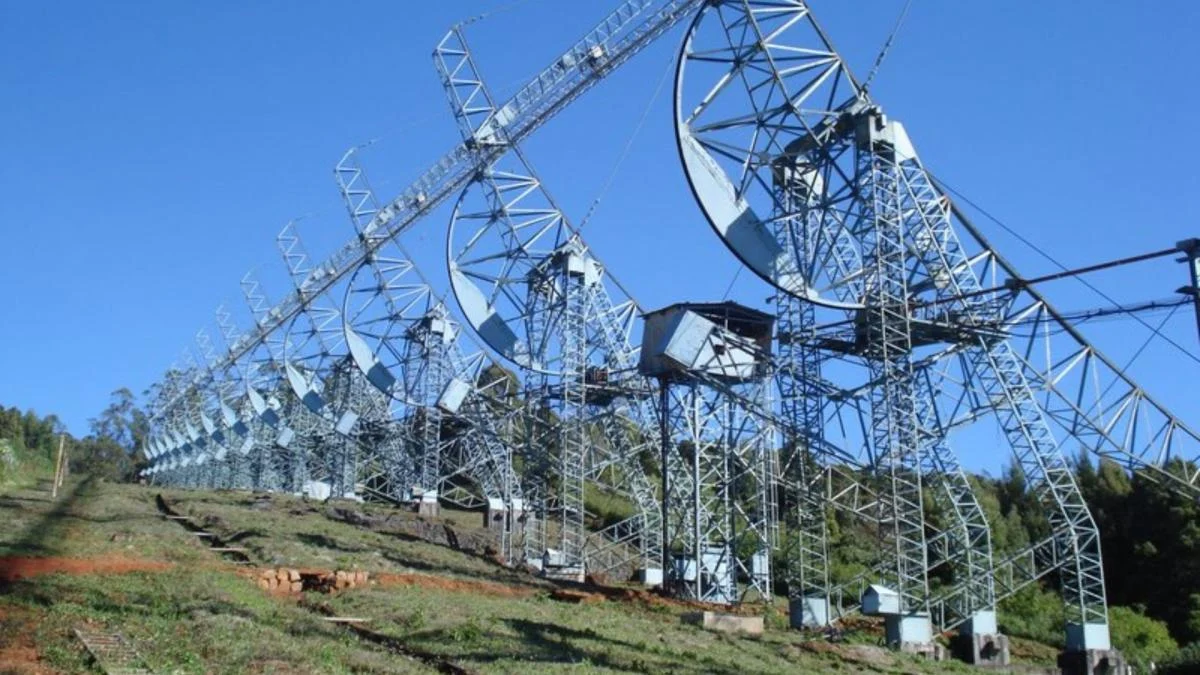
OOTY, TAMIL NADU — High above the rolling tea plantations of Ooty, in the serene landscape of the Nilgiri Mountains, stands one of the world’s most sophisticated scientific sentinels. For over 22 years, the GRAPES-3 (Gamma Ray Astronomy PeV EnergieS phase-3) muon telescope has been silently recording a relentless, invisible rain of subatomic particles. Now, a landmark study spanning two decades of data has provided scientists with a powerful new lens through which to view both the internal dynamics of Earth’s atmosphere and the protective magnetic shield of the Sun.
By analyzing more than four billion daily particle detections between 2001 and 2022, a multinational team of researchers from India and Japan has successfully decoupled the complex signals of solar activity from terrestrial seasonal shifts. This breakthrough, recently detailed in a comprehensive analysis, offers a novel methodology for monitoring space weather and refining long-term climate models, marking a significant leap forward in ground-based particle physics.
Deciphering the Cosmic Rain: Main Facts of the GRAPES-3 Breakthrough
The core of the research revolves around muons—heavy, fast-moving subatomic cousins of the electron. These particles are not original residents of our solar system; rather, they are the "grandchildren" of galactic cosmic rays. When high-energy protons and atomic nuclei from deep space collide with oxygen and nitrogen molecules in Earth’s upper atmosphere, they trigger a cascade of secondary particles, which eventually decay into muons.
The significance of the study lies in its ability to use these muons as biological "sensors" for two massive systems:
- The Interplanetary Magnetic Field (IMF): The Sun’s magnetic influence, which fluctuates over an 11-year cycle, acting as a gatekeeper that determines how many cosmic rays reach Earth.
- The Earth’s Upper Atmosphere: The temperature and density of the stratosphere, which fluctuates over a one-year seasonal cycle, affecting how many muons survive the journey to the ground.
The research team, a collaborative powerhouse, included experts from the Tata Institute of Fundamental Research (TIFR) in India, Cochin University of Science and Technology, and a consortium of Japanese institutions including Osaka City University, Chubu University, Nagoya University, the University of Tokyo, and Hiroshima City University. Their findings demonstrate that ground-based detectors can provide real-time, highly accurate data on atmospheric conditions that were previously only accessible via expensive satellite missions or weather balloons.

Two Decades of Vigilance: A Chronology of the Study
The journey to this discovery was not an overnight success but a marathon of data collection and refinement. The timeline of the GRAPES-3 experiment highlights the patience required for high-stakes astrophysics.
2001–2011: The First Solar Cycle
The study began at the turn of the millennium. During the first decade, the GRAPES-3 telescope—consisting of a massive array of plastic scintillator detectors and a large-area muon telescope—began its continuous monitoring. This period covered Solar Cycle 23, allowing researchers to observe how the muon count dipped and rose in inverse proportion to the Sun’s magnetic activity.
2012–2022: Refinement and Automation
As the experiment entered its second decade, the team faced the challenge of sensor aging and minor technical glitches. They developed novel, automated algorithms to correct these inconsistencies, ensuring that the data remained "pure" despite the passage of time. This period covered Solar Cycle 24 and the beginning of Solar Cycle 25, providing the necessary longitudinal data to distinguish between the Sun’s 11-year rhythm and Earth’s 12-month seasonal cycle.
2023–2024: The Mathematical Breakthrough
The culmination of the 22-year data set required a sophisticated mathematical approach. The team applied the Fast Fourier Transform (FFT) technique to isolate the specific frequencies of the overlapping signals. By 2024, the iterative filtering method was perfected, allowing the researchers to extract a "pure" atmospheric temperature signal by removing solar noise, and vice-versa.
The Physics of Muons and Magnetic Shields: Supporting Data
To understand the magnitude of this achievement, one must look at the mechanics of muon detection. Muons are notoriously short-lived, existing for only about 2.2 microseconds. However, because they travel at nearly the speed of light, time dilation allows them to reach the Earth’s surface.

The Solar "Gating" Effect
The Sun’s magnetic field is our first line of defense. When the Sun is at its "solar maximum," its magnetic field is tangled and strong, effectively deflecting a higher percentage of galactic cosmic rays. Consequently, the muon count at Ooty drops. During "solar minimum," the shield weakens, and the muon "rainfall" becomes a deluge. The GRAPES-3 data provided a precise mapping of this relationship, showing a direct correlation between the Interplanetary Magnetic Field (IMF) strength and the muon flux.
The Atmospheric "Expansion" Effect
Closer to home, the Earth’s atmosphere acts as a secondary filter. When the upper atmosphere (the stratosphere) heats up during summer months, it expands. This physical expansion means that the precursor particles (pions and kaons) created by cosmic ray collisions have to travel a longer distance through a less dense medium before they decay into muons. This increased distance gives them more time to decay prematurely or interact further, resulting in fewer low-energy muons reaching the detectors in Ooty.
Addressing Systematic Uncertainties
The study does acknowledge the complexities of particle physics. The researchers noted that their calculations involve "hadronic attenuation length"—a measure of how far particles travel before interacting with other matter. This value varies based on particle energy and type, introducing a layer of systematic uncertainty. However, by using the iterative filtering method, the team was able to minimize the "contamination" where solar fluctuations might mimic seasonal changes.
A Bridge Between Nations: Official Responses and Collaborative Effort
The success of the GRAPES-3 project is a testament to the long-standing scientific partnership between India and Japan. Officials from the Tata Institute of Fundamental Research (TIFR) have highlighted that this collaboration is one of the most productive in the field of cosmic ray research.
"The ability to maintain a complex detector array like GRAPES-3 for over two decades is a feat of engineering and international cooperation," noted a representative involved in the project. "By combining Indian expertise in high-altitude observation with Japanese advancements in data processing and particle physics theory, we have created a tool that transcends national boundaries."

Researchers from the participating Japanese universities emphasized that this ground-based approach is a cost-effective complement to space-based observations. While NASA’s spacecraft provide direct measurements of the Sun’s atmosphere and magnetic field, the Ooty observatory provides a continuous, ground-level verification that is essential for calibrating space-borne instruments.
Forecasting the Future: Implications for Space Weather and Climate
The implications of this research extend far beyond the walls of the Ooty observatory. As the world becomes increasingly dependent on satellite technology and global power grids, the ability to predict space weather has become a matter of national security and economic stability.
Space Weather and Satellite Protection
Solar storms and fluctuations in the magnetic field can disrupt GPS signals, damage satellite electronics, and even cause power outages on Earth. The GRAPES-3 methodology allows for real-time monitoring of the Sun’s magnetic shielding. By observing changes in the muon flux, scientists can potentially gain early warnings of solar disturbances heading toward Earth.
Refining Climate Models
Perhaps most importantly, the study provides a new way to measure the temperature profile of the high atmosphere. As global warming continues to alter the Earth’s climate, understanding how the upper atmosphere responds is crucial. Muon data provides a consistent, long-term record of stratospheric temperature changes, offering a "thermometer" that is independent of traditional ground-based weather stations.
A New Era of Ground-Based Astronomy
The development of this mathematical framework also paves the way for other spacecraft signals to be used in similar ways. In a related development, researchers have recently created tools to measure the Sun’s atmosphere using spacecraft radio signals. When combined with the muon data from GRAPES-3, scientists are entering an era where the entire solar system can be monitored through a network of integrated signals.

Conclusion
The 22-year study at Ooty stands as a monument to "slow science"—the idea that some of the universe’s most profound secrets can only be revealed through persistence, meticulous data collection, and the steady passage of time. By turning an invisible rain of cosmic particles into a precise scientific instrument, the researchers of GRAPES-3 have not only mapped the magnetic breath of the Sun but have also given us a new way to monitor the health of our own planet’s atmosphere.
As we look toward a future defined by environmental shifts and increased space exploration, the lessons learned in the Nilgiri Hills will undoubtedly serve as a foundation for the next generation of cosmic ray hunters. The invisible rain continues to fall, but for the first time, we truly understand what it is telling us.
