

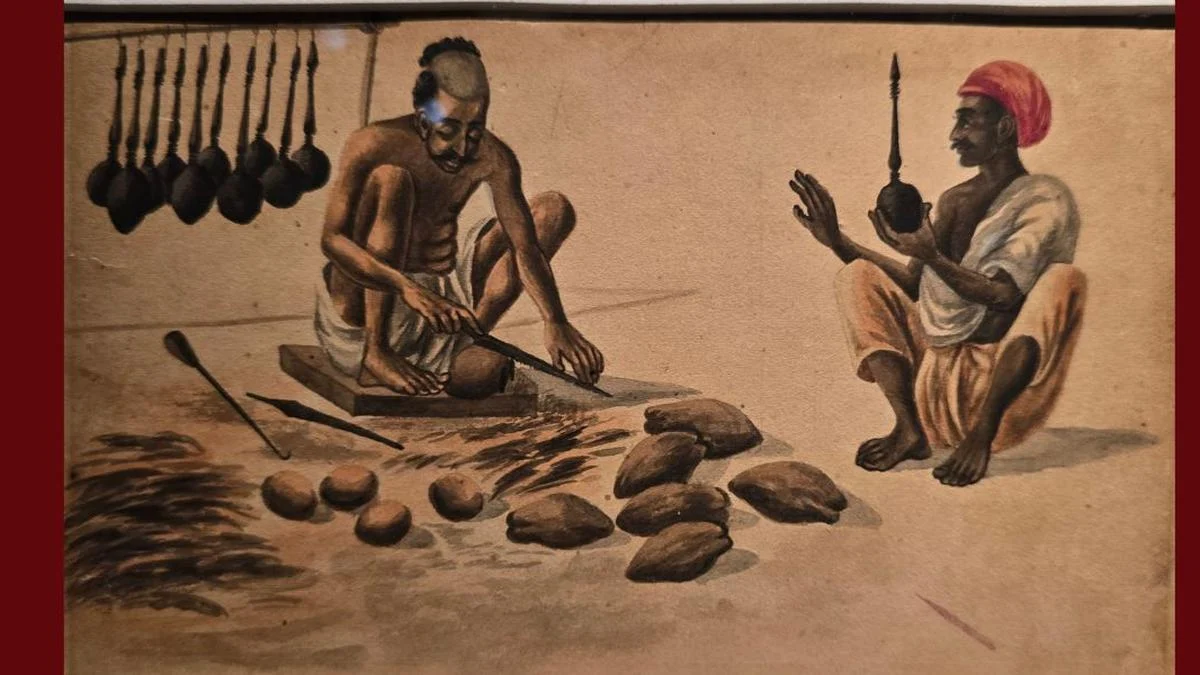
The visual history of 18th and 19th-century India is often dominated by the grandiosity of Mughal courtly life or the stiff formality of British colonial portraits. However, tucked away in the delicate brushstrokes of a nearly forgotten tradition lies a different story—one of the common man. Picture watercolours on imported paper, rendered with surgical precision against pale, minimalist backgrounds: two men in dhotis laboring over a distillery fire, or a roadside grocer (baniya) meticulously weighing pulses. This is Patna Kalam, a unique regional art form that served as a pre-photographic visual documentation of daily life.
Long confined to the dusty archives of international museums and private trunks in Bihar, Patna Kalam is currently experiencing a cautious but significant revival. Following a major exhibition at the Bihar Museum Biennale and a series of intensive workshops, the art world is asking: Can an art form built to capture the ephemeral nature of daily life survive in the modern era, or is it destined to remain a relic behind glass?

Main Facts: The Anatomy of a Visual Chronicle
Patna Kalam, also known as the Patna School of Painting, is a distinct offshoot of the "Company School" of art. It emerged as a hybrid style, blending the intricate detailing of Mughal miniatures with the naturalism and perspective of European aesthetics. Unlike the Mughal style, which focused on royalty, hunting scenes, and mythical epics, Patna Kalam turned its lens toward the "firka"—sets of paintings depicting the trades, festivals, and social customs of ordinary people.
Distinctive Characteristics
- Technique: The style is characterized by Kajli Syahi—a technique where the artist paints directly with the brush without any preliminary pencil sketching. This requires immense precision and a steady hand.
- Subject Matter: The art is resolutely secular. It features blacksmiths, servants fetching groceries, palanquin bearers, and women peeking through red curtains (purdah-nasheen).
- Minimalism: Unlike many Indian art forms, Patna Kalam is largely bereft of ornate borders or elaborate backgrounds. The focus remains entirely on the subject, often painted on bare backgrounds to emphasize the character’s movement and attire.
- Medium: While many works were done on imported European paper, artists also used mica (known locally as abrak), providing a unique translucent quality to the images.
Chronology: From Imperial Decline to Modern Revival
The trajectory of Patna Kalam is inextricably linked to the shifting tides of political power in the Indian subcontinent.

1750–1760: The Migration
The collapse of the Mughal Empire led to a mass exodus of court artists from Delhi. Many first migrated to Murshidabad in West Bengal under the patronage of the Nawabs. However, after the British victory at the Battle of Plassey in 1757, patronage dried up, forcing artists to move again. By 1760, a significant cluster of these artists had settled in Patna, then a bustling center of trade and administration.
1790–1840: The Golden Age
This period saw the rise of legendary figures like Sewak Ram and Hulas Lal. They pioneered the firka sets that became popular among the British officials of the East India Company, who wanted to carry home visual "postcards" of Indian life. The workshop tradition reached its zenith under cousins Shiva Lal and Shiva Dayal Lal between 1815 and 1840.

Late 19th Century: The Decline
The advent of the camera in the mid-1800s dealt a death blow to Patna Kalam. Photography offered a faster, cheaper, and more accurate way to document reality. Concurrently, the mass production of cheap lithographs in Europe further eroded the market for hand-painted watercolours. By the early 20th century, the tradition had almost entirely faded, with Ishwari Prasad Verma (the grandson of Shiva Lal) being among the last notable practitioners.
1943–1948: Academic Discovery
The art form was "rediscovered" by British scholars. P.C. Manuk published a monograph in 1943, and art historian Mildred Archer published the seminal book Patna Painting in 1948, acknowledging the massive private collections held by connoisseurs like Radha Krishna Jalan.

2023–2026: The Contemporary Resurgence
Beginning in 2023, the Indian National Trust for Art and Cultural Heritage (INTACH) and the Bihar Museum initiated a series of workshops and exhibitions. The Patna Kalam: Ek Virasat exhibition (December 2025 – February 2026) marked a turning point, bringing the art out of storage and into the public consciousness.
Supporting Data: Institutions and Inheritors
The survival of Patna Kalam has depended on a handful of institutions and "custodian families" who refused to let the legacy vanish.

The Global Footprint
Because the art was popular with British officials, some of the finest examples of Patna Kalam are currently housed outside India:
- The British Museum, London
- The Victoria & Albert Museum, London
- The Metropolitan Museum of Art, New York
Local Guardianship
In India, the Patna Museum and the Bihar Museum hold significant collections. However, private initiatives have been equally crucial.

- The Jalan Collection: The century-old Quila House (Jalan House) in Patna remains an iconic landmark. Aditya Jalan, the great-grandson of Dewan Bahadur Radha Krishna Jalan, recently opened Planet Patna, a private museum. Unlike the private family archives, Planet Patna is accessible to the public for a nominal fee of ₹100, showcasing Company-style paintings and historical artifacts, including items as diverse as Napoleon’s bed.
- The Descendants: Sanjay Kumar, a resident of Dhanbad and a descendant of Hulas Lal, continues to preserve family works, some of which were lent to the Bihar Museum for public viewing.
Official Responses: Strategies for a Sustainable Future
Government officials and art educators are now focused on moving Patna Kalam from "preservation" to "practice."
Anjani Kumar Singh, Director General of Bihar Museum, expressed optimism following the public response to recent exhibitions. "We hope to find good art trainers to impart technical skills and help create contemporary Patna Kalam," he stated. The museum plans to dedicate a permanent gallery to the style, potentially touring the collection internationally, similar to the successful Vaidehi Sita exhibition of 2024.

Bhairav Lal Das, Patna Chapter Convenor for INTACH, emphasizes the economic aspect of revival. INTACH has organized 11 workshops since 2023, aiming to build a "bank" of paintings that can be promoted and sold, providing incentives for budding artists to take up the craft professionally.
Jitendra Mohan, a Fine Arts professor, noted a surprising trend in these workshops. He observed that "fresh artists" (young students) often performed better than established folk artists (such as those from the Madhubani tradition) when it came to Patna Kalam. This is because Patna Kalam requires a specific understanding of human anatomy, measurement, and a realistic colour scheme that differs significantly from the stylized, two-dimensional nature of folk art.

Implications: Can the ‘Bazaar’ Art Return to the Streets?
The revival of Patna Kalam faces a fundamental paradox. It was originally an art of the "bazaar"—a quick, observational style born from the chaos of the streets. Today, however, it is a high-effort, time-intensive craft.
The Time and Space Conflict
Aditya Kumar Singh, an architect and urban sketcher, highlights a major hurdle: "Sketching a contemporary building takes me half-an-hour, while a Patna Kalam painting takes three days of full dedication." Furthermore, modern Patna is a sprawling, chaotic metropolis. The quiet, observant "street painting" of the 18th century is nearly impossible in today’s noisy urban environment, which lacks the "peace and space" required for such nuanced work.

Cross-Pollination and Commercial Viability
One path to survival lies in integration with other crafts.
- Tikuli Art: There is a strong link between Patna Kalam and Tikuli art (an 800-year-old tradition involving enamel paint on hard surfaces). Padma Shri awardee Ashok Kumar Biswas notes that while Patna Kalam influenced Tikuli, the latter survived because it adapted to home décor, coasters, and trays.
- Textile Design: Designer Sunita Prakash, through her company Bandhani, has successfully trained women to apply Patna Kalam motifs to fabric, creating a commercial bridge between fine art and wearable fashion.
The Educational Shift
The most promising implication is the interest among the youth. Students like Anurag Kumar Verma, who discovered the style through INTACH workshops, are now pursuing formal art education at prestigious institutions like Maharaja Sayajirao University, Baroda, with a focus on these traditional roots.

Conclusion
Patna Kalam is more than just a painting style; it is a historical record of an era before the lens replaced the brush. Its transition from the trunks of art colleges to the galleries of modern museums is a victory for Bihar’s cultural heritage. However, for it to truly "live" again, it must find a way to step out from behind the glass. Whether through textile design, urban sketching, or government-backed commercialization, the challenge for the next generation of artists will be to capture the "daily life" of the 21st century with the same delicate, unadorned honesty that their ancestors used two centuries ago.
