

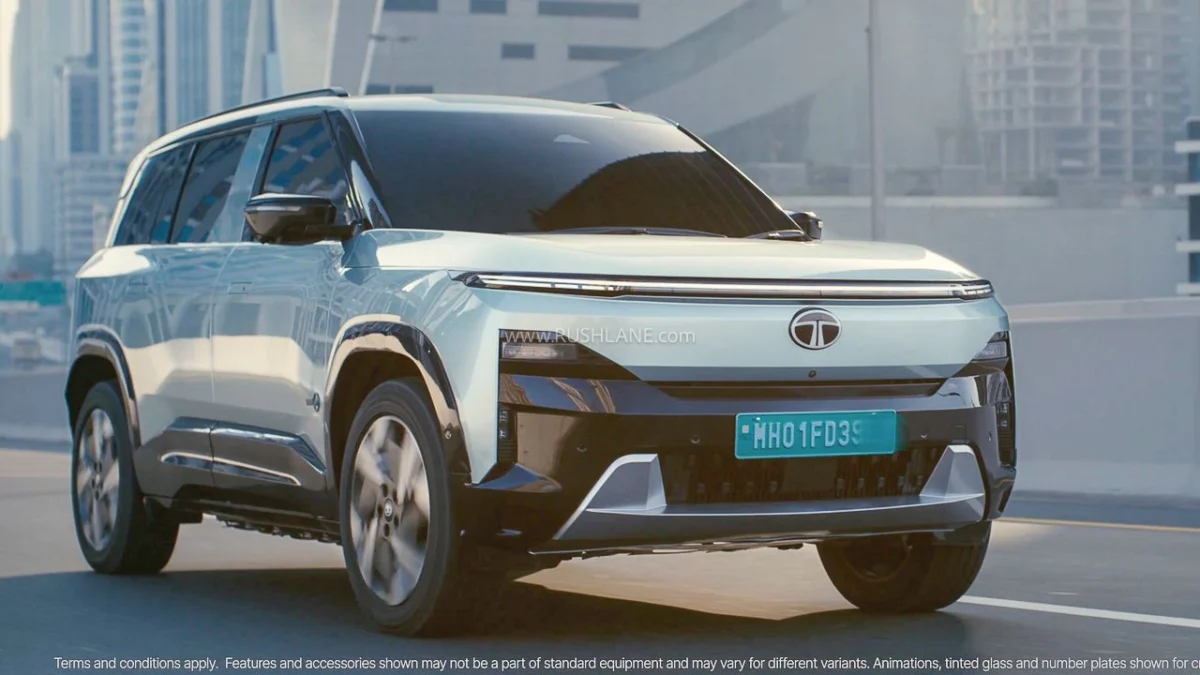
The Indian automotive landscape is currently witnessing a transformative era, driven largely by Tata Motors’ aggressive electrification strategy. Among the most anticipated vehicles in the company’s pipeline is the reincarnation of a cult classic: the Tata Sierra. While the original Sierra of the 1990s was a pioneer in the lifestyle SUV segment, the upcoming Tata Sierra EV is poised to redefine the premium electric SUV category.
As the official launch date of June 30, 2026, approaches, the industry has been abuzz with speculation regarding the technical prowess of this vehicle. New reports, citing dealer sources, have finally pulled back the curtain on the battery specifications and performance metrics of the Sierra EV, suggesting that Tata is leaving no stone unturned to ensure this "legend" dominates the market.
Main Facts: Positioning and Leaked Specifications
The Tata Sierra EV is strategically positioned to bridge the gap between the mid-range Curvv EV and the flagship Harrier EV. According to recent leaks, the Sierra EV will follow Tata’s "Persona" branding strategy, offering different battery configurations based on the trim level.
Battery and Powertrain Highlights:
- Base Variant (Pure Persona): Expected to be equipped with a 65 kWh battery pack. This aligns with the entry-level configurations of the Harrier EV, suggesting a standardized high-capacity floor for Tata’s premium electric offerings.
- Higher Trims: These are slated to feature a larger 75 kWh battery pack, catering to long-distance travelers and performance enthusiasts.
- Drivetrain Options: Tata Motors has officially confirmed the inclusion of a Dual Motor QWD (Quiet Wheel Drive/All-Wheel Drive) setup for the Sierra EV. Single-motor Rear-Wheel Drive (RWD) variants will likely serve as the entry point.
- Projected Range: Based on the efficiency of the Acti.ev platform, the 65 kWh variant is expected to offer a range exceeding 530 km, while the 75 kWh variant could potentially cross the 600 km mark on a single charge (ARAI/MIDC cycles).
Chronology: From 1991 Icon to 2026 Electric Powerhouse
The journey of the Sierra is a fascinating study of Indian automotive history and the evolution of consumer aspirations.

- The 1991 Original: Tata Motors launched the Sierra in 1991 as the first passenger car to be designed and produced in India. With its unique three-door design and massive rear glass windows, it was decades ahead of its time but remained a niche product.
- The 2020 Concept: After years of rumors, Tata Motors shocked the industry at the 2020 Auto Expo by revealing the Sierra EV Concept. It retained the iconic "Alpine window" design while showcasing a futuristic, minimalist aesthetic.
- The 2023 Evolution: At the 2023 Auto Expo, Tata showcased a more "production-ready" version of the Sierra. This version transitioned from a three-door to a more practical five-door layout, acknowledging the needs of the modern Indian family while keeping the spirit of the original design alive.
- 2025-2026 Testing Phase: Throughout late 2025 and early 2026, test mules of both the Internal Combustion Engine (ICE) and EV versions of the Sierra have been spotted across India and international terrains, including extreme weather testing in the Middle East.
- The Final Countdown: In June 2026, Tata Motors began dropping high-production teasers, leading to the confirmed launch date of June 30, 2026.
Supporting Data: Performance Benchmarks and Platform Synergy
The Sierra EV is built upon the Acti.ev (Advanced Connected Tech-Intelligent Electric Vehicle) architecture. This is a dedicated EV platform that allows for a flat floor, maximized cabin space, and the integration of large battery packs.
Comparative Performance Metrics
To understand the Sierra EV’s potential, one must look at its sibling, the Harrier EV. The data suggests a shared lineage:
| Metric | Harrier EV (Projected/Known) | Sierra EV (Anticipated) |
|---|---|---|
| Battery Size (Base) | 65 kWh | 65 kWh |
| Battery Size (Long Range) | 75 kWh | 75 kWh |
| Peak Power (RWD) | 238 bhp | ~230-240 bhp |
| Peak Torque (Dual Motor) | 504 Nm | 504 Nm |
| 0-100 km/h Sprint | 6.3 Seconds | < 6.2 Seconds (Due to lower weight) |
| Max Range (75 kWh) | 622 km | ~630-640 km |
The Sierra EV is expected to be slightly lighter and more aerodynamically efficient than the Harrier EV. This weight advantage implies that with the same 75 kWh battery, the Sierra EV could potentially offer a marginally higher range and a quicker 0-100 km/h acceleration time, making it one of the fastest electric SUVs in the sub-40 lakh segment.
The QWD Advantage
The Dual Motor QWD setup is a significant move for Tata. Unlike traditional mechanical 4WD systems, the electric AWD system allows for instantaneous torque distribution between the front and rear axles. This provides superior traction on slippery surfaces and enhanced stability during high-speed cornering.

Official Responses and Marketing Strategy
While Tata Motors has been tight-lipped about the exact specifications leaked by dealer sources, their marketing campaign speaks volumes. The company has moved away from traditional "city-car" marketing for the Sierra EV, focusing instead on "adventure and capability."
The Tal Moreeb Challenge
In a bold promotional move, Tata Motors has teased the Sierra EV tackling the Tal Moreeb sand dunes in the UAE. Known as one of the tallest and steepest sand dunes in the world (with a 50-degree incline), Tal Moreeb is a graveyard for many capable off-roaders. By showcasing the Sierra EV in this environment, Tata is making a clear statement: this is not just a "mall-roader." It is a rugged, capable SUV that happens to be electric.
The "Persona" Strategy
Official communication from Tata suggests that the Sierra EV will be available in multiple "Personas"—likely including Pure, Adventure, and Empowered.
- The Pure persona will likely house the 65 kWh battery, focusing on value and essential tech.
- The Adventure persona may introduce the QWD setup and rugged exterior cladding.
- The Empowered persona will be the luxury flagship, featuring the 75 kWh battery, V2L (Vehicle-to-Load), and V2V (Vehicle-to-Vehicle) charging capabilities, along with a lounge-like interior.
Implications: A High-Stakes Battle in the Mid-Size EV Segment
The launch of the Sierra EV on June 30, 2026, will signal the beginning of one of the most intense competitive periods in Indian automotive history.

1. Market Cannibalization vs. Market Expansion
Tata Motors faces a unique challenge. With the Curvv EV, Sierra EV, and Harrier EV, the company will have three premium electric SUVs priced within a relatively close bracket. However, the Sierra EV targets a specific "lifestyle" and "nostalgia" demographic that the more "coupe-like" Curvv or the "brawny" Harrier might not satisfy.
2. The Rivalry with Mahindra
The Sierra EV’s primary competitor will be the Mahindra BE 6. Mahindra’s "Born Electric" range is built on the INGLO platform and promises high performance. The battle between the Sierra EV and the BE 6 will essentially be a battle for the soul of the Indian EV enthusiast market.
3. Challenging the Global Giants
Beyond Mahindra, the Sierra EV is positioned to take on the Hyundai Creta EV and the Maruti Suzuki eVitara. While the Creta and eVitara will likely rely on brand trust and widespread service networks, Tata is banking on "Spec-Dominance"—offering larger batteries (75 kWh vs. the expected 60 kWh in rivals) and the iconic Sierra heritage to win over buyers.
4. Technological Democratization
By introducing 65 kWh and 75 kWh batteries in the Sierra, Tata is pushing the "standard" for range in India. This will likely force competitors to move away from smaller 40-50 kWh packs in the mid-size segment, ultimately benefiting the consumer with reduced range anxiety across the board.

Conclusion: The New Benchmark?
The Tata Sierra EV is more than just a car; it is a litmus test for Tata Motors’ ability to blend heritage with cutting-edge technology. If the leaked specifications of a 75 kWh battery and a sub-6.3 second 0-100 km/h time hold true, the Sierra EV will not only be a fitting tribute to its 1991 predecessor but also a formidable contender on the global stage.
As June 30, 2026, nears, all eyes are on the Tal Moreeb dunes and the subsequent showroom floors. Tata Motors has the momentum, the platform, and now, seemingly, the raw specs to ensure that the "Sierra" nameplate remains an icon for another thirty years. For the Indian consumer, the message is clear: the age of the uncompromising electric SUV has arrived.
