

Mumbai, India – In an era of rapid automotive transformation, Tata Motors has officially signaled its intent to not merely participate in the market but to redefine its boundaries. During its highly anticipated Investor Day meet, the homegrown automotive giant unveiled a meticulous five-year strategic roadmap, culminating in Fiscal Year 2031 (FY31). The plan outlines a massive product offensive, a significant ramp-up in manufacturing capacity, and a targeted expansion into untapped market segments, solidifying its position as a leader in both Internal Combustion Engine (ICE) and Electric Vehicle (EV) technologies.
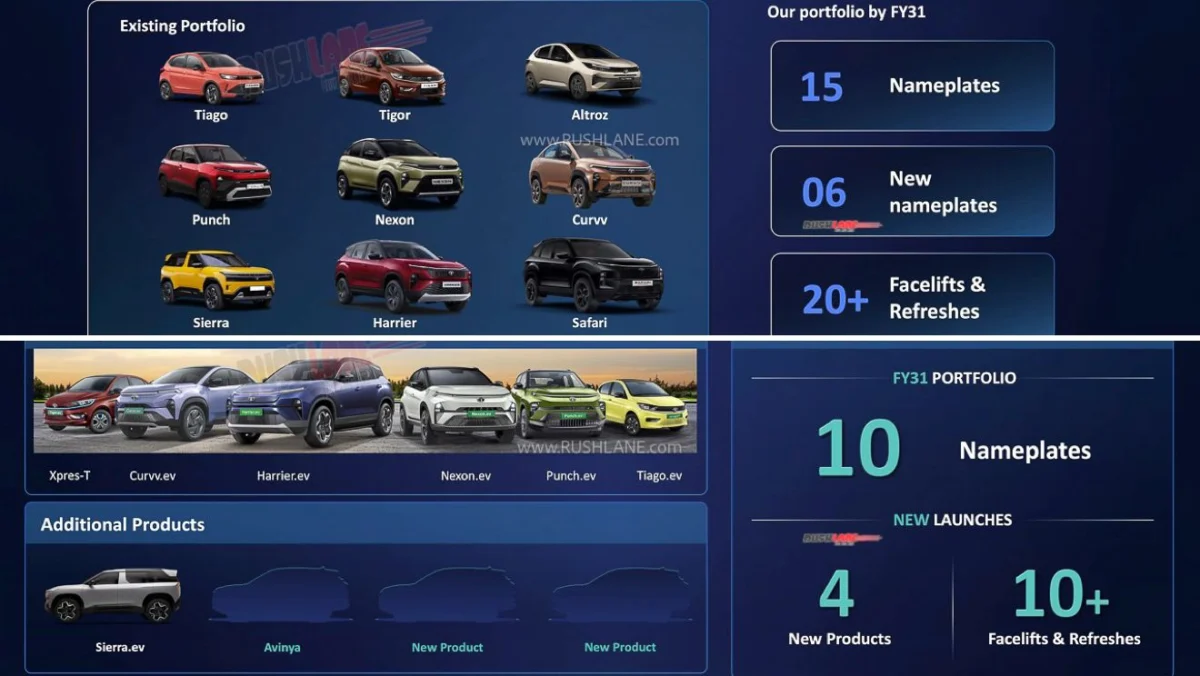
By the end of the decade, Tata Motors envisions a portfolio that is both broader and deeper, featuring 10 distinct EV models and 15 ICE models. This ambitious expansion is backed by a goal to secure over 25% market share in every segment it operates in, supported by an annual production capacity of 1.3 million units.
I. Main Facts: The Numbers Behind the Vision
The "FY31 Roadmap" is built on three primary pillars: Product Proliferation, Capacity Expansion, and Multi-Powertrain Dominance.
Portfolio Expansion
Tata Motors currently maintains a robust presence with nine ICE models and five EV models. By FY31, this will grow to 15 ICE models and 10 EV models. This expansion involves:
- 6 New ICE Models: Targeting "white spaces" and high-growth segments.
- 4 New EV Models: Including the much-anticipated Sierra EV and the production version of the Avinya.
- Sustained Innovation: Over 20 facelifts and refreshes for the ICE portfolio and more than 10 for the EV line-up to maintain product relevance and consumer interest.
Manufacturing and Market Share
- Capacity Hike: The company plans to increase its annual production from the current ~900,000 units to 1.3 million units within the next 24 to 36 months.
- Market Reach: Tata aims to cover 80% of India’s Passenger Vehicle (PV) market by FY31.
- Segment Leadership: A target of 25%+ market share in every segment where the brand is present.
II. Chronology: The Road to 2031
The rollout of this strategy is phased, focusing first on cementing its lead in the EV space before expanding into new ICE territories.
The Immediate Horizon (FY25 – FY26)
The next 18 months are critical for Tata’s "EV 2.0" phase.

- June 30, 2024: The scheduled launch of the Sierra EV. This reborn icon is expected to feature an All-Wheel Drive (AWD) dual-motor setup, positioning it as a premium lifestyle SUV.
- Late 2024/Early 2025: The debut of the Avinya brand’s first production model. Originally showcased as a concept, Avinya has evolved into a premium electric sub-brand that will utilize JLR’s (Jaguar Land Rover) EMA platform.
- Festive Season 2024: Anticipation is high for the Safari EV. Spotted frequently during road tests, the 7-seater electric SUV will be Tata’s direct answer to the Mahindra XEV 9S.
The Mid-Term Expansion (FY27 – FY29)
During this period, Tata will focus on its "Multi-Powertrain Strategy."
- The launch of the remaining two EV models, one of which is rumored to be an Electric MPV. This would bridge a significant gap in Tata’s current portfolio, allowing them to compete with the likes of the Kia Carens EV.
- Simultaneous introduction of new ICE models that utilize the "Acti.ev" and "Atlas" platforms, ensuring that even as EV adoption grows, the company remains a powerhouse in the traditional fuel segment.
The FY31 Maturity
By 2031, the strategy shifts toward "Fungible Manufacturing"—the ability to shift production between ICE, EV, and CNG on the same lines based on real-time market demand.
III. Supporting Data: Analyzing the Market Dynamics
Tata Motors’ confidence is rooted in its current performance metrics. As of 2024, the company commands nearly 70% of the Indian EV market, despite increasing competition.
The EV Surge
With the Tiago.ev, Punch.ev, Nexon.ev, and the recently launched Curvv.ev, Tata has built a ladder-like pricing structure. The addition of the Sierra, Safari EV, and Avinya will extend this ladder into the 25–50 lakh INR price bracket. Tata targets an EV penetration of 30%+ within its own sales mix by FY31, far outpacing the projected industry average.
The CNG Factor
While EVs grab headlines, Tata’s CNG strategy is equally aggressive. By pioneering the "Twin Cylinder" technology—which preserves boot space—Tata has successfully rebranded CNG from a "budget" choice to a "smart" choice. The company currently holds the second-largest CNG portfolio in India, trailing only Maruti Suzuki. By FY31, Tata aims for a 25%+ market share in the CNG space, viewing it as a vital bridge for customers not yet ready to transition to full electric.
Production Footprint
To reach the 1.3 million unit mark, Tata will leverage its geographically diverse manufacturing base:

- Pune, Maharashtra: The traditional heart of Tata’s PV production.
- Sanand, Gujarat: Recently bolstered by the acquisition of the Ford India plant, providing a ready-made ecosystem for high-volume scaling.
- Ranjangaon, Maharashtra: A key hub for engine and transmission production.
- Panapakkam, Tamil Nadu: The newest site, expected to play a massive role in high-end manufacturing and exports.
IV. Official Strategy: The "Fungible" Philosophy
During the Investor Day, Tata Motors’ leadership emphasized that the "secret sauce" to their FY31 goal is Manufacturing Agility.
The company is moving away from dedicated, rigid assembly lines. Instead, they are investing in "flexible and fungible" facilities. This means if petrol prices spike and EV demand surges, a specific plant can shift its output ratio in favor of EVs within weeks, rather than months.
Furthermore, the strategy involves "Structural Expansion." Rather than just building new factories, Tata is optimizing existing shops—paint shops, body shops, and final assembly—to remove bottlenecks. This capital-efficient approach allows for a higher Return on Capital Employed (ROCE) while scaling up to meet the 1.3 million unit target.
Supplier Integration
Tata is also working to increase supplier capacities. The company recognizes that a 1.3-million-unit goal is only achievable if the vendor ecosystem—providing everything from semiconductors to seat upholstery—scales in tandem. Tata is reportedly offering long-term volume guarantees to key suppliers to encourage their own capital expenditures.
V. Implications: Reshaping the Indian Auto Landscape
The ripple effects of Tata Motors’ FY31 roadmap will be felt across the entire Indian economy and the global automotive supply chain.
1. Competitive Pressure
Tata’s aggressive "white space" strategy is a direct challenge to the market dominance of Maruti Suzuki and Hyundai. By targeting 80% of the PV market, Tata is moving into segments it previously ignored, such as premium MPVs and lifestyle off-roaders. Competitors will likely be forced to accelerate their own EV timelines and price their products more competitively to retain market share.

2. The Death of the "One-Size-Fits-All" Powertrain
Tata’s success with the "Multi-Powertrain" approach (offering the same car in Petrol, Diesel, CNG, and EV) has proven that Indian consumers value choice. This forces the industry to move away from the idea that one technology will "win." Instead, the future is a hybrid landscape where different powertrains serve different use cases.
3. Economic and Environmental Impact
A move to 30% EV penetration by a market leader like Tata will significantly contribute to India’s Net Zero goals. Economically, the expansion to 1.3 million units will create thousands of direct and indirect jobs, particularly in the emerging "Green Tech" corridor of Gujarat and Tamil Nadu.
4. Technological Sovereignty
With the Avinya and the JLR partnership, Tata Motors is transitioning from a manufacturer of "affordable" cars to a global contender in high-tech automotive software and modular platforms. The FY31 plan isn’t just about selling more cars; it’s about elevating the "Made in India" brand to a level of global sophistication.
Conclusion
Tata Motors’ FY31 roadmap is a bold declaration of intent. By balancing the legacy of Internal Combustion Engines with the inevitability of Electric Vehicles, the company is positioning itself as a versatile titan. While the path to 1.3 million units and a 25% share in every segment is fraught with challenges—from global supply chain volatility to evolving battery chemistries—Tata’s track record over the last five years suggests that they are more than capable of turning these ambitious projections into asphalt-burning reality.
As the Sierra EV prepares for its June 30th debut, the world will get its first glimpse of whether this new era of Tata Motors can live up to the high expectations set during its Investor Day. One thing is certain: the Indian automotive landscape in 2031 will look vastly different, and Tata Motors intends to be the one holding the map.
