

VISAKHAPATNAM – In a significant move to bolster the regional economy and foster gender-inclusive industrial growth, the port city of Visakhapatnam recently hosted a high-profile conference titled "Celebrating Women Entrepreneurs: Urban Ecosystem and Grassroots Leadership." The event, held on Tuesday, June 16, 2026, served as a vital platform for women business leaders, ranging from artisanal micro-entrepreneurs to urban innovators, to converge and deliberate on the future of female-led commerce in Andhra Pradesh.
The conference was not merely a ceremonial gathering but a strategic assembly aimed at dismantling the systemic barriers—finance, market access, and digital literacy—that often hinder women from scaling their ventures. Organized by the Global Alliance for Mass Entrepreneurship (GAME) and Aspire For Her (AFH), in partnership with the Women’s Wing of the Visakhapatnam Chamber of Commerce and Industry (VCCI), the event underscored the critical role of "mass entrepreneurship" in achieving sustainable economic development.
I. Main Facts: A Convergence of Policy and Passion
The core objective of the conference was to bridge the gap between urban entrepreneurial ecosystems and grassroots leadership. By bringing together over a hundred entrepreneurs, industry veterans, and policy enablers, the organizers sought to create a roadmap for transitioning women-led businesses from subsistence-level operations to scalable, market-competitive enterprises.
Key highlights of the event included:
- High-Level Representation: The presence of Member of Parliament (MP) M. Sribharat and Visakhapatnam Metropolitan Region Development Authority (VMRDA) Commissioner N. Tej Bharath signaled strong political and administrative backing for the movement.
- Strategic Partnerships: The collaboration between GAME (focused on systemic entrepreneurial growth) and Aspire For Her (a massive community of 1.2 million women) provided a unique blend of technical expertise and network reach.
- Sectoral Diversity: The event showcased a wide spectrum of industries, including handcrafted ceramics, traditional arts, and the blue economy (fisheries), highlighting that entrepreneurship knows no sectoral bounds.
II. Chronology of the Event: From Dialogue to Display
The day’s proceedings were meticulously structured to move from theoretical discussions to tangible showcases of entrepreneurial success.
Morning Session: The Policy and Visionary Outlook
The conference commenced with an inaugural session where dignitaries emphasized the importance of Visakhapatnam as an emerging hub for women entrepreneurs. MP M. Sribharat opened the floor by discussing the legislative and infrastructural support necessary to nurture a "fearless" entrepreneurial culture among women in the region. This was followed by a keynote address that set the tone for the day: moving beyond "micro-finance" toward "growth-finance."
Mid-Day: Panel Discussions and "Spotlight" Sessions
The heart of the conference lay in its technical sessions. Panelists, including successful business owners and bank representatives, engaged in rigorous debates regarding:
- Market Access: How to move products from local "haats" to global e-commerce platforms.
- Digital Opportunities: Leveraging AI and social media marketing to reduce customer acquisition costs.
- Institutional Support: The role of government schemes and private equity in scaling small businesses.
"Spotlight" sessions allowed individual entrepreneurs to take the stage and share their "Business Journeys." These narratives often touched upon the "double burden" of domestic responsibilities and professional ambitions, providing a realistic look at the grit required to succeed.
Afternoon: The Exhibition and Buyer-Seller Networking
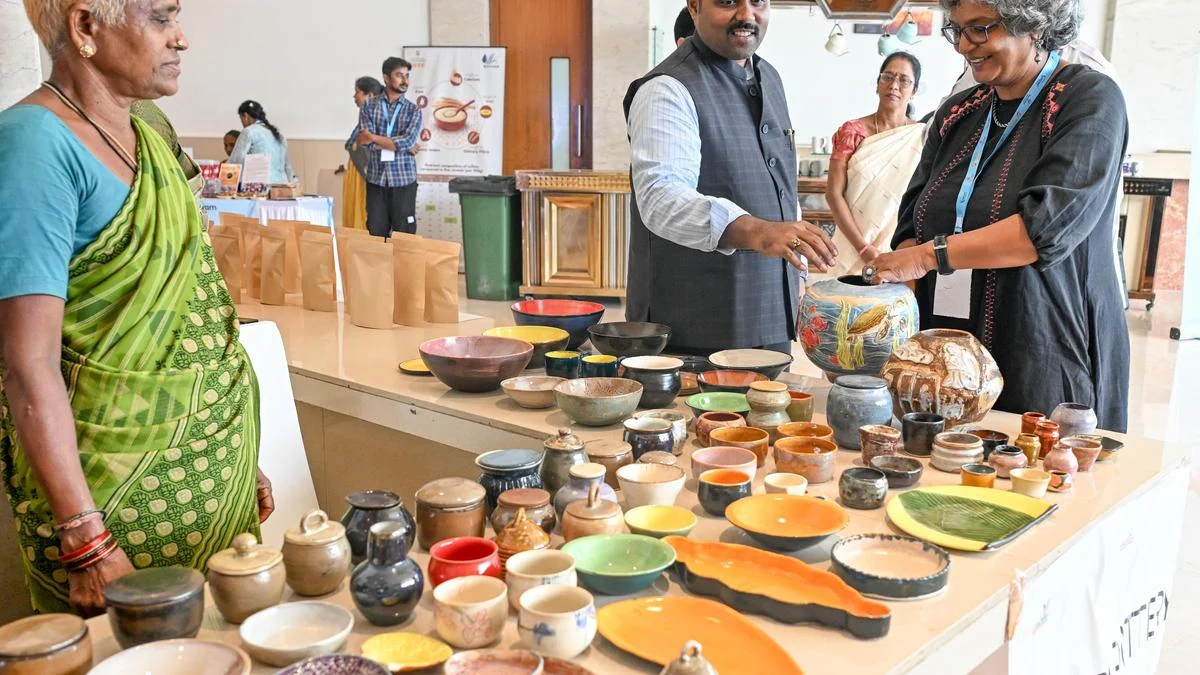
Parallel to the discussions, an exhibition zone remained the center of attraction. This was not just a display of products but a live marketplace where VMRDA Commissioner N. Tej Bharath and other officials interacted directly with producers. The day concluded with structured networking sessions designed to link grassroots producers with urban distributors and retail partners.
III. Supporting Data: The Pillars of Local Entrepreneurship
To understand the impact of such conferences, one must look at the specific entities that participated, representing the diverse economic fabric of Andhra Pradesh.
The Case of the Visakhapatnam Town Fisherwomen Dry Fish Cooperative Society
Perhaps the most poignant example of grassroots resilience was the participation of this cooperative. Registered in 1987, it stands as one of the oldest Fishermen Farmer Producer Organisations (FFPOs) in the region.
- Membership: 164 dedicated women.
- Function: Processing, quality control, and marketing of dry fish.
- Significance: This cooperative represents the "blue economy" at the community level. Their presence at a high-level conference highlights the shift from unorganized labor to a structured, cooperative business model that can negotiate better prices in the market.
Arra Pottery and Sankalpa Art Village
On the other end of the spectrum were ventures like Arra Pottery, which focuses on high-end, handcrafted ceramic ware. These enterprises represent the "Urban Ecosystem" side of the conference—businesses that rely on design thinking, aesthetic branding, and niche urban markets. By placing Arra Pottery alongside the Fisherwomen’s Cooperative, the event fostered a cross-pollination of ideas, where traditional skills could learn from modern branding, and vice versa.

The Power of the Network: Aspire For Her (AFH)
Data shared by Divya Sampath of AFH revealed the sheer scale of the potential workforce. With a community of 1.2 million women, AFH provides a massive data set on the challenges women face. Their "Hamsafal" program, implemented in collaboration with GAME, is specifically designed to create "pathways to parity," ensuring that women have the mentorship required to navigate the "valley of death" that many startups face in their first three years.
IV. Official Responses: A Call for Ecosystem Synergy
The rhetoric from the event’s leaders focused on "collaboration" rather than "isolated effort."
Subhash Kiran, Programme Director at GAME, told The Hindu that the secret sauce to entrepreneurial success is the local ecosystem. "Entrepreneurship flourishes when local ecosystems work together. Through collaborations with community organisations, industry and market partners, we are working to help women entrepreneurs move beyond subsistence livelihoods and build enterprises that can scale and access larger markets," Kiran stated. His comments reflect a shift in economic philosophy: from simply helping women "survive" to helping them "thrive and scale."
Divya Sampath of Aspire For Her emphasized the digital and networking aspect. She noted that the Hamsafal programme is more than just a training module; it is an access point. By connecting a woman in Visakhapatnam to a mentor in Mumbai or a buyer in Dubai, the program effectively dissolves geographical barriers.
VMRDA Commissioner N. Tej Bharath expressed his admiration for the handcrafted sectors. During his visit to the stalls, he noted that the VMRDA is keen on exploring how urban planning can include dedicated spaces—such as permanent exhibition centers or "women’s markets"—to ensure these entrepreneurs have a consistent venue to reach consumers.
V. Implications: The Economic Ripple Effect
The "Celebrating Women Entrepreneurs" conference has several long-term implications for Visakhapatnam and the broader Indian economy.
1. Transition from "Necessity" to "Opportunity" Entrepreneurship
In many developing economies, women enter business out of necessity (subsistence). The strategies discussed at this conference—market linkages and institutional finance—are designed to shift this toward "opportunity entrepreneurship," where businesses are started because a market gap is identified, leading to higher job creation and innovation.
2. Strengthening the FFPO Model
The spotlight on the Fisherwomen Dry Fish Cooperative Society suggests a renewed interest in Farmer Producer Organizations. If this model is successfully scaled, it could revolutionize the coastal economy of Andhra Pradesh, ensuring that the primary producers retain a larger share of the value chain.
3. Digital Literacy as a Leveler
The emphasis on digital opportunities implies that the next phase of growth for these women will be "tech-enabled." Whether it is using UPI for seamless transactions or Instagram for storytelling, digital literacy is being positioned as the ultimate equalizer between a rural artisan and a city-based boutique owner.
4. Policy Integration
The participation of the MP and VMRDA Commissioner suggests that the insights gained from this conference may soon find their way into local policy. This could result in better credit facilities for women-led MSMEs and more inclusive urban development projects that recognize women as primary economic stakeholders.
Conclusion
As Visakhapatnam positions itself as a premier industrial and IT destination, the "Celebrating Women Entrepreneurs" conference serves as a timely reminder that the city’s economic soul also resides in its grassroots leaders and urban creators. By fostering an environment where a ceramic artist and a dry-fish processor can share a platform with policymakers, the event has laid the groundwork for a more equitable and robust entrepreneurial future. The success of the "Hamsafal" program and the continued partnership between GAME, AFH, and VCCI will be the litmus test for how far this movement can go in transforming the lives of millions of women across the country.
