The modern era has been defined by the ubiquity of synthetic plastics. From the intricate components of aerospace engineering to the mundane convenience of food packaging, synthetic polymers have provided the structural backbone of global industry for over half a century. However, this "Plastic Age" has come at a staggering environmental cost. As landfills overflow and microplastics infiltrate the deepest reaches of the oceans, the quest for sustainable alternatives has moved from the fringes of academia to the center of industrial strategy.
At the forefront of this transition is a team of researchers from the Indian Institute of Technology (IIT) Bombay. Led by Professor Aparna Singh and her doctoral student Nitin Kumar Arya, the team is pioneering a new generation of "green composites" that utilize abundant, indigenous grasses—specifically Munja and Bermuda grass—to reinforce recycled and biodegradable plastics. Their work, which has already resulted in several patents, promises to replace traditional, environmentally damaging materials like fiberglass with lightweight, high-strength, and fully recyclable alternatives.
Main Facts: The Science of Green Composites
The core of the innovation lies in the development of natural-fibre-reinforced plastics (NFRPs). For decades, industry has relied on synthetic fibre-reinforced plastics (SFRPs), such as carbon fibre or glass fibre, to achieve high strength-to-weight ratios. While effective, these materials are notoriously difficult to recycle and rely entirely on non-renewable fossil fuels.
The IIT Bombay team has successfully demonstrated that common wild grasses can perform as well as, or in some cases better than, these synthetic counterparts. By integrating Saccharum munja (Munja grass) and Cynodon dactylon (Bermuda grass) into polymer matrices like High-Density Polyethylene (HDPE), Polypropylene (PP), and Polylactic Acid (PLA), they have created a suite of materials that are:
- Environmentally Sustainable: They utilize agricultural waste and fast-growing native weeds.
- Economically Viable: These grasses are significantly cheaper than synthetic glass or carbon fibres.
- Mechanically Superior: The composites exhibit enhanced tensile strength, toughness, and thermal stability.
- Highly Recyclable: Unlike fiberglass, which often ends up in landfills because it cannot be easily processed, these grass-based composites are designed for a circular economy.
Professor Aparna Singh explains the fundamental drive behind the research: “It increases the extent of the biodegradable component in the matrix. These fibres are also cheaper than thermoplastics. The strength and toughness of the composites improve significantly by adding these natural fibres.”
Chronology of Development: From Field to Filament
The journey toward these patented materials began with the identification of untapped natural resources. While international research has long focused on commercial natural fibres like hemp, flax, and jute, the IIT Bombay team looked toward India’s indigenous landscape.
Phase 1: Identifying the "Super Grasses"
The team selected Munja grass and Bermuda grass for their unique properties. Munja is a hardy, tall grass often used in traditional Indian crafts, known for its high cellulose content and durability. Bermuda grass, while often dismissed as a common garden weed, possesses a dense, fibrous structure that makes it an ideal candidate for reinforcement.
Phase 2: Solving the Adhesion Problem
A major hurdle in the development of natural composites is the "interfacial bonding" between the fibre and the plastic. Plastics like HDPE are hydrophobic (water-repelling), while natural fibres are hydrophilic (water-attracting). This mismatch usually prevents them from sticking together, leading to weak materials.
Traditionally, this is solved using expensive and often toxic chemical "compatibilizers." The IIT Bombay team spent years developing eco-friendly methods to bypass this complexity. For Bermuda grass, they developed a simple alkaline (sodium hydroxide) treatment to strip away natural waxes and impurities, allowing the fibres to bond tightly to the HDPE matrix without heavy chemical additives.
Phase 3: Scaling the Manufacturing Process
The team didn’t stop at laboratory samples. They tested their composites across three major manufacturing platforms:
- Injection Moulding: Creating durable, solid parts by mixing chopped Munja fibres directly with HDPE pellets.
- Vacuum-Assisted Resin Transfer Moulding (VARTM): Weaving Munja fibres into fabrics and infusing them with epoxy resin for industrial-grade strength.
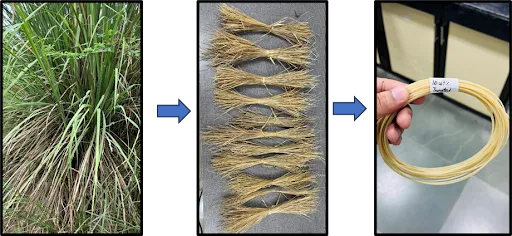
- 3D Printing (Fused Deposition Modelling): Developing a specialized filament that solves the warping issues inherent in 3D printing pure plastics.
Supporting Data: Breaking Down the Performance
The technical success of these composites is backed by significant empirical data. One of the most impressive breakthroughs occurred in the realm of high-performance industrial applications. By using the VARTM process to weave Munja fibres into a thermosetting epoxy resin, the researchers recorded a 40% improvement in tensile strength compared to standard resins. This allows the grass-based composite to compete directly with synthetic glass fibre in heavy-duty applications.
In the realm of 3D printing, the data solved a long-standing manufacturing bottleneck. High-Density Polyethylene (HDPE) is a preferred material for many products but is notoriously difficult to 3D print because it shrinks and warps as it cools.
The team developed a filament containing between 5% and 40% Munja grass. The data showed that the natural fibres act as a stabilizing "scaffolding." Because the fibres have a lower thermal expansion coefficient than the plastic, they prevent the material from contracting unevenly. This allows for the rapid prototyping of complex, high-strength parts that were previously impossible to manufacture using recycled HDPE.
Furthermore, the alkaline treatment of Bermuda grass proved that "less is more" in green chemistry. By removing the surface impurities of the weed, the team achieved a tensile strength that "far exceeds" that of pristine, unreinforced HDPE, all while reducing the overall cost of the raw material.
Official Responses: Voices from the Lab
The researchers emphasize that this is not just a scientific curiosity, but a necessary evolution for Indian industry.
Professor Aparna Singh highlights the shift away from expensive, imported fibres: “While many studies focus on commercial natural fibres such as hemp, flax, or jute, our work demonstrates the engineering potential of abundant indigenous grasses which remain largely unexplored for advanced polymer composite applications.”
She further elaborates on the technical challenges they overcame: “Natural fibres inherently possess hydrophilic surfaces, whereas HDPE is hydrophobic. This mismatch generally leads to poor fibre–matrix adhesion, inefficient stress transfer, and deterioration of mechanical properties. Achieving strong interfacial bonding without relying heavily on expensive compatibilisers was a significant challenge.”
Nitin Kumar Arya, who played a pivotal role in the 3D printing research, notes the versatility of their discovery: “The research successfully demonstrated the use of the same natural fibre system in injection moulding, fused deposition modelling (3D printing), and vacuum-assisted resin transfer moulding (VARTM). This broad processing compatibility significantly enhances the industrial scalability and commercialisation potential of the developed composites.”
Arya also pointed out the specific problem they solved for the 3D printing industry: “HDPE is known to be one of the most difficult thermoplastics to process… due to its high thermal shrinkage and warpage. Overcoming this challenge was one of the primary motivations of the study.”
Implications: A Paving Stone for the Circular Economy
The implications of IIT Bombay’s work extend far beyond the laboratory, touching upon several multi-billion-dollar industries.
The Automotive Sector
The automotive industry is under intense pressure to reduce vehicle weight (to improve fuel efficiency) and increase the use of recyclable materials. India’s increasingly strict regulations regarding vehicle end-of-life and recycling mean that manufacturers are looking for alternatives to fiberglass. The grass-reinforced composites are lightweight and rigid, making them ideal for fuel tanks, dashboards, bumpers, and interior panels.
Sustainable Construction and Housing
Because these composites are resistant to moisture rot and termite damage—unlike traditional wood or low-grade plastics—they are perfect for the construction of eco-friendly building panels, structural supports, and furniture. This could revolutionize the production of outdoor furniture, chairs, and tabletops, providing a "green" alternative to both timber and pure synthetics.
Consumer Goods and Packaging
As the global outcry against single-use plastics grows, these composites offer a middle ground. They can be used to create durable, reusable household items and "green" packaging solutions that are easier to recycle than multi-layered synthetic materials.
Economic Impact on Rural Communities
By creating an industrial demand for wild grasses like Munja, this technology has the potential to create new revenue streams for rural communities. What was once considered agricultural waste or a common weed can now be harvested as a high-value industrial feedstock.
Conclusion: The Future is Green
The work of Professor Singh, Nitin Kumar Arya, and the IIT Bombay team represents a pivotal shift in material science. By stripping away the "toxic complexity" of traditional manufacturing and looking toward the natural world for solutions, they have proven that the path to a sustainable future may be literally growing under our feet.
As the world urgently searches for ways to cut carbon emissions and reduce its reliance on fossil-fuel-derived synthetics, these grass-reinforced plastics offer a blueprint for the future. They bring us one step closer to a "circular economy"—a world where the products we use are not only born from the earth but can eventually return to it without leaving a trace of destruction. Through indigenous innovation and rigorous engineering, the humble wild grass is poised to become the steel of the 21st-century green revolution.