

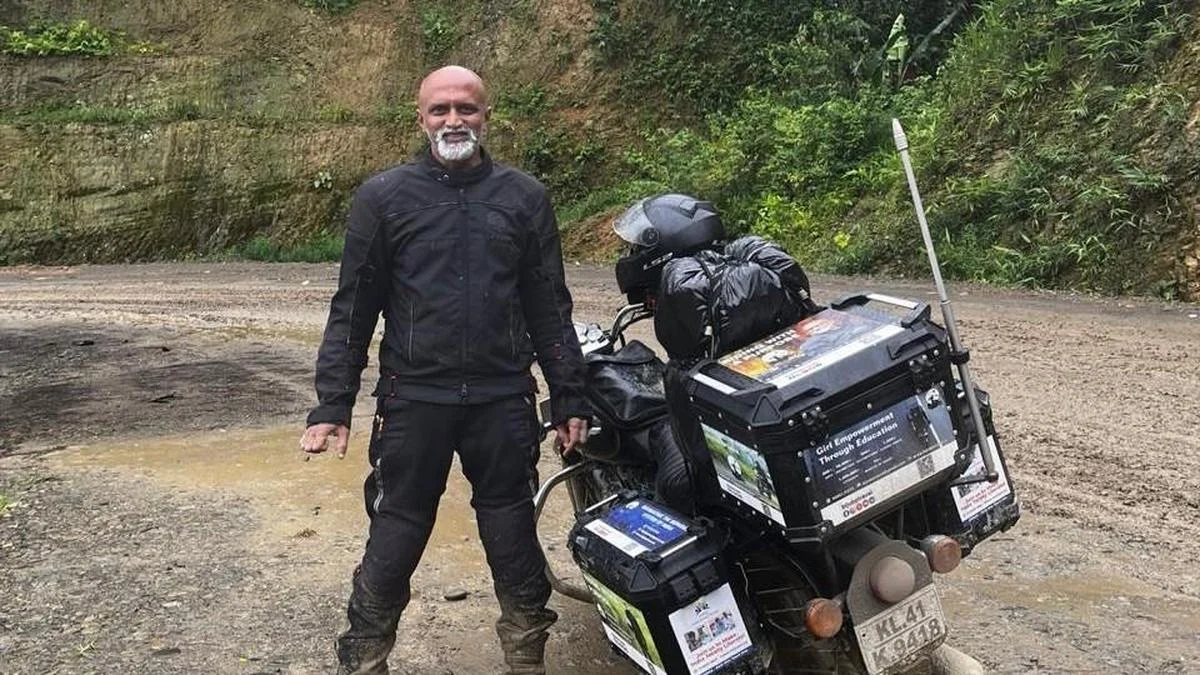
THIRUVANANTHAPURAM — In an era where travel is often reduced to "Instagrammable" moments and fleeting glimpses of landscapes, 53-year-old Biju BP has redefined the purpose of the long-haul journey. For the former banker, a motorcycle was not merely a mode of transport but a mobile pulpit from which he championed the cause of girl empowerment and education across the vast, intricate tapestry of the Indian subcontinent.
After spending 666 days on the road, traversing every state and Union Territory in India, Biju’s marathon effort has been officially recognized by the World Records Union. He was awarded the record for the ‘longest solo motorcycle ride across Indian states and Union Territories promoting girl empowerment through education,’ a feat that concluded in October last year but was formally ratified this May following a rigorous verification process.
The Genesis: Trading the Ledger for the Open Road
The story of Biju BP is one of a profound mid-life pivot. For twenty-five years, Biju served as a dedicated bank employee, navigating the structured world of finance and corporate responsibility. However, beneath the professional exterior was a growing restlessness and a passion for the open road.
"I started long-distance trips after I turned 40, utilizing my mandatory annual leave for expeditions," Biju recalls. These trips, including a 15-day ride from Kochi to Rajasthan, served as a catalyst. Yet, he noticed a recurring emotional pattern: the exhilaration of the departure was always overshadowed by the melancholy of the return. The "Sunday Scaries" had become a permanent fixture of his post-trip reality, as the weight of workplace pressures loomed large.
At the age of 50, Biju made a life-altering decision. He opted for voluntary retirement, choosing to sacrifice the security of a banking career for the uncertainty and enrichment of a pan-India expedition. "I realized that a lifetime is not enough to travel across India. You cannot imagine the diversity that is out there," he says. But he knew that to sustain a journey of such magnitude, it needed a soul—a purpose that transcended mere sightseeing.

Chronology of an All-India Expedition
Biju’s journey was not a sprint but a marathon of endurance, cultural immersion, and advocacy.
Phase I: The Departure and the Mission
Setting out with a clear objective, Biju focused his advocacy on "Girl Empowerment through Education." Having observed the socio-economic hurdles faced by women in India, he sought to engage with local communities at the grassroots level. He leveraged his membership in the Rotary Club to create a network of support, ensuring that wherever he rode, he had a platform to speak.
Phase II: The Institutional Outreach
Over the course of nearly two years, Biju visited approximately 500 educational institutions. These were not mere courtesy calls. In each school or college, he held interactive sessions. His route took him through the diverse topographies of the Western Ghats, the arid plains of Central India, the high-altitude passes of the North, and the lush landscapes of the Northeast.
Phase III: The Verification Period
The ride officially ended in October 2023. However, the transition from traveler to record-holder required a different kind of endurance. For several months, Biju and his supporters meticulously compiled evidence for the World Records Union. This included GPS logs, thousands of photographs, video recordings of his sessions, and a massive archive of newspaper clippings from various regional dailies that covered his progress. In May 2024, the record was officially conferred.
Supporting Data: The Scale of Advocacy
The impact of Biju’s 666-day journey can be quantified through the sheer scale of his engagement:

- Duration: 666 days of continuous travel.
- Reach: All 28 Indian States and 8 Union Territories.
- Institutional Impact: Over 500 schools, colleges, and vocational centers visited.
- Collaborative Network: Partnered with dozens of Rotary Club chapters and numerous local NGOs.
- Demographics: While the focus was on girls, the sessions were largely co-educational, emphasizing the role of boys in fostering a gender-equal society.
Biju’s definition of empowerment was a central theme of his data-driven advocacy. "Empowerment is when you take decisions for yourself," he told students. By targeting co-ed institutions, he addressed the critical need for boys to learn how to interact with empowered women, aiming to dismantle patriarchal norms from the classroom upward.
Field Observations and Impactful Encounters
Biju’s journey provided him with a raw, unfiltered view of the challenges facing young women in India, ranging from child marriage and labor to the social stigma surrounding menstrual health.
One of the most significant interventions occurred in Tamil Nadu during a period of severe flooding. While working on relief efforts with the Rotary Club, Biju encountered a 16-year-old girl who was already a mother. A local teacher informed him that a high percentage of girls in that specific community dropped out after Class VIII to be married off.
Moving beyond advocacy into direct action, Biju and a lawyer within his volunteer group formed an immediate awareness task force. They educated the community on the legal repercussions of the Prohibition of Child Marriage Act. Follow-up reports indicate that the intervention was successful; the community has reportedly seen a total cessation of underage marriages since the group’s involvement.
Furthermore, Biju’s journey served to debunk several regional stereotypes. He admits to entering Bihar with trepidation, influenced by negative media portrayals, only to be met with what he describes as the warmest hospitality of his entire trip. Similarly, his time in Nagaland challenged his preconceptions about the safety and accessibility of the Northeast.

"People say India is not safe to travel," Biju observes. "I admit there are issues, but we end up highlighting only the negative aspects. I returned with many good memories and a belief in the inherent goodness of people across these borders."
Official Validation and Technical Rigor
The recognition by the World Records Union (WRU) serves as a formal validation of Biju’s logistical and physical feat. The WRU’s verification process is notoriously stringent, requiring proof that the rider not only covered the distance but also remained true to the stated cause of the journey.
The documentation submitted by Biju acted as a sociopolitical map of India. Each news clipping and photograph served as a data point, proving that the ride was a continuous effort of advocacy. The official certification recognizes the "Longest solo motorcycle ride across Indian states and Union Territories promoting girl empowerment through education," a category that highlights the intersection of adventure sports and social activism.
Implications: The Future of Solo Advocacy
Biju BP’s achievement has significant implications for how social causes can be championed in the digital age. His journey suggests that "slow travel" combined with a specific social mission can create a more profound impact than traditional, centralized NGO campaigns.
1. Breaking the "Safety Myth"
Biju’s successful solo navigation of the entire country—including regions often deemed "sensitive"—provides a counter-narrative to the discourse on travel safety in India. While he acknowledges the risks, his journey emphasizes that with proper planning and community engagement (such as the Rotary network), the country is accessible to those willing to explore it.

2. Individual Agency in Social Change
Now working as a consultant, Biju maintains that his journey is a blueprint for individual agency. "If I was able to do this, anybody can," he asserts. His story suggests that retirement need not be a withdrawal from society but can be a period of intense, meaningful contribution.
3. Redefining Masculinity in Advocacy
By choosing "girl empowerment" as his theme, Biju—a middle-aged man—sent a powerful message about male allyship. His presence in schools talking about periods and child marriage helped normalize these conversations, suggesting that the fight for gender equality is not a "women’s issue" but a societal necessity that requires active participation from men.
As Biju BP settles back into a more stationary life in Kerala, the dust on his motorcycle may have settled, but the ripples of his 666-day odyssey continue to be felt in the 500 institutions he visited. His record is more than a certificate; it is a testament to the idea that the road to progress is best traveled one village, one school, and one conversation at a time.
