

The Indian automotive landscape is witnessing a significant shift. No longer is the "entry-level" segment defined solely by frugality and basic transport. Today’s urban consumer demands a blend of sophistication, cutting-edge technology, and uncompromising safety. Leading this charge is Tata Motors with its latest iteration of the Tiago. By offering a unified design language across three distinct powertrains—Petrol, CNG, and Electric—the new Tiago range seeks to redefine what a compact hatchback can be.
Main Facts: A Triple-Threat Strategy
The updated Tata Tiago range arrives not as a mere facelift, but as a comprehensive re-evaluation of the compact car’s value proposition. The core of this update lies in "premiumization." Tata has integrated features previously reserved for mid-size SUVs into this hatchback, such as a 360-degree HD Surround View Camera and a Blind View Monitor—both segment-firsts.
The range is anchored by a price bracket of INR 4.69 lakh to 8.55 lakh, positioning it competitively against rivals like the Maruti Suzuki Swift and the Hyundai Grand i10 Nios. However, the Tiago’s unique selling point remains its "Power of Choice" strategy. Whether a buyer prioritizes the traditional mechanical feel of a petrol engine, the low running costs of factory-fitted CNG, or the futuristic, silent performance of an EV, the Tiago provides a consistent aesthetic and qualitative experience across all three.

Chronology: From the "Kite" to a Segment Leader
To understand the significance of the new Tiago, one must look at its lineage. Launched originally in 2016 under the internal codename "Project Kite," the Tiago was the first vehicle to embody Tata Motors’ "Impact Design" philosophy. It was the car tasked with shedding the commercial-segment image left behind by the Indica and Bolt.
- 2016: The Tiago launches, winning acclaim for its build quality and design.
- 2018: The introduction of the Tiago NRG (cross-hatch) and the performance-oriented JTP version.
- 2020: A major mid-life facelift introduced BS6 compliance and a 4-star Global NCAP safety rating, a milestone for the segment.
- 2022: The launch of the Tiago.ev, democratizing electric mobility in India.
- 2024/25: The current update focuses on digital integration, enhanced safety (6 airbags as standard), and a more "mature" design language.
This timeline showcases a steady progression from a budget-friendly hatchback to a tech-laden vehicle that challenges the hierarchy of the Indian car market.
Supporting Data: Engineering the Three Personalities
The Tiago’s versatility is backed by robust technical specifications tailored to different driving cycles.
1. The Petrol Powerhouse
The heart of the conventional Tiago is the 1.2-litre Revotron engine. This three-cylinder unit produces 86PS of power and 113Nm of torque. While these figures are standard for the segment, the refinement levels have been notably improved in this latest update. The engine is paired with either a 5-speed manual or an Automated Manual Transmission (AMT), catering to both enthusiasts and city commuters.

2. The CNG Revolution
Tata’s iCNG technology has solved the "boot space" dilemma that plagued the industry for decades. By utilizing Twin-Cylinder Technology—two smaller tanks tucked under the luggage floor rather than one massive cylinder—the Tiago retains a usable boot. In CNG mode, it delivers 75.5PS and 96.5Nm. Crucially, it is one of the few CNG cars in India to offer a "Direct Start" feature, allowing the car to start directly on gas, and an AMT option for those seeking clutch-less convenience in high-traffic zones.
3. The Electric Vanguard
The Tiago.ev remains the flagship of the range in terms of technology. It is offered with two battery options:
- Medium Range: 19.2kWh battery, delivering an estimated real-world range of 160–170 km.
- Long Range: 24kWh battery, producing 114Nm of torque and achieving 0–60 km/h in 5.7 seconds. Its real-world range sits between 205–215 km.
The EV also introduces iRA.ev connected features, allowing owners to pre-cool their cabins via a smartphone app—a luxury feature now available in a compact hatch.
Design and Interior: The "Segment-Above" Feel
The exterior updates are subtle yet impactful. The "Lux Beam" LED headlamps and the "Halo Lightbar" tail lamps give the car a wider, more planted look. The addition of textured wheel-arch cladding and new alloy designs helps the Tiago bridge the gap between a standard hatchback and a more rugged crossover aesthetic.
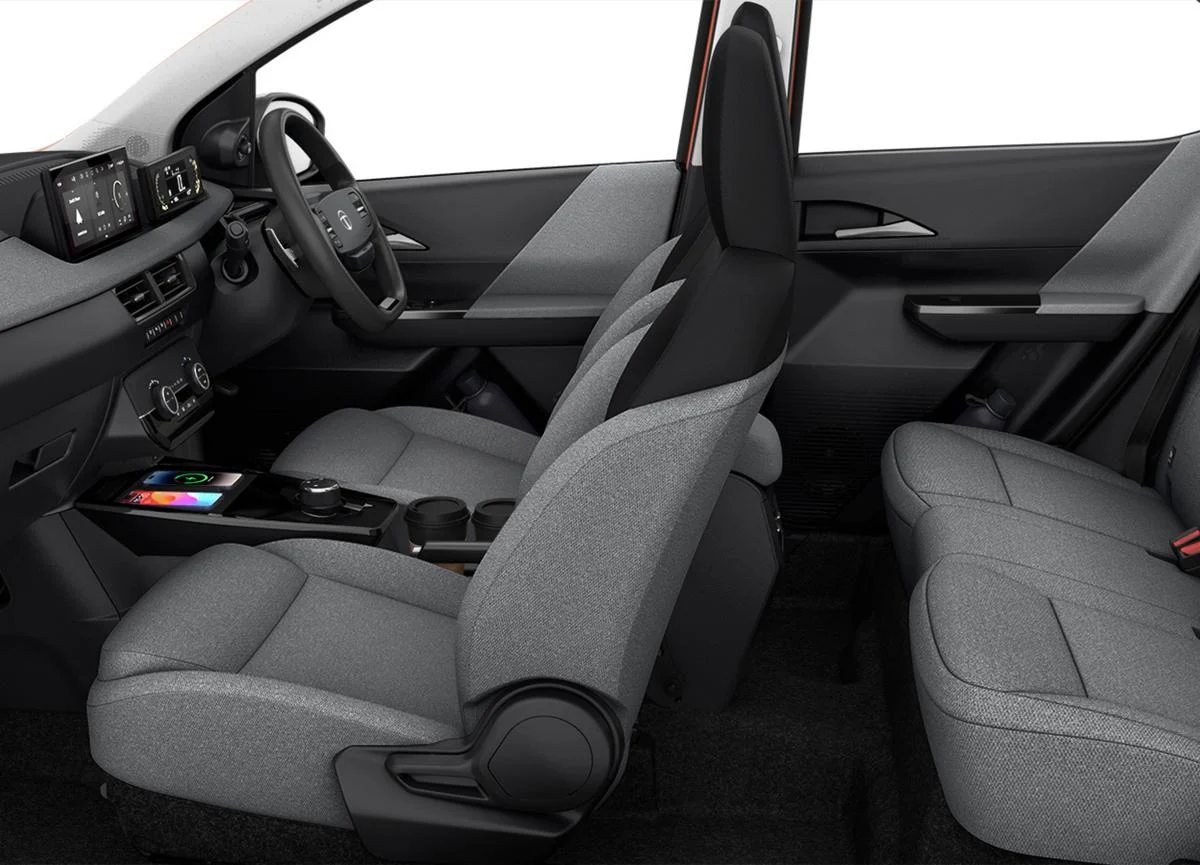
Inside, the transformation is even more pronounced. The "Fabricia Luxe" dashboard uses materials that feel soft to the touch and visually sophisticated. The centerpiece is the 26.03cm (10.25-inch) HD touchscreen. This system is not just larger; it is powered by a more modern processor that supports wireless smartphone integration. Complementing this is the Digital Island Cluster, a fully digital instrument gallery that provides the driver with clear, concise data, from tire pressure monitoring to EV energy flow.

Official Context and Market Positioning
While Tata Motors has not released a singular "response" to this specific update, the vehicle reflects the company’s broader "New Forever" philosophy. Industry analysts note that Tata is aggressively moving toward a "Safety-First" marketing strategy. By making six airbags standard across all variants, Tata is positioning the Tiago as the safest choice in its class, forcing competitors to either follow suit or risk losing market share to safety-conscious millennial buyers.
Company representatives have frequently highlighted that the Tiago is often the "first car" for many Indian families. By packing it with high-end features like the 360-degree camera, Tata is ensuring that first-time buyers do not feel they are compromising. This strategy aims to build brand loyalty that will eventually lead these customers to upgrade to the Nexon, Harrier, or Safari in the future.
Ride Quality: The Unsung Hero
Beyond the screens and the lights, the Tiago’s greatest strength remains its mechanical composure. Indian road conditions are notoriously unpredictable, featuring everything from smooth highways to unpaved rural tracks. The Tiago’s suspension is tuned with a slightly firm but highly absorbent character.
The steering is weighted to be light at city speeds for easy maneuvering but gains a reassuring heft as the speedometer climbs. This stability at high speeds is a hallmark of Tata’s chassis engineering, often making the Tiago feel like a much larger vehicle on the highway. For the EV variant, the lower center of gravity (due to the floor-mounted battery) further enhances cornering stability, making it arguably the most "fun-to-drive" car in the line-up.

Implications: Small Cars No Longer Need to Feel Small
The arrival of the enriched Tiago range has several long-term implications for the Indian automotive industry:
- Democratization of Technology: Features like 360-degree cameras and blind-spot monitoring were once the exclusive domain of luxury cars costing upwards of INR 20 lakh. Their inclusion in the Tiago signals that high-end tech will soon be a standard expectation in every segment.
- The Decline of the "Budget" Stigma: The Tiago proves that an entry-level price point does not have to mean a "cheap" interior. The move toward premium materials (Fabricia Luxe) suggests that the "utilitarian" hatchback era is coming to an end.
- The Multi-Fuel Future: By offering Petrol, CNG, and EV in the same shell, Tata is providing a blueprint for the transition to green energy. It allows consumers to choose their level of "greenness" without sacrificing the comfort or features they have grown accustomed to.
- Safety as a Standard, Not an Option: With the standard inclusion of six airbags and ESP (Electronic Stability Program), the Tiago is setting a new benchmark for the "minimum" safety requirements in India.
Verdict: A Mature Choice for a Modern India
The new Tata Tiago range is a testament to how much the compact car segment has matured. It is no longer just about getting from point A to point B at the lowest possible cost. It is about doing so with a sense of pride, a suite of safety features that protect the family, and a level of technology that keeps the driver connected to the world.
Whether it is the zingy response of the Tiago.ev, the clever packaging of the iCNG, or the reliable familiarity of the Revotron petrol, the Tiago remains a cohesive, well-rounded package. It is a car that refuses to be defined by its dimensions, proving once and for all that a small car can carry a very large presence.
Price Range: INR 4.69 lakh – 8.55 lakh (Ex-showroom)
Data provided in association with Motorscribes and The Hindu.
