

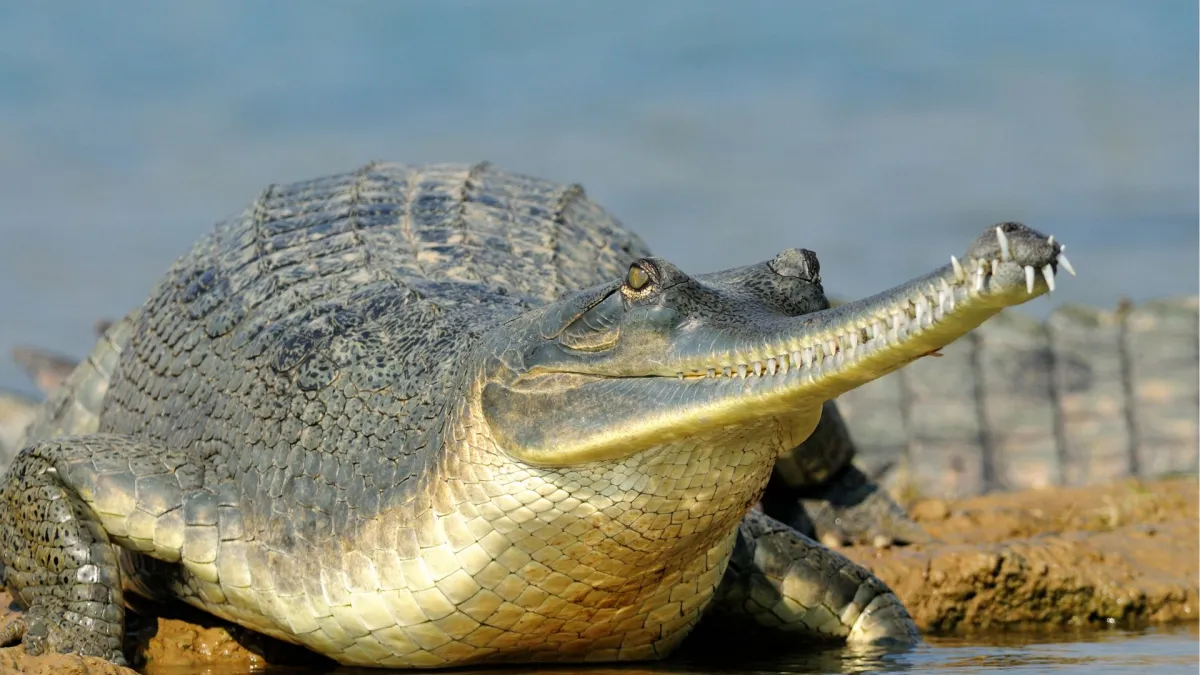
BENGALURU — In the mist-shrouded mornings along the riverbanks of North India, a prehistoric ritual unfolds. The gharial (Gavialis gangeticus), a critically endangered crocodilian characterized by its elongated, needle-like snout, emerges from the water to greet the day. For decades, biologists assumed these ancient reptiles were beckoned by the rising warmth of the sun. However, groundbreaking new research has revealed a far more complex and fragile reality: the gharial’s daily rhythm is dictated not by heat, but by light.
This discovery, spearheaded by an international coalition of scientists, warns that the increasing encroachment of artificial light at night (ALAN) and the shifting thermal patterns caused by climate change could throw the gharial’s biological clock into a state of lethal disarray.
Main Facts: The Primacy of Light over Heat
For the fewer than 1,000 gharials remaining in the wild, the transition from water to land is a critical survival maneuver. As ectotherms, gharials cannot internally regulate their body temperature; they must rely on external sources to maintain a metabolic sweet spot between 30°C and 33°C. This process, known as thermoregulation, is essential for digestion, growth, and immune function.
The prevailing scientific consensus once held that temperature was the primary "proximal cue"—the immediate environmental trigger—that signaled to a gharial when to begin its morning bask. However, a study conducted by researchers from the University of Helsinki (Finland), the Wildlife Institute of India (Dehradun), and the Leibniz Institute of Freshwater Ecology and Inland Fisheries (Germany) has overturned this assumption.

The study concludes that gharials rely on "illuminance"—the intensity of light hitting a surface—rather than ambient temperature to decide when to leave the safety of the water. This means that even if the air is significantly colder than the water, a certain threshold of morning brightness will compel the reptiles to crawl onto the riverbank. In the evolutionary history of the gharial, light has served as a reliable predictor that heat is forthcoming. But in the modern world, where light and heat are increasingly decoupled by human activity, this ancient instinct is becoming a liability.
Chronology: A Multi-Institutional Investigation
The research project was born out of a need to understand why gharial populations remain so precariously balanced on the edge of extinction despite decades of conservation efforts. The team focused their observations on the Deori EcoCentre in the Morena district of Madhya Pradesh, a vital hub for gharial conservation and breeding.
Phase 1: Observation and Data Collection
The team monitored a total of 382 gharials across various age groups, ranging from tiny hatchlings to massive adults. By observing the animals in controlled yet naturalistic enclosures, the researchers were able to separate the variables of light and temperature—factors that are usually so intrinsically linked in the wild that they are difficult to study in isolation.
Phase 2: Statistical Modeling
Using advanced statistical modeling, the researchers analyzed thousands of data points regarding the timing of "emergence" (leaving the water) and "submergence" (returning to the water). They looked for "breakpoints"—specific environmental values that triggered a change in behavior.

Phase 3: The Discovery of the Mismatch
By late 2023 and early 2024, the data revealed a consistent pattern. The morning transition was tightly correlated with light levels, whereas the evening return to the water lacked a clear environmental trigger, suggesting that internal factors like hunger or "heat soaking" (reaching a maximum thermal capacity) might govern the end of the day.
Supporting Data: Age-Specific Vulnerabilities
The study’s most alarming data points concern the youngest members of the species. The researchers found that gharial hatchlings are significantly more sensitive to light than adults.
- Sensitivity Thresholds: Hatchlings were observed responding to much lower levels of illuminance than older gharials. While this allows them to maximize their potential time in the sun, it frequently leads them into "cold stress" scenarios.
- The Temperature Gap: In the early morning, water temperatures are often higher than air temperatures. Because hatchlings follow light cues, they frequently leave 25°C water to enter 18°C air simply because the sky has reached a certain brightness.
- Thermal Inertia: Large adults have significant body mass, which acts as a thermal buffer. They lose heat slowly. Hatchlings, conversely, have a high surface-area-to-volume ratio, meaning their body temperatures plummet almost immediately upon entering cool air.
- The "Cue-Environment Mismatch": The study found that hatchlings often had the lowest recorded body temperatures of any group during the morning hours because they were the most "obedient" to light cues, regardless of the actual thermal benefit of being on land.
Official Responses and Scientific Perspectives
The international research team has expressed a mixture of scientific fascination and conservationist alarm. Representatives from the Wildlife Institute of India (WII) noted that while the gharial is a "living fossil" that has survived for millions of years, its specialized sensory system may not be able to adapt to the rapid pace of the Anthropocene.
"We are seeing a disconnect between evolutionary programming and modern environmental reality," noted one of the study’s contributors. "The gharial has evolved to trust the light. For millions of years, if the sky was bright, the sun’s heat followed shortly. Now, with light pollution from growing urban centers near the Chambal and other river systems, that trust is being betrayed."

Experts from the Leibniz Institute (IGB) emphasized that this research provides a "blueprint" for future conservation. They argue that protecting the gharial involves more than just preserving water quality and fish stocks; it requires the preservation of the "scotobiology" (the biology of darkness) of their habitats.
Implications: Light Pollution and the Future of Conservation
The implications of this study are far-reaching, affecting both wild habitat management and captive breeding programs.
1. The Threat of ALAN (Artificial Light At Night)
As cities in India and Nepal expand, the "sky glow" from streetlights, industrial hubs, and residential areas increases. If artificial light reaches gharial nesting and basking sites, it could fool hatchlings into emerging from the water in the middle of the night or too early in the morning. This would leave them exposed to freezing temperatures and nocturnal predators without the benefit of solar warmth to jumpstart their metabolism.
2. Climate Change and Thermal Decoupling
Climate change is altering the relationship between light and heat. If air temperatures rise while seasonal light patterns remain constant, or if unseasonable cold snaps occur during bright periods, gharials may find themselves on land during dangerous thermal windows. The study suggests that the "predictive power" of light is being eroded, making the environment less "readable" for the species.

3. Redesigning Conservation Zones
The research calls for the establishment of "Dark Sky" corridors along the Chambal, Girwa, and Son rivers. This would involve:
- Restricting high-intensity lighting near riverbanks.
- Using motion-sensor or shielded lighting in nearby villages to reduce sky glow.
- Maintaining natural vegetation buffers that create "light shadows," protecting the river from inland illumination.
4. Enhancing Captive Breeding
For zoos and eco-centers like Deori, the study provides actionable data. Enclosures must be designed to ensure that the youngest gharials have access to "thermal retreats"—areas where the air is artificially warmed—if they choose to follow light cues during chilly mornings. Furthermore, the presence of "light shadows" from walls or trees must be carefully managed to ensure they do not create confusing micro-environments for the reptiles.
Conclusion: A Call for Holistic Protection
The gharial is an indicator species; its health reflects the health of the entire river ecosystem. The revelation that light pollution could be a silent killer for this species adds a new layer of urgency to environmental protection efforts in South Asia.
Just as researchers have found that underground clay layers in the Brahmaputra River Basin can act as biological triggers for the release of arsenic into groundwater—reminding us that hidden environmental mechanisms have profound impacts on life—this study reminds us that the "invisible" threat of light can be just as potent as a chemical toxin. To save the gharial, we must protect not just the water they swim in and the fish they eat, but the very integrity of the day-night cycle that has guided them since the age of the dinosaurs. Without the return of natural darkness, the sun may set for the last time on this remarkable species.
