

Introduction: A Landmark Achievement for Indian Auto Retail
The Indian automotive landscape has reached an unprecedented pinnacle as retail sales for passenger vehicles (PVs) crossed the 4-lakh unit threshold for the first time in the month of July. According to the latest comprehensive data released by the Federation of Automobile Dealers Associations (FADA), July 2026 has etched its place in history, reflecting a robust consumer appetite and a resilient economy despite minor month-on-month fluctuations.
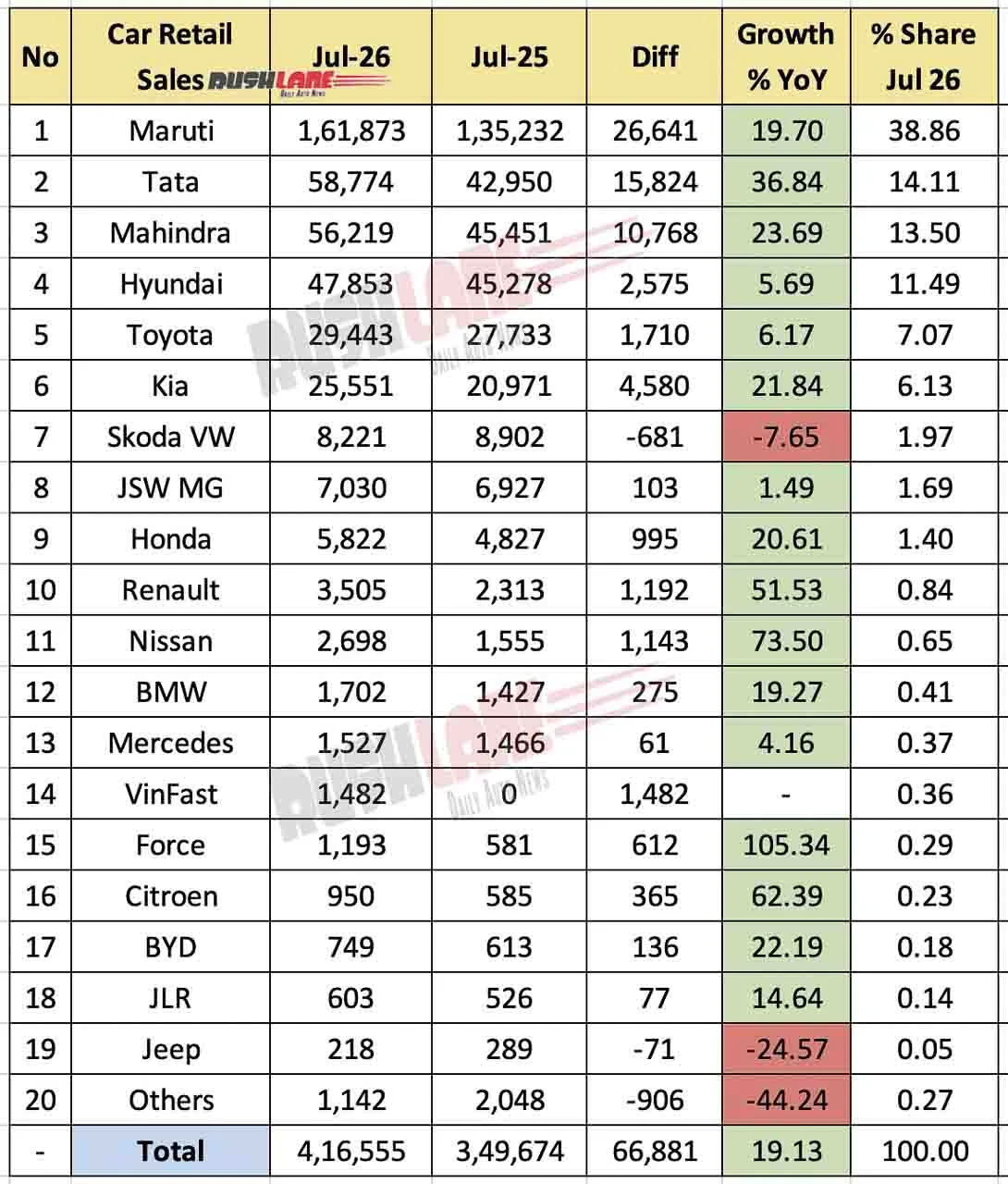
Total passenger vehicle registrations for July 2026 reached 4,16,555 units, representing a significant year-on-year (YoY) growth of 19.13% compared to the 3,49,674 units retailed in July 2025. This surge is not merely a statistical anomaly but a testament to the evolving dynamics of the Indian middle class, improved credit availability, and a flurry of new model launches that have captivated the domestic market. While the year-on-year trajectory remains steeply upward, the market witnessed a marginal cooling of 1.68% compared to the 4,23,677 units registered in June 2026, suggesting a brief period of normalization following a high-octane start to the summer.
Chronology of Growth: From Recovery to Record-Breaking Performance

To understand the magnitude of July 2026’s performance, one must look at the chronological progression of the Indian auto sector over the past 24 months. In 2024 and early 2025, the industry was grappling with supply chain stabilization and the transition to stricter emission norms. By July 2025, the market had stabilized at roughly 3.5 lakh units.
The journey to the 4-lakh milestone in July 2026 was paved by a consistent month-on-month build-up throughout the first quarter of the 2026-27 fiscal year (FY27). April and May 2026 saw aggressive dealer dispatches and high retail conversion rates, culminating in a June that nearly touched the record books itself. The momentum carried into July, traditionally a month characterized by the onset of monsoons which can occasionally dampen showroom footfalls. However, the "monsoon slowdown" was non-existent this year, as total automobile retail across all segments (including two-wheelers, three-wheelers, and commercial vehicles) hit a new high of 25,91,138 units, a staggering 25.89% increase over the previous year.
Detailed Supporting Data: Manufacturer Performance and Market Share
The competitive hierarchy of the Indian passenger vehicle market saw familiar names maintaining their dominance, though the gaps between the "Big Three" and the rest of the field are evolving.
Maruti Suzuki: The Undisputed Sovereign
Maruti Suzuki India Limited (MSIL) continues to command the lion’s share of the Indian roads. With 1,61,873 units retailed in July 2026, the company posted a 19.70% YoY growth. More impressively, Maruti Suzuki maintained a market share of 38.86%. This indicates that nearly four out of every ten cars registered in India carry the Maruti badge. The success of the Nexa premium outlets, particularly models like the Fronx and Grand Vitara, has allowed the brand to retain its volume leadership while moving up the value chain.

The Battle for Second: Tata Motors vs. Hyundai vs. Mahindra
One of the most compelling narratives in the July 2026 data is the performance of Tata Motors. Retaining the second spot, Tata Motors registered 58,774 units, achieving a robust 36.84% YoY growth—the highest among the top five manufacturers. This growth has allowed Tata to widen its lead over the perennial challenger, Hyundai.
Hyundai Motor India recorded 47,853 registrations, a modest 5.69% increase YoY. While Hyundai remains a formidable force with a strong SUV portfolio, it currently finds itself in fourth place, as Mahindra & Mahindra (M&M) secured the third position. Mahindra retailed 56,219 units, growing 23.69% YoY. Mahindra’s "SUV-only" strategy continues to pay dividends, with high demand for the XUV and Scorpio series driving significant retail volumes.
Mid-Tier and Growth Brands
Toyota Kirloskar Motor maintained its fifth-place standing with 29,443 units, followed by Kia India at 25,551 units. Conversely, Skoda Auto Volkswagen India faced headwinds, reporting a 7.65% decline in retail registrations to 8,221 units. Among the smaller players, JSW MG Motor (7,030 units) and Honda Cars India (5,822 units) showed steady performance, while Renault (3,505 units) and Nissan (2,698 units) both enjoyed healthy growth spurts, signaling a revival for the French and Japanese alliance partners.
The Luxury and Emerging Segment
In the premium space, BMW India emerged as the leader with 1,702 registrations, outpacing its rival Mercedes-Benz, which saw ,1527 units registered. A notable entry into the Indian market is VinFast. The Vietnamese EV specialist, which recently commenced Indian operations, made a splash with 1,482 registrations in July, signaling a rapid acceptance of new-age global brands. Jaguar Land Rover (603 units) and Volvo (noted in broader luxury data) continue to hold niche segments, while Jeep India saw a contraction, falling to 218 units.
The Shifting Energy Paradigm: Fuel Mix Evolution

Perhaps the most significant long-term trend revealed in the July 2026 data is the rapid diversification of the "fuel mix." The Indian consumer is no longer tethered solely to traditional internal combustion engines (ICE).
- Petrol and Ethanol: While still the dominant force, the share of petrol and ethanol-powered vehicles dropped from 47.62% in July 2025 to 41.68% in July 2026. This decline reflects a conscious shift toward more economical or "greener" alternatives.
- CNG and LPG: Compressed Natural Gas (CNG) has become a mainstream choice for the Indian middle class. The share of CNG/LPG vehicles jumped to 24.67% from 21.38% a year ago.
- Electric Vehicles (EVs): The EV revolution is gaining traction. Electric passenger vehicles accounted for 7.90% of total registrations in July 2026, up from 5.14% in the previous year. This nearly 3% gain in market share highlights the impact of improved charging infrastructure and a wider array of affordable EV models.
- Hybrids: Hybrid technology, championed by brands like Toyota and Maruti Suzuki, maintained a healthy and stable share of 8.02%, appealing to buyers who desire fuel efficiency without range anxiety.
- Diesel: Despite various regulatory pressures, diesel’s share remained surprisingly resilient at 17.73%, driven largely by the heavy SUV segment where torque and long-distance efficiency remain paramount.
Official Responses and Market Context
The Federation of Automobile Dealers Associations (FADA), which compiles this data based on Vahan registrations, noted that the crossing of the 4-lakh mark is a "psychological and economic milestone." FADA representatives emphasized that while wholesale numbers (factory-to-dealer) often grab headlines, retail numbers (dealer-to-customer) provide the true pulse of the economy.
Industry analysts point out that the growth in July is particularly impressive given the high base of the previous year. The "inventory levels" at dealerships remain a point of discussion; while sales are high, FADA has previously cautioned dealers against overstocking. However, with the festive season approaching in the coming months, the current retail velocity suggests that the inventory is being absorbed efficiently.
The government’s push for "Green Mobility" and the continued investment in road infrastructure are cited as primary external catalysts. The expansion of the Bharat NCAP safety ratings has also influenced buyer behavior, with consumers increasingly opting for higher-spec, safer vehicles, which in turn drives up the average ticket size of retail sales.

Implications and Future Outlook: A Strong Start to FY27
The data for July 2026 contributes to a very optimistic picture for the 2026-27 fiscal year. For the April-July 2026 period (YTD FY27), passenger vehicle retail sales stood at 16,87,040 units, a 22.80% increase compared to the 13,73,821 units sold in the same period last year.
Across all vehicle categories—including the vital two-wheeler segment which serves as an indicator of rural economic health—total retail registrations for FY27 YTD have risen by 18.27%, surpassing the 1-crore (10 million) mark at 1,04,76,327 units.
What lies ahead?
- Festive Momentum: With the 4-lakh mark breached in July, the industry is eyeing even higher numbers for the upcoming festive months of September and October.
- Competitive Realignment: The neck-and-neck race between Tata, Mahindra, and Hyundai suggests that the battle for the "Silver Medal" in the Indian market will intensify, likely leading to better consumer offers and faster innovation.
- Infrastructure Synergy: As the EV share nears the 10% tipping point, the pressure on the public and private sectors to accelerate charging station deployment will reach a fever pitch.
In conclusion, July 2026 stands as a watershed moment for the Indian automotive industry. The transition from a 3-lakh-per-month market to a consistent 4-lakh-per-month market signals that India is firmly entrenched as one of the world’s most vital and dynamic automotive hubs. As the fuel mix continues to evolve and new players like VinFast enter the fray, the Indian consumer is the ultimate winner, enjoying more choice, better technology, and a more competitive marketplace than ever before.
