

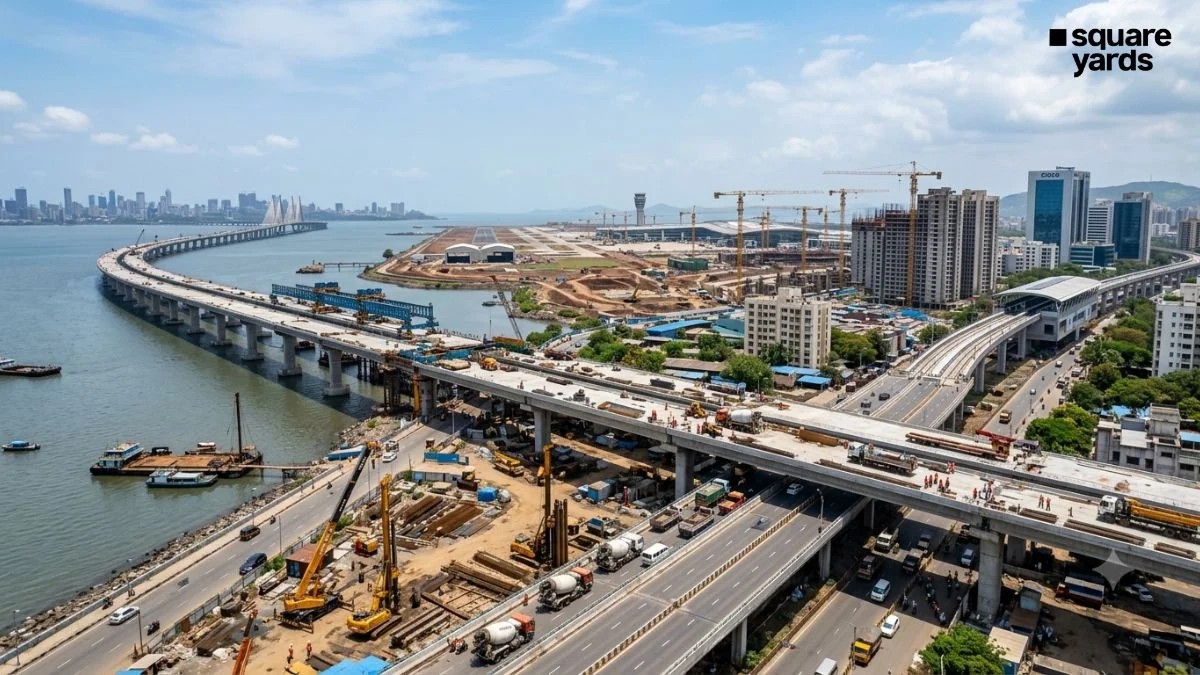
NAVI MUMBAI – For nearly half a century, the narrative of the Mumbai Metropolitan Region (MMR) was dictated by a single, immovable center: South Mumbai. As the city’s population exploded, Thane emerged as the logical residential extension, offering a reprieve from the island city’s stratospheric prices. However, by mid-2026, a seismic shift in the region’s real estate hierarchy has become undeniable.
Recent data and market analysis from Square Yards Research reveal that Navi Mumbai is no longer just a "satellite city" or a secondary option for those priced out of Mumbai. It has transformed into the fastest-growing residential market in the MMR, driven by a convergence of mega-infrastructure projects, a burgeoning employment ecosystem, and a strategic balance of affordability and lifestyle.
Main Facts: A New Center of Gravity
The transformation of Navi Mumbai is evidenced by its rising share in the regional market. According to the latest figures from H1 2026, Navi Mumbai accounted for nearly 21% of all residential launches across the MMR. This is a significant jump from the 18% share it held in 2014. More tellingly, its share of total housing sales has surged from 16% to 22% in the same period.
This data suggests a fundamental shift: Navi Mumbai is no longer merely absorbing the "spillover" demand from a congested Mumbai. Instead, it is generating its own organic demand. Homebuyers are now choosing Navi Mumbai as their first preference, attracted by planned urban layouts that contrast sharply with the often chaotic redevelopment landscape of Mumbai and the dense corridors of Thane.
The city’s evolution is characterized by three pillars:
- Connectivity Revolution: The completion of trans-harbor links and international transit hubs.
- Commercial Decentralization: The transition from a "bedroom community" to a self-sustaining economic hub.
- Value-to-Space Ratio: The ability to offer larger, modern configurations at a fraction of the cost of Mumbai’s suburbs.
Chronology: The Road to 2026 Dominance
To understand Navi Mumbai’s current ascent, one must look at the timeline of its development, which transitioned from slow-burn planning to a rapid-fire infrastructure explosion.
- The Planning Era (1970s – 1990s): Conceived by CIDCO as a twin city to Mumbai, Navi Mumbai spent decades establishing its "nodes" like Vashi, Nerul, and Belapur. While well-planned, it lacked the high-speed connectivity needed to challenge Mumbai’s dominance.
- The Infrastructure Blueprint (2010 – 2019): This decade saw the conceptualization of "Mega Projects." The Navi Mumbai International Airport (NMIA) and the Mumbai Trans Harbour Link (MTHL) moved from the drawing board to the construction phase. During this time, Navi Mumbai’s share of MMR launches hovered around 17-18%.
- The Acceleration Phase (2020 – 2024): Despite global economic headwinds, infrastructure work in Navi Mumbai accelerated. The "Atal Setu" (MTHL) neared completion, and the Navi Mumbai Metro became a reality. Developers began land banking aggressively in previously overlooked areas like Ulwe and Pushpak Nagar.
- The Realization Phase (2025 – 2026): By July 2026, the operational status of the Atal Setu and the nearing completion of the NMIA have fundamentally altered travel times. What was once a two-hour commute to South Mumbai has been slashed to 30 minutes, effectively integrating Navi Mumbai into the city’s core economic fabric.
Supporting Data: Decoding the Growth Metrics
The data provided by Square Yards Research highlights a market that is both resilient and high-yielding. While many parts of the MMR struggle with inventory overhang, Navi Mumbai shows a healthy balance between supply and demand.
1. Launch and Absorption Trends
In H1 2026, developers launched approximately 49,000 housing units across the MMR. Navi Mumbai’s substantial share in these launches is matched by its absorption rate. Unlike speculative markets where high supply leads to price stagnation, Navi Mumbai’s sales have kept pace, indicating a high presence of end-users rather than just investors.
2. The Price Gap Analysis
As of June 2026, the average asking price in Navi Mumbai stands at Rs 19,300 per square foot (psf). While this represents a steady appreciation over the years, it remains a bargain compared to Mumbai’s premium markets, where prices often start at double or triple this amount for comparable infrastructure.
Micro-Market Pricing Breakdown (June 2026):
- Vashi: Rs 33,350 psf (The premium gateway node)
- CBD Belapur: Rs 19,950 psf (The commercial heart)
- Ulwe: Rs 15,600 psf (The airport-adjacent growth corridor)
- Panvel: Rs 15,050 psf (The logistics and transit hub)
3. Demographic Shifts
The buyer profile in Navi Mumbai has evolved. While it was once the domain of government employees and retired professionals, the current demand is driven by:
- IT/ITeS Professionals: Attracted by the growing number of data centers and tech parks in the Mahape-Airoli belt.
- Logistics Executives: Driven by the expansion of the Jawaharlal Nehru Port Authority (JNPA) and the new airport.
- First-Time Homebuyers: Young families from Mumbai seeking 2BHK and 3BHK units that are financially out of reach in the island city.
Official Responses and Expert Perspectives
Industry leaders and urban planners view Navi Mumbai’s rise as a necessary evolution for the survival of the Mumbai Metropolitan Region.
Spokesperson, Square Yards Research:
"Navi Mumbai’s growth is a textbook example of infrastructure-led real estate development. For years, the market was waiting for the ‘connectivity promise’ to be fulfilled. Now that the Atal Setu is operational and the airport is a reality, the risk premium has vanished. We are seeing a flight of capital from the saturated markets of Central Mumbai toward the organized nodes of Navi Mumbai."
Urban Planning Consultant, MMRDA (Simulated Perspective):
"The decentralization of Mumbai was the goal since the 1970s. What we are seeing in 2026 is the final realization of that vision. By creating a multi-modal transport network—combining the Metro, the suburban rail expansion (Panvel-Karjat), and the water taxis—we have made Navi Mumbai the most accessible point in the entire region."
Local Developers’ Association:
Developers in the region note that the "quality of life" factor is now a major selling point. "In Navi Mumbai, we can offer wide roads, planned open spaces, and reliable utilities. You don’t just buy an apartment here; you buy an ecosystem that Mumbai simply cannot offer due to its legacy infrastructure constraints," says a prominent developer active in the Kharghar-Panvel belt.
Implications: The Future of the Region
The ascendancy of Navi Mumbai carries profound implications for the future of Indian urbanism and the MMR’s economic trajectory.
1. The Decline of the "Monocentric" Model
Mumbai is transitioning from a city with one center to a polycentric region. Navi Mumbai is emerging as a competing core, particularly for the services and logistics sectors. This reduces the burden on Mumbai’s aging infrastructure and allows for a more equitable distribution of wealth and development across the harbor.
2. The "Thane vs. Navi Mumbai" Rivalry
For a decade, Thane was the preferred residential destination for the middle class. However, Navi Mumbai is now narrowing the gap and, in many aspects, outperforming Thane. While Thane offers established social infrastructure, Navi Mumbai offers better "future-proofing" through its planned layouts and the sheer scale of the NMIA, which Thane cannot replicate.
3. Socio-Economic Gentrification
As prices in nodes like Vashi and Belapur climb toward the Rs 30,000 psf mark, we are seeing a "trickle-down" effect. This is pushing affordable housing further into the periphery, toward Taloja, Dronagiri, and the areas beyond Panvel. While this expands the MMR’s footprint, it also necessitates continued investment in last-mile connectivity.
4. Commercial Real Estate Boom
The residential surge is being followed closely by commercial interest. With the airport becoming operational, Navi Mumbai is set to become a global logistics hub. This will create a self-sustaining loop: more jobs lead to more housing demand, which in turn attracts better retail and social infrastructure.
Conclusion
As of July 2026, the verdict is clear: the center of gravity in the Mumbai Metropolitan Region has shifted eastward. Navi Mumbai has successfully shed its image as a suburban afterthought to become a formidable real estate powerhouse.
For homebuyers, the window of "relative affordability" is still open, but closing fast as the city’s infrastructure matures. For developers, Navi Mumbai represents the most stable and scalable land bank in the region. The next chapter of the MMR’s growth story is no longer being written in the boardrooms of Nariman Point or the high-rises of Worli; it is being written across the bridge, in the wide, planned avenues of Navi Mumbai.
