

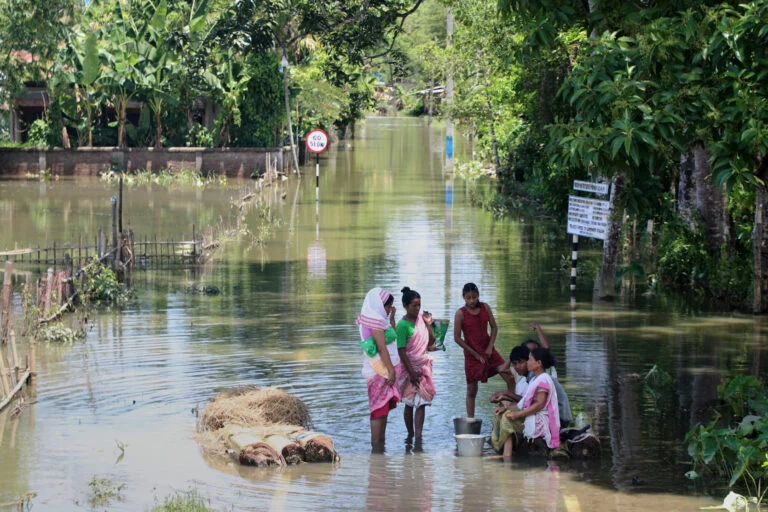
While the eyes of the world were fixed on the high-stakes drama of the World Cup finals on the night of July 19, 2026, a different, more harrowing struggle for survival was unfolding in the heart of Northeast India. As football fans cheered, the residents of Nepalikhuti, a small village in the Sivasagar district of Assam, were climbing onto rooftops to escape a sudden, violent surge of water that threatened to swallow their entire world.
The floods of July 2026 have emerged as a watershed moment for the region, not only due to the scale of the destruction but because they have reignited a fierce debate over climate change, infrastructure planning, and the consequences of unregulated extractive industries. As of mid-August, the death toll continues to rise, and the ecological and economic scars left by the receding waters remain raw.
I. Main Facts: The Scale of the Catastrophe
The 2026 monsoon season has proven to be one of the deadliest in recent memory for the Brahmaputra basin. According to the flood bulletin released by the Assam State Disaster Management Authority (ASDMA) on August 9, the impact has been widespread and devastating:
- Human Cost: The death toll in Assam reached 100 by August 10, with an additional 13 fatalities reported in the neighboring state of Nagaland.
- Displacement: Over 1.3 lakh (130,000) people have been directly affected across ten districts. As of the latest reports, 52 relief camps remain operational, providing shelter to more than 8,000 displaced individuals.
- Agricultural Ruin: An estimated 119,000 hectares of cropland have been submerged. For a state where the majority of the population depends on agriculture, this represents a multi-year economic setback.
- Livestock Loss: In the village of Nepalikhuti alone, approximately 5,000 cows were swept away. For these agrarian communities, livestock is not just property; it is the primary source of livelihood and a form of "living insurance."
- Geographic Focus: While 28 revenue circles were impacted, the districts of Golaghat and Sivasagar bore the brunt of the disaster, accounting for 255 of the 456 affected villages.
II. Chronology of a Disaster: July 19 and its Aftermath
The disaster began in earnest during the early afternoon of July 19, triggered by torrential rainfall in the upstream hills of Nagaland.

July 19, 1:00 PM: In Santak Panchali, Sivasagar, the water arrived with terrifying speed. Sourav Choudhury, a local resident, recalls that the water level rose from the ground to chest-height in just twenty minutes. His family, along with 40 others, sought refuge in the upper floor of a local primary school.
July 19, 7:30 PM: In Betbari village, the confluence of the Dikhow and Dorika rivers became a flashpoint. Ashok Kotoky, a local teacher, witnessed 99% of the houses in his village being submerged within hours. "I have never seen a flood like this in my lifetime," Kotoky stated, echoing a sentiment shared by elders across the region.
July 19, Midnight: As the flood crest moved downstream, Nepalikhuti was hit. Residents were forced onto rooftops in the dark. Approximately 60 to 65 families huddled in a single two-storeyed building as they watched their homes literally wash away.
July 20 – August 3: The immediate aftermath was characterized by a communication and logistics breakdown. In Nagaland’s Mon district, massive landslides and mudslides disconnected roads and severed electricity. It took nearly three days for government aid to reach some of the more remote pockets, with NGOs and private citizens filling the gap in the interim.
August 10: While water levels began to recede in some areas, the crisis shifted from a rescue operation to a recovery and health crisis. Silt and knee-deep mud prevented families from returning home, while a surge in snakebites and insect-borne ailments began to strain local hospitals.

III. Supporting Data: Environmental and Health Impacts
The 2026 floods were not merely a "water event"; they were an ecological upheaval.
The Transboundary Wildlife Crisis
The sheer power of the currents was illustrated by the fate of a captive elephant in Nagaland’s Mon district. The animal was swept away by the floodwaters, crossing the state border into Assam, where it was eventually found in Bihubor, Sivasagar. Chiranjeev P. Jain, the Divisional Forest Officer of Sivasagar, noted that while the elephant survived, it suffered superficial injuries and required extensive medical evaluation—a testament to the trauma inflicted on the region’s fauna.
Public Health Concerns
As the floodwaters stagnated, medical emergencies shifted. Dr. Surajit Giri, an anesthesiologist at Demow Model Hospital, reported a significant spike in insect bites and snakebites. During the height of the flood, Dr. Giri was forced to treat patients via telephone. Once the waters receded, the hospital saw 150 patients in a short period, including two critical cases involving Banded Kraits who required evacuation by the National Disaster Response Force (NDRF).
The Humanitarian Response
Tirtha Prasad Saikia, Director of the North-East Affected Area Development Society (NEADS), highlighted the findings of Rapid Needs Assessments (RNA). The most urgent requirements were not just food, but safe drinking water and "dignity kits" for women and girls. NEADS has reportedly reached 20,000 families, illustrating the vital role of civil society when state machinery is overextended.
IV. Official Responses and Political Friction
The government response has been a mix of immediate financial relief and defensive posturing regarding the causes of the disaster.

Financial Aid: Assam Chief Minister Himanta Biswa Sarma announced an interim relief of ₹15,000 per affected family, with an additional ₹10,000 for families in the hardest-hit districts of Sivasagar and Charaideo. Furthermore, electricity bills for July were waived for these districts, and insurance companies were directed to expedite claims with minimal documentation. In Nagaland, Chief Minister Neiphiu Rio announced an ex-gratia of ₹400,000 for the families of the deceased.
The "Cloudburst" Debate: A point of contention emerged when CM Sarma attributed the flood to a cloudburst in Nagaland. However, the India Meteorological Department (IMD) debunked this claim, stating that while rainfall was heavy, it did not meet the technical criteria for a cloudburst. This discrepancy has fueled arguments that the disaster was not purely a "natural" occurrence.
The Mining Controversy: Debabrata Saikia, a leader in the Indian National Congress, labeled the event a "meticulously engineered man-made disaster." He pointed to illegal open-cast coal mining in Nagaland and unchecked sand and stone mining along the Dikhow riverbanks in Assam. These activities, he argued, create artificial ponds and destabilize riverbeds, making the terrain far more susceptible to flash floods.
V. Implications: A Man-Made Crisis in a Changing Climate?
The 2026 floods have exposed the fragility of the "economic connectivity" model currently being pursued in Northeast India. Experts argue that the disruption of "ecological connectivity" is the silent driver of these increasingly frequent catastrophes.
Infrastructure vs. Drainage
Mirza Zulfiqur Rahman, a prominent researcher on the Brahmaputra basin, argues that infrastructure projects like highways have ignored natural drainage patterns. "People who gave their land for projects are now being hit the hardest because they weren’t involved in the planning," Rahman noted. By obstructing the flow of tributaries, these projects turn heavy rain into lethal floods.

The Need for Bio-Regional Governance
The fact that rain in the Nagaland hills can devastate villages in the Assam plains underscores the need for a unified management strategy. Currently, flood management is largely handled within state silos. However, the 2026 disaster demonstrates that Nagaland and Assam are hydrologically inseparable.
Rahman and other experts are calling for a "bio-regional governance framework." This would involve:
- Systematic Studies: Moving beyond reactionary relief to understanding the long-term changes in the Brahmaputra flood plains.
- Regulating the Extractive Industry: Enforcing the court-ordered task forces to stop illegal mining that alters river morphology.
- Wetland Restoration: Protecting the "sponges" of the ecosystem—wetlands and local ponds—that have been degraded by urban expansion and infrastructure.
Conclusion
As the people of Nepalikhuti and Mon town begin the arduous task of shoveling silt from their homes and mourning their lost livestock, the 2026 floods serve as a grim reminder. The tragedy was a culmination of heavy monsoon rains, yes, but it was exacerbated by years of ecological neglect and unscientific development.
The 100 lives lost in Assam are not just statistics; they are a call for a fundamental shift in how the Northeast balances its developmental ambitions with its environmental realities. Without a transition toward basin-wide management and stricter environmental oversight, the "worst floods of a lifetime" may soon become a tragic annual tradition.
