

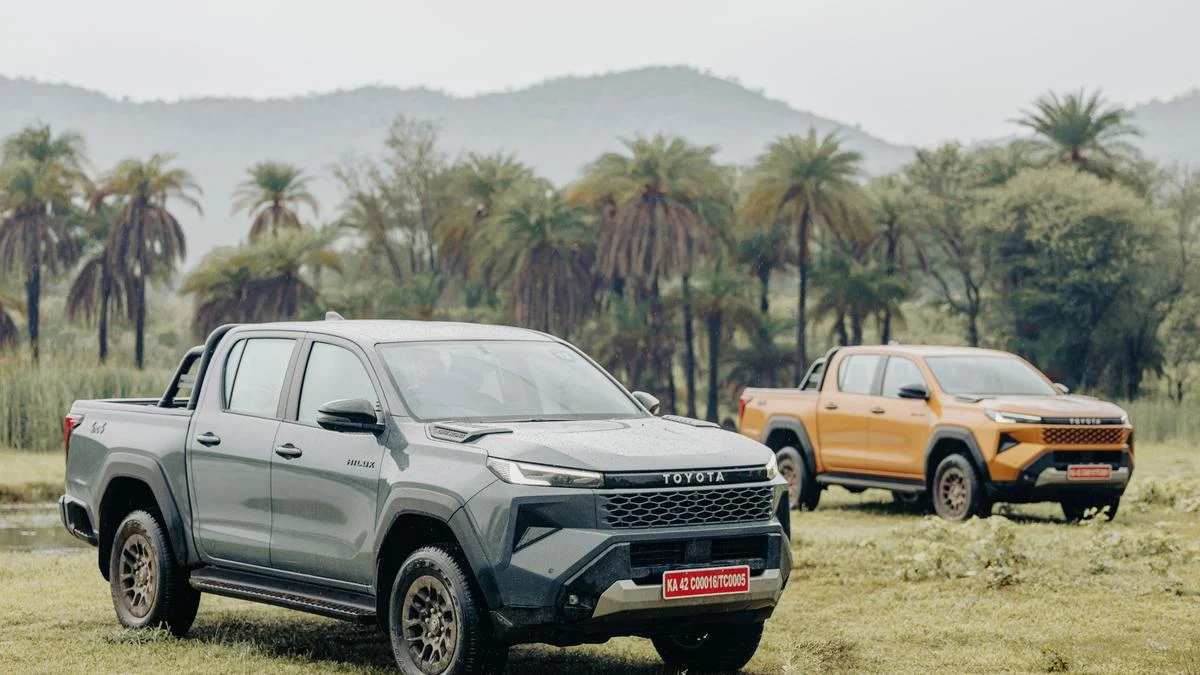
The Toyota Hilux occupies a space in the Indian automotive landscape that is, quite literally, occupied by nothing else. While the industry frequently uses the term "lifestyle vehicle" to describe anything with a hint of ruggedness, the Hilux is perhaps the only vehicle currently on sale that truly embodies the term in its global context. It is not merely a pickup truck; it is a mechanical legend that has earned its stripes in the most unforgiving environments on Earth—from the freezing plateaus of Antarctica to the blistering dunes of the Sahara.
In India, where the luxury SUV market is crowded with chrome-laden "soft-roaders," the Hilux arrives as a stark, purposeful alternative. The latest update to this iconic nameplate seeks to balance its "indestructible" reputation with the modern expectations of an increasingly sophisticated Indian buyer. Toyota’s approach has been surgical: refining the aesthetic and technological interface while doubling down on the mechanical grit that defines the Hilux DNA.
Main Facts: The 2024 Refresh at a Glance
The updated Toyota Hilux is positioned as a premium niche offering, priced between INR 31.99 lakh and INR 36.69 lakh (ex-showroom). This pricing places it above its only direct competitor, the Isuzu D-Max V-Cross, and squarely in the crosshairs of established D-segment SUVs like the Jeep Meridian and even its stablemate, the Toyota Fortuner.

The update introduces several pivotal changes:
- Design Philosophy: The introduction of the "Cyber Sumo" design language, moving away from the previous "workhorse" look to a more aggressive, futuristic aesthetic.
- Drivetrain Consolidation: The range has been streamlined to focus on the 2.8-litre turbo-diesel engine, now paired exclusively with a six-speed automatic transmission across both 4×2 and 4×4 variants.
- Technological Integration: A larger infotainment suite with wireless smartphone connectivity addresses a long-standing grievance regarding the previous model’s dated cabin tech.
- Functional Simplification: Interestingly, Toyota has opted to remove certain luxury appointments—such as leather upholstery and dual-zone climate control—repositioning the truck as a more utilitarian, "go-anywhere" tool.
Chronology: The Evolution of a Legend
To understand the significance of the current Hilux, one must look at its lineage. First launched globally in 1968, the Hilux was originally a compact utility vehicle. Over eight generations, it evolved into a mid-size pickup that became the backbone of industries and expeditions worldwide.
The Hilux’s journey in India is relatively recent. While its platform sibling, the Fortuner, has dominated the Indian luxury SUV segment for over a decade, Toyota hesitated to bring the Hilux to India due to the traditionally small market for private pickup trucks. However, seeing a growing "overlanding" culture and a demand for high-end adventure vehicles, Toyota finally launched the Hilux in India in early 2022.

The 2024 update represents the first major refinement of the Indian-spec Hilux. It serves as a response to market feedback that demanded a more "imposing" look and better cabin technology, even if it meant sacrificing some of the creature comforts found in traditional luxury cars. This pivot marks a strategic decision to distance the Hilux from the Fortuner, framing it not as a "Fortuner with a bed," but as a distinct, more rugged alternative for the true enthusiast.
Design and Aesthetics: The "Cyber Sumo" Transformation
The most immediate change is the visual presence. Toyota’s "Cyber Sumo" design language is a bold departure from the conservative styling of the past. The front end is dominated by a flatter, more vertical bonnet line that gives the truck a squared-off, muscular snout. The redesigned grille is larger and more intricate, flanked by revised LED headlamp clusters that provide a sharper, more modern "signature" at night.
The side profile remains dominated by its sheer scale. Measuring over 5.3 meters in length, the Hilux dwarfs almost everything else on the road. The update adds black 17-inch alloy wheels, which provide a stark contrast to the body paint and emphasize the truck’s high ground clearance. A subtle but highly practical addition is the integrated side step in the rear cargo bed, allowing owners to easily access the load area—a feature often requested by those who use the Hilux for hauling camping gear or motorcycles.

Interior and Technology: A Trade-off in Luxury
Inside, the Hilux presents a paradox. On one hand, the cabin is more technologically advanced than ever. A new, significantly larger touchscreen dominates the dashboard, finally offering wireless Apple CarPlay and Android Auto. The user interface is crisper, and the inclusion of a 360-degree camera system is a game-changer for a vehicle of this size, making tight parking spots and narrow off-road trails manageable.
On the other hand, Toyota has intentionally "de-specced" certain areas of the interior. The previous leather seats have been replaced by high-quality fabric, the electric adjustment for the driver’s seat has been removed, and the automatic climate control has been swapped for a manual unit.
While these omissions might seem regressive in a 35-lakh-rupee vehicle, they align with the Hilux’s "adventure-first" mission. Fabric seats are arguably better for a vehicle that will be exposed to dust, mud, and sweat, and manual controls are often more durable in extreme environments. Toyota’s calculation is clear: the Hilux buyer isn’t looking for a "limousine with a bed"; they are looking for a cabin that can be hosed out (metaphorically) after a weekend in the wilderness.

Supporting Data: Performance and Engineering
Under the hood lies the heart of the beast: the 2.8-litre, four-cylinder GD-series turbo-diesel engine.
Engine Specifications:
- Power: 201 PS @ 3,400 rpm
- Torque: 500 Nm @ 1,600–2,800 rpm
- Transmission: 6-Speed Torque Converter Automatic
- Performance: 0–100 km/h in approximately 12 seconds
- Fuel Efficiency: Real-world average of ~10 km/l
The 500 Nm of torque is the defining characteristic of this powertrain. It provides a relentless surge of momentum that makes the Hilux feel much lighter than its 2.2-ton kerb weight suggests. Toyota has also made significant strides in NVH (Noise, Vibration, and Harshness) levels. Improved insulation in the firewall and floor pans means the typical diesel "clatter" is well-muted, allowing for comfortable long-distance cruising at triple-digit speeds.
The chassis remains a classic ladder-frame construction, providing the structural rigidity required for heavy-duty off-roading and a payload capacity of roughly 500kg. While some international markets have moved to electric power steering, the Indian-spec Hilux retains a hydraulic setup. This provides a heavy, reassuring feel that communicates exactly what the front wheels are doing—a vital trait when navigating rocky terrain.

Off-Road Prowess: Where the Legend Lives
The Hilux’s true value proposition is revealed only when the pavement ends. It features a shift-on-the-fly 4WD system with high and low-range ratios.
Key off-road hardware includes:
- Electronic Locking Rear Differential: Ensures power is sent to the wheels with grip, even if one wheel is suspended in mid-air.
- Active Traction Control (A-TRC): Uses the brakes to mimic the effect of a limited-slip differential on the front axle.
- Wading Depth: A massive 700mm, allowing it to cross streams and flooded roads with ease.
- Approach and Departure Angles: Optimized bumpers allow the Hilux to climb steep inclines and drop into deep ruts without scraping its overhangs.
During testing, the Hilux demonstrated an almost arrogant level of capability. It tackled steep, silt-covered inclines in 2WD mode that would leave most "luxury SUVs" spinning their wheels. When shifted into 4L (4-Low), the torque multiplication is so immense that the truck can crawl over boulders at a walking pace with virtually no throttle input required.

Implications: The Market Positioning
The Toyota Hilux is not a vehicle for the masses. In a market like India, where "value for money" is often measured by the number of features per rupee, the Hilux is an anomaly. It is a vehicle where the value is hidden in the thickness of the steel, the durability of the suspension bushings, and the reliability of the electronics.
The Urban Compromise
Living with a Hilux in a city like Mumbai or Delhi is a commitment. Its length makes it difficult to navigate narrow lanes, and its height prevents it from entering many basement parking lots. For the urban buyer who never intends to leave the city, the Hilux is an impractical choice.
The Adventure Enabler
However, for a specific demographic—farm owners, estate managers, serious off-roaders, and long-distance tourers—the Hilux is peerless. It offers the peace of mind that no matter how remote the location or how bad the weather, the vehicle will get you back home. It is an emotional purchase, a statement of intent that says the driver values capability over vanity.

Conclusion: A Class of One
The updated Toyota Hilux remains a niche product, but it is now a more polished one. By leaning into its rugged identity rather than trying to mimic a luxury SUV, Toyota has solidified the Hilux’s position as the ultimate tool for the Indian adventurer.
At a price point of INR 31.99 lakh to 36.69 lakh, it is an expensive proposition, especially considering the lack of certain "premium" features. But as the saying goes in the world of overlanding: "If you want to go into the outback, take a Land Rover; if you want to come back, take a Toyota." The Hilux is the embodiment of that philosophy. You don’t buy a Hilux because you need a car; you buy a Hilux because you need a Hilux.
