

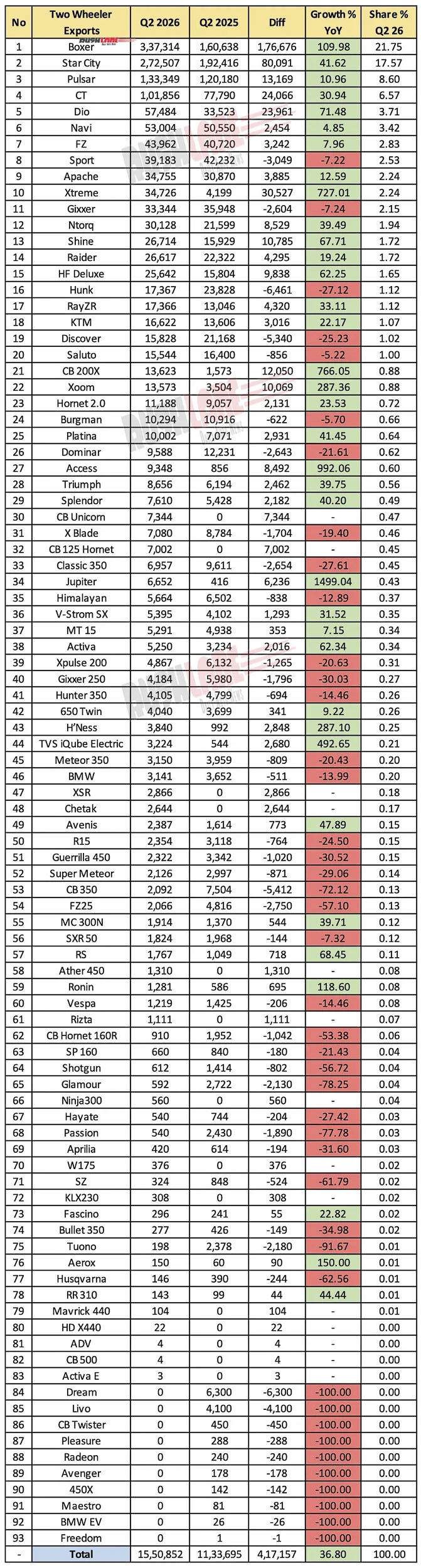
The global landscape of personal mobility is undergoing a seismic shift, and at the heart of this transformation lies the Indian two-wheeler industry. According to the latest export data for the second quarter of the 2026 calendar year (April–June), India has solidified its position as a premier manufacturing hub for the world. With a staggering year-on-year growth and an increasingly diverse portfolio of products, Indian manufacturers are no longer just meeting domestic demand; they are defining the streets of Africa, Latin America, Southeast Asia, and Europe.
Main Facts: A Quarter of Unprecedented Growth
The Q2 2026 export figures paint a picture of a robust and resilient industry. Total two-wheeler shipments from Indian shores reached 15,50,852 units, a significant leap from the 11,33,695 units recorded during the same period in 2025. This represents a healthy 36.80% year-on-year (YoY) growth, with an additional 4.17 lakh units flowing into international markets.
Key highlights from the quarter include:
- Dominance of Commuter Legends: The Bajaj Boxer and TVS Star City continue to be the "bread and butter" of Indian exports, collectively accounting for nearly 40% of the total export volume.
- The Rise of Performance: While commuters lead in volume, performance brands like the Hero Xtreme and Honda CB 200X registered astronomical growth rates exceeding 700%.
- Scooterization of Exports: The Honda Dio and Hero Xoom are proving that the Indian scooter format has a massive global appeal, particularly in emerging markets.
- Electric Vehicle (EV) Expansion: Though volumes remain low compared to Internal Combustion Engine (ICE) models, the EV segment saw exponential growth, led by the TVS iQube and Bajaj Chetak.
Chronology: From Domestic Resilience to Global Aggression
To understand the Q2 2026 surge, one must look at the trajectory of the Indian automotive sector over the last 24 months.
In early 2025, the industry was grappling with the tail-end of global supply chain inconsistencies and fluctuating raw material costs. However, by the final quarter of 2025, Indian OEMs (Original Equipment Manufacturers) began aggressive forays into new territories, specifically targeting the ASEAN and Latin American regions with tailored products.
By the start of 2026, the "Make in India" initiative, bolstered by various Production Linked Incentive (PLI) schemes, began to yield high-volume results. The transition from Q1 to Q2 2026 saw a strategic shift where manufacturers optimized their production lines to prioritize export-spec models, anticipating a surge in demand from developing economies seeking affordable yet durable transportation.
The April–June 2026 window marks the culmination of these strategic pivots. The Boxer’s 109.98% growth, for instance, isn’t an overnight success but the result of Bajaj Auto’s decade-long investment in the African "Boda Boda" (motorcycle taxi) ecosystem, which reached a new peak this quarter.
Supporting Data: The Leaders and the Disruptors
The Volume Kings: Bajaj and TVS
Bajaj Auto remains the undisputed king of Indian two-wheeler exports. The Bajaj Boxer retained its top spot with 3,37,314 units, growing from 1,60,638 in Q2 2025. This single model accounts for 21.75% of all two-wheelers shipped from India. Its rugged build and ease of maintenance make it the vehicle of choice for last-mile delivery and rural transport across the globe.

TVS Motor Company secured the second position with the Star City, exporting 2,72,507 units (a 41.62% increase). TVS has successfully positioned the Star City as a more premium alternative to basic commuters in several markets, capturing a 17.57% market share of total exports.
The Exponential Growth Segment
The most striking figures come from models that were previously considered "niche" in the export market:
- Hero Xtreme: Recorded a mind-boggling 727% growth, jumping from 4,199 units to 34,726 units. This suggests a massive successful push into markets hungry for entry-level streetfighters.
- Honda CB 200X: Registered a 766% growth, reaching 13,623 units. The demand for small-capacity adventure-tourers is clearly on the rise globally.
- TVS Jupiter: While primarily a domestic favorite, its exports skyrocketed from a mere 416 units last year to 6,652 units—a clear indicator of TVS expanding its scooter footprint.
The Premium and Mid-Capacity Pulse
The partnership between Indian manufacturers and global giants is also bearing fruit. The Triumph range (manufactured by Bajaj) saw an export of 8,656 units, up nearly 40%. KTM exports, another Bajaj-managed operation, grew by 22% to 16,622 units.
However, the premium segment was a mixed bag for Royal Enfield. While the 650 Twins grew by 9.22%, the Classic 350 saw a decline of 27.61%, and the Himalayan dipped by 12.89%. Analysts suggest this may be due to a transition period as the brand prepares for new model iterations and increased competition in the middle-weight segment from brands like Triumph and Harley-Davidson (via Hero).
The Electric Frontier
The EV sector is the newest frontier. TVS iQube led the charge with 3,224 units (up from 544), followed by the Bajaj Chetak at 2,644 units. Startups are also making their mark; Ather Energy exported 1,310 units of the 450 series and 1,111 units of the new Rizta. Even the Honda Activa Electric made its debut on the export charts, albeit with a symbolic 3 units, signaling the start of a new era.
Official Responses and Industry Sentiment
While official statements from individual CEOs are often guarded, the consensus among industry bodies like SIAM (Society of Indian Automobile Manufacturers) is one of cautious optimism.
A senior analyst at a leading Mumbai-based brokerage firm noted, "The Q2 2026 data confirms that India has decoupled its export success from domestic volatility. Even when the Indian monsoon might dampen local sales, the global demand for Indian engineering remains insatiable. The massive growth in Hero and Honda’s performance models shows that the world now trusts India for more than just 100cc commuters."
Spokespersons from Bajaj Auto have previously emphasized that their "Global Footprint" strategy is based on building local ecosystems in export markets rather than just shipping crates. This approach is clearly reflected in the Boxer’s dominant 21.75% share.

Industry experts also point toward the stabilizing of the Red Sea shipping routes and improved container availability as secondary factors that allowed these record-breaking volumes to be physically moved to international ports during this quarter.
Implications: What This Means for the Future
The implications of the Q2 2026 export data are far-reaching for the Indian economy and the global automotive stage.
1. Foreign Exchange and Economic Stability
With over 1.5 million units exported in a single quarter, the two-wheeler industry has become a vital contributor to India’s trade balance. The shift toward higher-value products (like the Xtreme, CB 200X, and Triumph) means the "value per unit" is increasing, bringing in more foreign exchange per shipment.
2. R&D Hub Status
The success of models like the Honda Navi (53,004 units) and the TVS Ntorq (30,128 units) proves that Indian R&D centers are capable of creating unique vehicle formats that resonate globally. India is no longer just a "factory"; it is an "innovation hub."
3. The EV Transition Lead
While China currently dominates the global electric two-wheeler market, the steady growth of the iQube, Chetak, and Ather exports suggests that India is positioning itself as the "quality alternative." As European and Southeast Asian nations tighten emission norms, Indian manufacturers are ready with proven, export-ready EV platforms.
4. Supply Chain Resilience
The 36.8% growth indicates that the Indian component ecosystem has matured. To support these volumes, thousands of Tier-2 and Tier-3 suppliers have scaled up, creating a "moat" that makes it difficult for other nations to compete on the cost-to-quality ratio.
Conclusion
The second quarter of 2026 will likely be remembered as the period when India’s two-wheeler industry transitioned from a regional player to a global hegemon. Led by the relentless Boxer and supported by a new wave of high-performance and electric machines, the "Made in India" badge is now a common sight on roads from Lagos to Lima. As manufacturers continue to diversify their portfolios and embrace the electric revolution, the momentum seen in Q2 is not just a peak, but the new baseline for an industry in its prime.
