

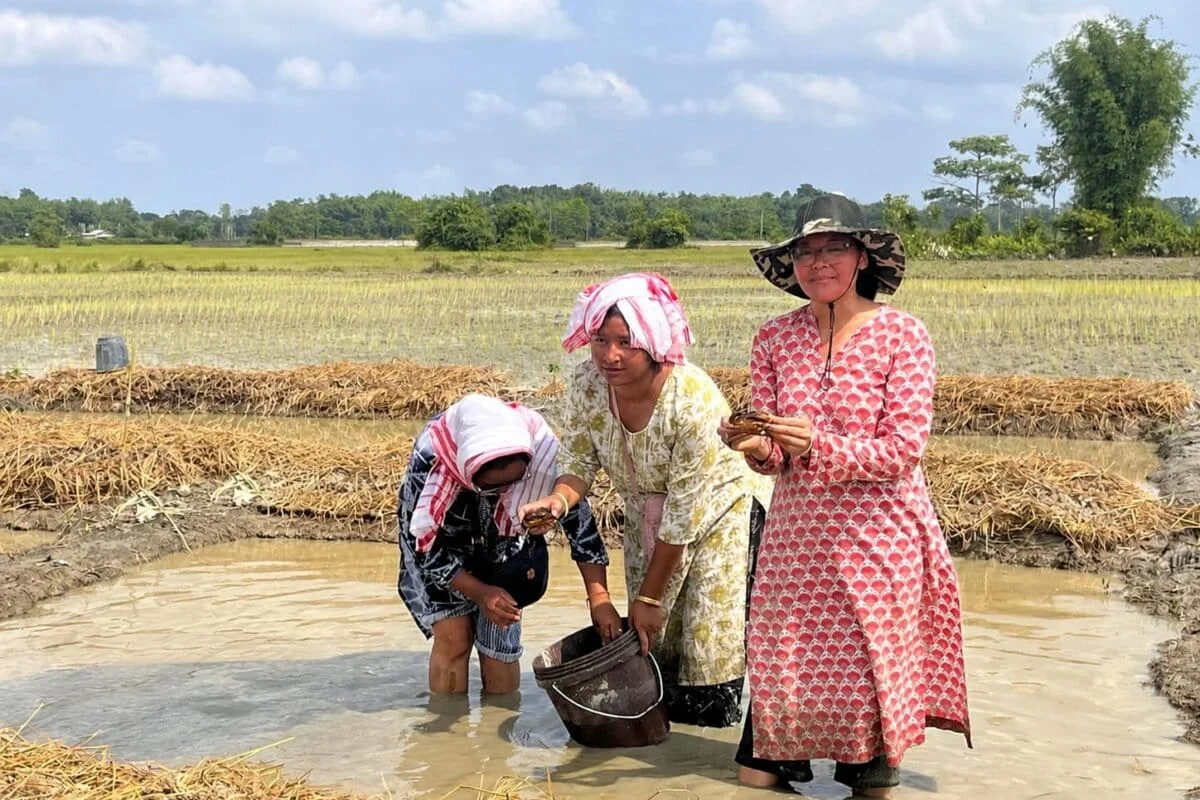
In the verdant landscape of Assam’s Upper Brahmaputra Valley, the rhythm of agriculture is undergoing a quiet but profound transformation. Under a relentless summer sun that defies the traditional cooling rains of the season, the women of Borborua block in Dibrugarh are waddling through knee-deep water, not merely to plant rice, but to sow the seeds of a climate-resilient future.
As they hum traditional folk songs, their hands move with practiced precision, tucking saplings of Betguti (Oryza sativa)—an indigenous rice variety—into the mud. But this year, the paddy will have unconventional companions: freshwater mud crabs. This women-led integrated rice-crab farming model is emerging as a beacon of hope against the dual threats of erratic climate patterns and the gradual degradation of agricultural land.
Main Facts: A Symbiotic Shift in Himalayan Foothills
The core of this agricultural innovation lies in the transition from traditional monoculture or fish-paddy systems to a more robust rice-crab ecosystem. For generations, Assamese farmers utilized "paddy-fish" farming, particularly in flood-prone areas where the indigenous Bau-dhaan (deep-water red rice) thrived. However, the climate crisis has rendered this ancient practice increasingly volatile.
The new model, spearheaded by the Assam State Rural Livelihood Mission (ASRLM) and local natural farming advocates, leverages the unique biological traits of indigenous rice and mud crabs. Unlike hybrid varieties that require strict water management and chemical inputs, the Betguti rice variety is celebrated for its ability to withstand both prolonged dry spells and sudden, heavy deluges.

The introduction of crabs into these fields serves a multi-functional purpose. Economically, they provide a high-value "second crop." Biologically, they act as natural aerators and pest control agents. This integrated approach is currently being scaled across 219 blocks in Assam, positioning the state as a leader in community-led, climate-adaptive agriculture.
Chronology: From Crisis to Innovation
The journey toward rice-crab farming was born out of necessity. Over the last decade, the traditional monsoon patterns of Northeast India have become increasingly unpredictable.
The Failure of Tradition (2015–2023):
Historically, farmers relied on the monsoon to flood their fields, allowing fish to enter from nearby water bodies. However, Samir Bordoloi, a prominent natural farming advocate, notes that the "long dry spells" between heavy rain events began killing off fish stocks. Fish require a consistent water level that the modern climate no longer guarantees.
The Hybrid Experiment (2018–2024):
To combat falling yields, the state saw a surge in hybrid rice cultivation. According to the Economic Survey of Assam 2025-2026, the area under hybrid rice grew from 8% in 2018-19 to nearly 13% by 2024-25, with high-yielding varieties (HYVs) covering 74% of the state’s total rice area. While productivity initially rose, these varieties proved fragile in the face of the extreme "flash droughts" now common in the region.
The 2025 Pivot:
In early 2025, a strategic dialogue between Bordoloi and the ASRLM shifted the focus back to indigenous wisdom. Recognizing that mud crabs are significantly more resilient to low-water conditions than fish, the ASRLM launched a pilot project in the Narayanpur block of Lakhimpur district.

The Pilot Success:
Nikumoni Bora, a local farmer and "Krishi Sakhi" (Community Agriculture Care Service Provider), volunteered to dedicate one bigha (0.33 acres) of her land to the experiment. Using Betguti seeds sourced from traditional seed keepers, she integrated the mud crabs. The results were immediate and lucrative, leading to the current expansion into the Dibrugarh district and beyond.
Supporting Data: The Science and Economics of the Rice-Crab Nexus
The success of this model is not merely anecdotal; it is supported by emerging environmental research and significant economic returns for smallholder farmers.
The Biological Advantage
Research into rice-crab systems reveals a "virtuous cycle" of nutrient exchange.
- Soil Aeration: As crabs burrow into the mud, they naturally aerate the soil, allowing oxygen to reach the roots of the rice plants more effectively. This reduces the need for mechanical tilling.
- Pest Management: Crabs feed on common paddy pests and weeds, effectively eliminating the need for chemical pesticides. This not only lowers costs but also ensures the final product is organic.
- Nitrogen Cycling: Aquatic life in paddies has been shown to stabilize soil nitrogen levels. Studies indicate that rice-crab systems improve the Carbon-to-Nitrogen (C:N) ratio, enhancing long-term soil fertility and water purification.
Economic Viability
For a small-scale farmer like Nikumoni Bora, the financial implications are transformative.
- Yield: From just 8 kilograms of Betguti seeds, she harvested nearly two quintals (200 kg) of rice.
- Crab Profits: The crabs grew fourfold in size within just three months. Sold at local markets for ₹300-400 per kilogram, the crabs provided a liquidity boost that traditional rice farming could not match.
- Total Earnings: In the last year, Bora earned ₹1.35 lakh (USD 1,600 approx.) through the sale of rice, seeds, and crabs—a figure that significantly supplements her honorarium as a Krishi Sakhi.
Climate Resilience
The Betguti variety offers a wider planting window. While hybrid seeds must be planted within a strict timeframe to ensure yield, Betguti can be planted as late as the end of July, allowing farmers to wait out early-season droughts. It reaches maturity in 150 days, providing a stable harvest even when the monsoon is delayed.

Official Responses: Institutionalizing Natural Farming
The Assam State Rural Livelihood Mission (ASRLM) is now moving to move this practice from a niche experiment to a state-wide standard.
Anirban Roy, an official with the ASRLM, emphasizes that the goal is holistic. "We are not just looking at yield; we are looking at the health of the community," Roy stated. The ASRLM is currently training 260 women farmers from 80 different blocks in Dibrugarh.
Policy Integration:
The ASRLM plans to collaborate with the National Health Mission to promote the nutritional benefits of indigenous rice. "We want to draw up a nutritional chart for varieties like Betguti," Roy explained. "There is a massive opportunity to introduce these nutrient-dense, pesticide-free grains into the mid-day meal programs in schools, ensuring that the next generation grows up on healthy, locally-sourced food."
Scientific Validation:
Pallab Kumar Sarma, Chief Scientist at the Biswanath College of Agriculture (AICRPDA), supports the scaling of this model. He notes that integrated farming is the only sustainable path forward for dryland and variable-rain agriculture. "It increases income while ensuring nutritional security. By reducing the reliance on agrochemicals, we are protecting the biodiversity of the Brahmaputra basin," Sarma added.
Implications: Empowering Women and Preserving Heritage
The implications of the rice-crab revolution extend far beyond the borders of Assam’s paddy fields. It represents a significant shift in the socio-economic standing of rural women.

Gender Empowerment:
The project is almost entirely women-led. By positioning women as "Krishi Sakhis," the ASRLM is transforming them into community leaders and technical experts. As Nikumoni Bora puts it, "Us women, we don’t give up easily. If we know something is good for our families and the environment, we will take it forward." This model provides women with independent income streams, which are often reinvested into children’s education and family healthcare.
Biodiversity Preservation:
The push for Betguti and 25 other indigenous varieties is a direct challenge to the "monoculture of the mind" that has dominated Indian agriculture since the Green Revolution. By creating a market for these seeds, the project ensures that genetic diversity is preserved in the soil rather than just in seed banks. This diversity is the ultimate insurance policy against a changing climate.
A Scalable Model for the Global South:
As many regions across Southeast Asia and Africa face similar challenges—erratic rainfall, rising temperatures, and the high cost of chemical inputs—Assam’s rice-crab model offers a blueprint. It demonstrates that "low-input, high-resilience" farming is not a step backward, but a sophisticated leap forward.
The Road Ahead:
While the challenge of climate change is daunting, the women of Borborua and Narayanpur are proving that adaptation is possible through the marriage of indigenous wisdom and modern organizational structures. As they expand their collective efforts—recently leasing 20 bighas of land for communal farming—they are not just growing food; they are rewriting the rules of survival in the 21st century.
The air in Dibrugarh remains hot, and the rains remain uncertain, but in the muddy waters of the rice fields, a new, resilient ecosystem is taking root, one crab and one indigenous sapling at a time.
