

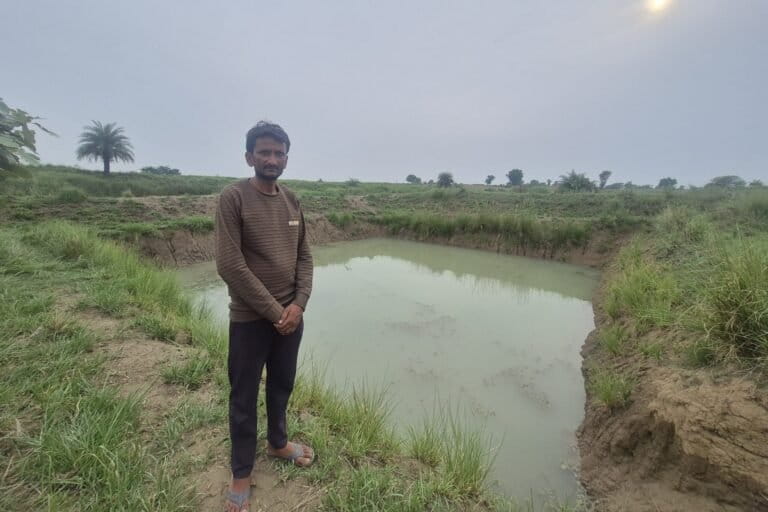
BANDA AND CHITRAKOOT, UTTAR PRADESH – In the parched landscape of Manipur village, located in the Mahua block of Uttar Pradesh’s Banda district, 35-year-old Vipin Kumar Yadav stands at the edge of a ten-foot-deep excavation that was supposed to be his shield against drought. Instead, the "khet talab" (farm pond) serves as a stark barometer of a failing monsoon.
“Very low rain this year; only one rain in this season till now,” Yadav remarked this July, staring at the parched earth. His pond, which should have been brimming with the lifeblood of the upcoming Rabi season, is less than half full. “Last year, the entire pond was full. I used that water to irrigate my wheat. This year, it hasn’t even reached five feet. I am worried: how will the wheat and mustard crops survive?”

Yadav’s anxiety is a microcosm of a larger crisis unfolding across the Bundelkhand region—a semi-arid, climate-vulnerable belt spanning Uttar Pradesh and Madhya Pradesh. As a strengthening El Niño threatens to disrupt weather patterns further, the very infrastructure designed to build resilience is crumbling under the weight of technical failures, lack of maintenance, and institutional rigidity.
The Core Reality: A Region on the Edge
Bundelkhand has long been synonymous with water scarcity. Agriculture here is a high-stakes gamble with nature. In Banda, rainfall by August 1 was recorded at 26% below the seasonal normal. In neighboring Mahoba, the deficit was even more staggering at 43%.
For farmers like Vipin, the farm pond is not a luxury but a necessity for survival. In 2023, his pond—dug just a year prior—allowed him to irrigate four acres of wheat twice. The results were transformative: his yield jumped from a meager 3.5–4.5 quintals per acre to an impressive 9–10 quintals. However, the success of these ponds is entirely contingent on a robust monsoon to fill them and a technical design that can retain the water. This year, both are failing.
The threat is compounded by global climatic shifts. The Union Ministry of Earth Sciences recently warned that El Niño intensified to moderate levels in July and could reach "very strong" levels by the October-December window. The US National Oceanic and Atmospheric Administration (NOAA) corroborated this, citing a 90% chance of a very strong El Niño, potentially the most intense recorded since 1950. For Bundelkhand, this translates to a disastrous outlook for the winter crops that rely on residual moisture and stored pond water.
Chronology: From Royal Wisdom to Bureaucratic Schemes
The concept of rainwater harvesting is not new to Bundelkhand. Historically, the region was a masterclass in water management.
- The Medieval Era: The Chandela and Bundela rulers (10th to 16th centuries) developed sophisticated, interconnected systems of tanks, lakes, and step-wells. These structures were designed to catch runoff in the hilly terrain, ensuring that even in dry years, the groundwater remained recharged.
- The Drought Acceleration (1968–1992): Studies indicate that while major droughts occurred once every 16 years in the 18th and 19th centuries, the frequency tripled during the late 20th century. Between 2001 and 2016, the region suffered through 13 droughts in 15 years.
- The 2009 Bundelkhand Package: Following years of agrarian distress, the Union Cabinet approved a ₹72.66 billion special package. A key pillar was the construction of 30,000 farm ponds and 20,000 dug wells across the region.
- 2016–Present: The Uttar Pradesh government launched the Khet-Talab Yojana under the Pradhan Mantri Krishi Sinchayee Yojana. In its initial phase, 2,000 ponds were dug with a 50% government subsidy (roughly ₹52,500 per small pond). Today, the scheme continues under the Rashtriya Krishi Vikas Yojana, yet the transition from traditional community management to individual, state-subsidized ponds has brought unforeseen challenges.
Supporting Data: The Yield Gap and Technical Hurdles
The efficacy of farm ponds is backed by research, but their failure is equally documented through ground-level data.

- Irrigation Disparity: According to Uttar Pradesh Agriculture Statistics 2022-23, irrigation coverage is alarmingly low: only 47% in Chitrakoot and 61% in Banda. The rest remains at the mercy of the clouds.
- The Cost of Failure: When a pond fails, the financial toll is heavy. Bulli Mawasi, a 65-year-old farmer in Chitrakoot, lost 0.25 acres of his land to a pond that was never finished due to a "lack of funds." Now, he pays ₹250 an hour to rent irrigation equipment and ₹1,000 for diesel, totaling ₹3,500 for a single 10-hour session—money he is forced to borrow at high interest.
- Siltation and Capacity: In Mahoba, 28-year-old Mukesh Kumar’s pond, dug in 2023, has already lost three feet of depth to silt. In Chitrakoot, Mullu Kol’s pond has seen its capacity halved from six feet to three feet since 2009.
Official Responses: Policy vs. Ground Reality
The Indian government has recognized the looming El Niño threat. Agriculture Minister Shivraj Singh Chouhan recently directed that water-conservation structures be repaired and strengthened under the Viksit Bharat-Guarantee for Rozgar and Ajeevika Mission (Gramin) Act (VB-G RAM G).
However, local officials point to a critical "missing link" in the policy: maintenance.
- Baljeet Bahadur, Chitrakoot Soil Conservation Officer: “There is no budget for seepage control, desiltation, or maintenance,” he admitted. He noted that farmers often limit the pond’s depth to whatever the government subsidy covers, leading to sub-standard structures that fail within a few seasons.
- P.C. Vishwakarma, Mahoba Soil Conservation Officer: While emphasizing that a standard pond can hold 1.15 million liters—theoretically enough for three rounds of irrigation for a hectare of wheat—he acknowledged that without maintenance provisions, these assets are depreciating rapidly.
Technical Implications: Why the Ponds are Failing
The failure of the Khet-Talab scheme in many areas is not just a matter of low rain; it is a failure of "one-size-fits-all" engineering.

1. Poor Site Selection:
Shashikant Tripathi, a hydrogeology expert and retired professor from Mahatma Gandhi Chitrakoot Gramodaya Vishwavidyalaya, argues that scientific assessment is often ignored. “In Bundelkhand’s plateau terrain, site selection must consider underlying rock, slope, and drainage density. A scientifically placed pond can retain water for five months; a poorly placed one is just a hole in the ground.”
2. Seepage and Soil Type:
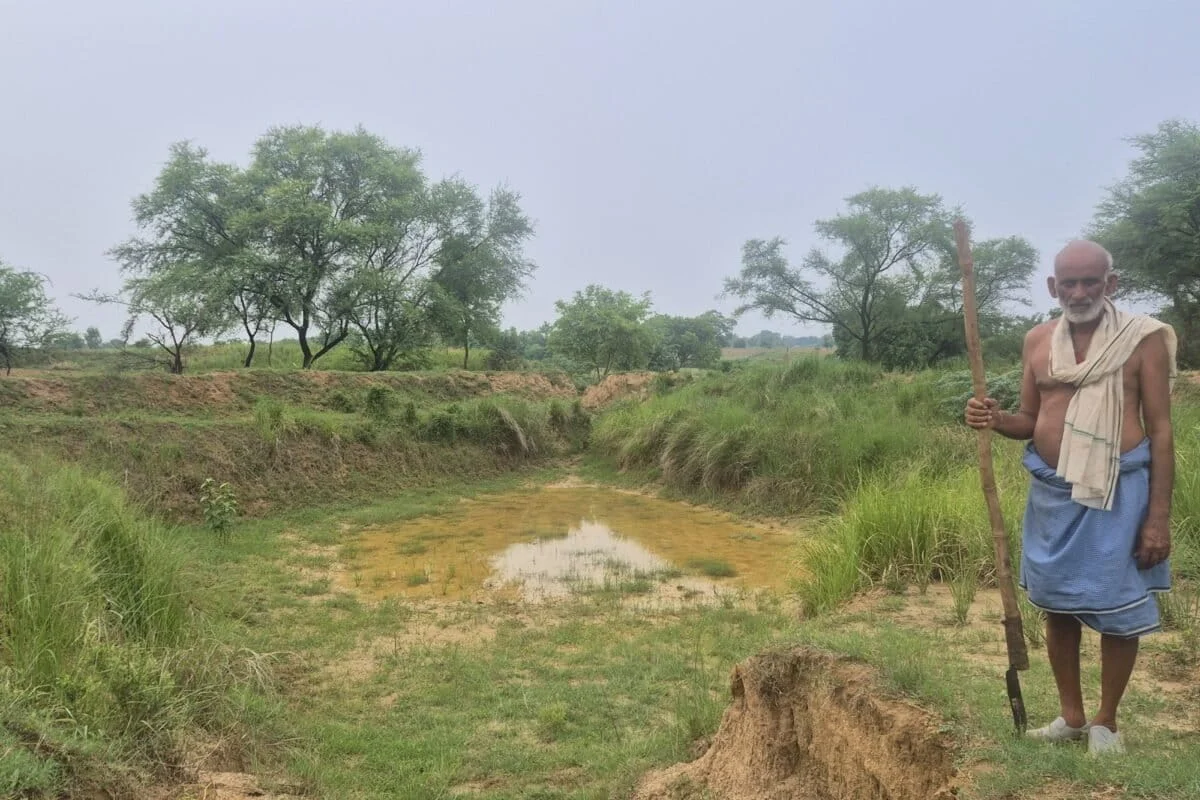
In villages like Doda Mafi, the soil is predominantly sandy. Sunder Kol, 65, finds his pond bone-dry despite recent rains. “Water doesn’t stay. The soil just drinks it up,” he said. Experts like Gaya Prasad Gopal of the Akhil Bhartiya Samaj Seva Sansthan suggest lining ponds with black polythene and clay soil, but such measures are not covered by the current subsidy structure.
3. Siltation and the Maintenance Trap:
Siltation is the silent killer of farm ponds. As runoff enters the pond, it carries topsoil that settles at the bottom, gradually reducing storage capacity. Under current schemes, the responsibility for desilting lies solely with the farmer. For smallholders already struggling with debt, the cost of hiring a JCB or labor to desilt a pond is prohibitive.

4. The Shift from Community to Individual:
A 2023 case study by Erasmus University Rotterdam highlighted a sociological shift. Originally, water harvesting in Bundelkhand was a community-led effort to rejuvenate old tanks and raise awareness. When the government adopted the scheme, the focus shifted to "visible physical structures." Communication with farmers and the use of local experiential knowledge were sidelined in favor of meeting construction targets.
The Path Forward: From Structures to Systems
For farm ponds to truly serve as a climate adaptation tool, experts argue for a fundamental shift in strategy.
- Science-Led Interventions: Kaushal Garg, a senior hydrology scientist at ICRISAT, insists that pond construction must begin with a scientific assessment of rainfall patterns and soil conditions. “These interventions must be science-led, not just target-driven,” he says.
- Institutionalized Maintenance: There is a growing call to link pond maintenance with MGNREGA (VB-GRAM-G). By allowing Gram Panchayats to use employment funds for desilting and bunding individual farm ponds, the state could ensure the longevity of these assets.
- Design Flexibility: Rather than fixed dimensions (22x20x3 meters), pond sizes should be tailored to the specific cultivable area and crop requirements of the individual farm.
- Integrated Irrigation: Mukesh Kumar from Mahoba suggested that the government should couple pond subsidies with support for drip or sprinkler irrigation. This would allow farmers to stretch their limited water reserves further, moving away from flood irrigation which wastes the precious stored runoff.
Conclusion
As Vipin Kumar Yadav looks at his half-empty pond in Banda, the stakes couldn’t be higher. The farm pond was meant to be a symbol of self-reliance, a way for the farmer to "harvest the clouds." But without a robust support system for maintenance and a more scientific approach to construction, these ponds risk becoming monuments to failed policy rather than shields against a changing climate.

In Bundelkhand, where the memory of the Chandelas’ flourishing lakes still haunts the parched earth, the modern "khet talab" remains a fragile promise. For the region’s farmers, the upcoming winter will be the ultimate test of whether these structures can survive the "very strong" El Niño on the horizon—or if they will simply remain dry craters in a thirsty land.
