

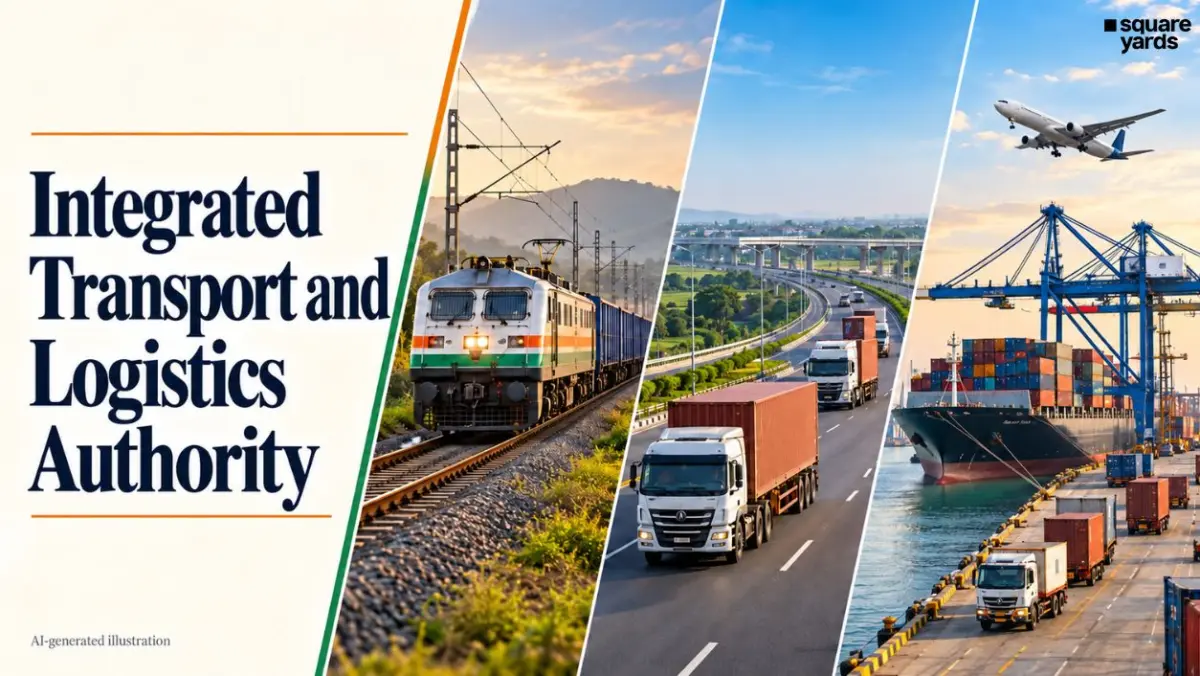
New Delhi — In a landmark move designed to dismantle the long-standing silos of India’s infrastructure ministries, the Union Cabinet, chaired by the Prime Minister, officially approved the establishment of the Integrated Transport and Logistics Authority (ITLA) on October 6, 2026. Conceived as a high-powered Special Purpose Vehicle (SPV), the ITLA is set to become the nation’s apex body for transport and logistics planning, signaling a shift from reactive project building to proactive, data-driven ecosystem management.
As India marches toward its goal of becoming a $5 trillion economy, the ITLA represents the institutional "brain" required to synchronize the country’s massive investments in roads, railways, ports, and aviation. By integrating these disparate sectors under a single planning umbrella, the government aims to further slash logistics costs and provide a predictable roadmap for the real estate and industrial sectors.
1. Main Facts: The Mandate and Structure of ITLA
The Integrated Transport and Logistics Authority is not merely another advisory committee; it is designed as a technical and monitoring powerhouse with a multi-layered mandate.
The Ten-Year National Transport Master Plan
At the heart of ITLA’s mission is the creation of a National Transport Master Plan (NTMP). This plan will carry a horizon of ten years or more, providing a long-term vision that transcends political cycles. The NTMP will cover eight critical sectors:
- Roadways and Expressways
- Railways (Freight and Passenger)
- Maritime Ports and Shipping
- Civil Aviation
- Inland Waterways
- Coastal Shipping
- Urban Mobility (Metros and Bus Rapid Transit)
- Logistics Infrastructure (Multi-modal parks and warehouses)
Oversight and Review
One of the most significant powers granted to the ITLA is the authority to review the five-year sectoral plans and annual budget outlays of individual transport ministries. The objective is to ensure that a railway line being planned by the Ministry of Railways actually aligns with a port expansion being planned by the Ministry of Shipping, preventing the "bottleneck effect" that has historically plagued Indian infrastructure.
Technical Appraisal and Monitoring
The ITLA will serve as a gatekeeper for large-scale investments. It is mandated to technically appraise and monitor all central infrastructure projects with a capital expenditure of Rs 500 crore or more. While financial appraisal—the actual "cutting of checks"—remains with existing finance ministry mechanisms, the ITLA will evaluate the technical viability and post-completion impact of these projects.
The National Transport Data Repository
In an era where data is the new oil, the ITLA will manage a massive National Transport Data Repository. By synthesizing data from GST e-way bills, FASTag (toll data), Vahan (vehicle registration), GPS tracking systems, and urban traffic sensors, the ITLA will generate real-time heat maps of how goods and people move across the subcontinent. This "digital twin" of India’s movement will allow for precision planning of new hubs.
2. Chronology: The Evolution of Indian Connectivity
The birth of the ITLA is the culmination of over a decade of incremental reforms aimed at fixing India’s fragmented logistics landscape.
- 2014–2017: The Era of Mega-Projects. The government launched ambitious schemes like Bharatmala (highways) and Sagarmala (ports). While successful in increasing the pace of construction, these projects often operated in isolation.
- 2019: Launch of the National Common Mobility Card (NCMC). An early attempt at integration, the NCMC aimed to create a "One Nation, One Card" system for all public transport.
- 2021: PM Gati Shakti National Master Plan. The government launched a GIS-based platform to map all infrastructure. This provided the visual data, but lacked a central authority to enforce inter-ministerial coordination.
- 2022: National Logistics Policy (NLP). The NLP set a target to reduce logistics costs from 13-14% of GDP to a single-digit figure.
- October 6, 2026: Establishment of ITLA. Recognizing that GIS maps and policies weren’t enough, the Cabinet created the ITLA to provide the institutional "teeth" to enforce the Gati Shakti vision.
3. Supporting Data: The Economic Imperative
The drive toward the ITLA is fueled by compelling economic data. According to recent industry reports, India’s logistics costs have already seen a significant decline, falling to approximately 10% to 10.7% of GDP in FY26, down from 13-14% a decade ago.
This improvement is the direct result of an estimated $360 billion in infrastructure investment over the last ten years. However, economists argue that the "low-hanging fruit" has been picked. To reach the global benchmark of 8% (seen in many developed economies), India must solve the "last-mile" problem.
Current Regional Growth Metrics (FY26):
- Established Hubs: Delhi-NCR, Mumbai, and Bengaluru continue to lead in logistics leasing, but vacancy rates remain low due to land constraints.
- High-Growth Emerging Markets: Ahmedabad and Kolkata have seen logistics leasing grow at over 30% year-on-year, driven by their roles as gateway cities for the Western and Eastern corridors respectively.
- Infrastructure Efficiency: Projects monitored under the pilot phase of integrated planning showed a 15% reduction in "project creep" (time and cost overruns) compared to those managed under traditional silos.
4. Official Responses and Institutional Perspectives
The announcement has been met with a mixture of optimism from the industry and cautious observation from policy analysts.
The Union Cabinet’s Perspective:
In a statement following the approval, a senior government spokesperson noted: "The ITLA is the final piece of the puzzle for ‘Atmanirbhar Bharat.’ We are moving away from a system where ministries work in departmental silos. ITLA ensures that every rupee of the taxpayer’s money spent on a road or a rail line is maximized by ensuring it connects seamlessly to the rest of the network."
Industry Reactions:
The Logistics Federation of India welcomed the move, stating that a unified data repository would allow private players to optimize their supply chains. "If we know exactly where the bottlenecks are through the ITLA’s data, we can relocate our warehouses to more efficient nodes, reducing the ‘dead-mileage’ of our trucks," said a spokesperson for a leading 3PL (Third-Party Logistics) provider.
Real Estate Developers:
The Confederation of Real Estate Developers’ Associations of India (CREDAI) highlighted the "predictability factor." Developers have long struggled with "ghost projects"—infrastructure promised but never delivered. A ten-year Master Plan provides the certainty needed for long-term residential and commercial investments.
5. Implications for Real Estate and Urban Development
The creation of the ITLA is perhaps most significant for the property market. Real estate value is fundamentally a function of accessibility.
Strengthening Logistics Clusters
In established hubs like Chennai, Pune, and Delhi-NCR, the ITLA’s focus on multimodal links—connecting a highway directly to a dedicated freight corridor terminal, for instance—will solidify existing warehouse belts. This makes land in these areas more "bankable" for institutional investors and Real Estate Investment Trusts (REITs).
The Rise of Transit-Oriented Development (TOD)
In urban centers, the ITLA will push for Unified Metropolitan Transport Authorities (UMTAs). For homebuyers, this is a game-changer. Historically, a metro station might be built without a connecting bus depot or "first-mile" bicycle tracks. ITLA’s oversight ensures that "commute time," the primary metric for home valuation, is reduced through better interchanges. Properties located near these "well-connected nodes" are expected to command a 15-20% premium over isolated developments.
De-risking Secondary Cities
Cities like Lucknow, Jaipur, and Nagpur are poised to benefit. As the ITLA identifies new freight corridors, these secondary cities will transition from mere transit points to "logistics heartlands," sparking demand for both industrial land and affordable housing for the resulting workforce.
6. The Fine Print: Challenges and Strategic Risks
Despite the ambitious vision, the ITLA faces several hurdles that could determine whether it becomes a transformative force or just another bureaucratic layer.
The "Advisory" Trap
India’s history is littered with coordination bodies that lacked executive power. If the ITLA’s appraisals are merely advisory and do not have the power to halt or redirect funding, ministries may continue to prioritize their internal agendas over the National Master Plan.
Overlap with PM Gati Shakti
There is a potential for institutional friction between the ITLA and the existing Gati Shakti framework. While Gati Shakti is a digital platform, ITLA is a physical authority. Defining the boundary between "digital mapping" and "institutional planning" will be critical in the first 24 months of operation.
The Implementation Lag
The National Common Mobility Card (NCMC) serves as a cautionary tale. Launched in 2019 to unify transport payments, it was functional in only 13 metro projects and 11 bus corporations by mid-2026. Data integration is technically complex and requires the cooperation of state governments, many of whom may be hesitant to share granular traffic and tax data with a central authority.
Risks for Property Buyers
For the individual investor, the ITLA presents a "speculation risk."
- Timeline Mismatch: A ten-year master plan is a long-term document. Prices in an area might spike the moment a project is mentioned in the plan, but actual construction could be a decade away.
- The Rs 500 Crore Threshold: The ITLA focuses on "macro" connectivity. However, the value of a specific apartment complex is often decided by "micro" connectivity—local municipal roads and sewage—which fall outside the ITLA’s federal mandate.
Conclusion: The Connectivity Dividend
The establishment of the Integrated Transport and Logistics Authority marks a sophisticated evolution in how India views its physical geography. It is an acknowledgement that in a modern economy, the space between points A and B is as important as the points themselves.
For the economy, the "connectivity dividend" promised by the ITLA could be the catalyst that finally brings India’s logistics costs in line with global leaders, making Indian exports more competitive. For the real estate sector, it provides a rare glimpse into the future, offering a blueprint of where the next generation of growth will occur.
However, the success of the ITLA will not be measured by the maps it draws, but by the bottlenecks it breaks. Investors and citizens alike should watch for the first release of the National Transport Master Plan. The true winners of the next property and industrial boom will be those who read that plan first and align their investments with the places where planning and execution finally meet.
