

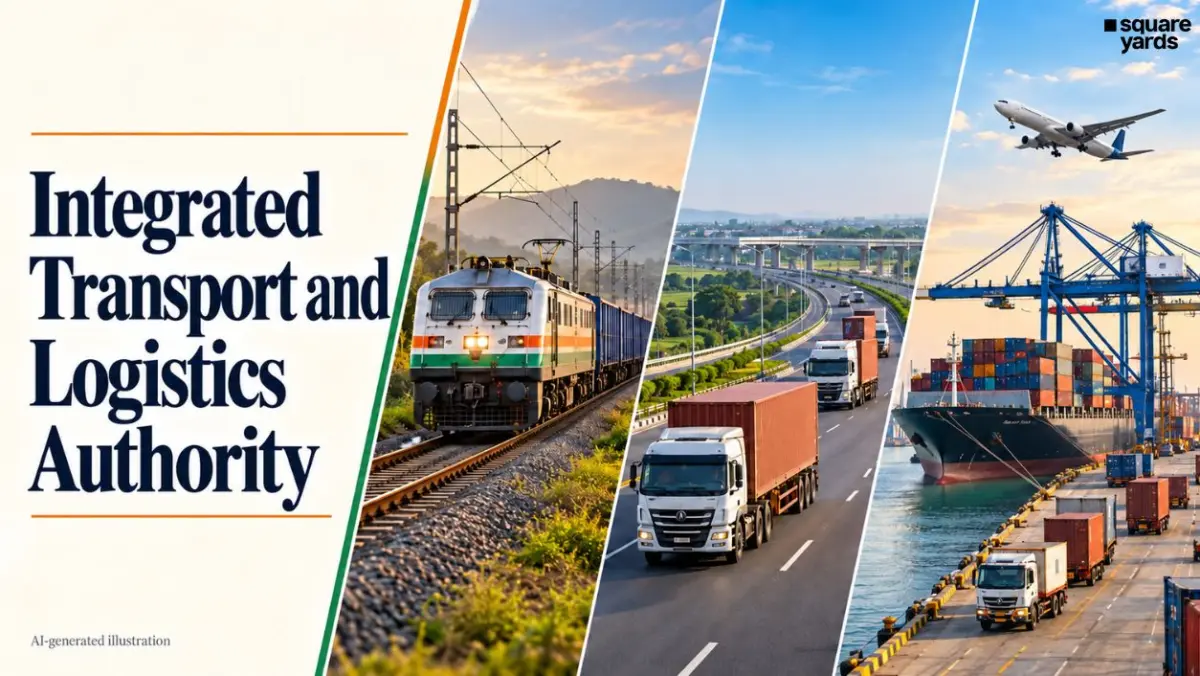
New Delhi, October 9, 2026 — In a move designed to harmonize India’s sprawling and often fragmented infrastructure landscape, the Union Cabinet, chaired by the Prime Minister, officially approved the creation of the Integrated Transport and Logistics Authority (ITLA) on October 6, 2026. Established as a high-powered Special Purpose Vehicle (SPV), the ITLA is set to become the definitive apex body for the nation’s transport and logistics planning, signaling a shift from departmental silos to a unified, data-driven master strategy.
1. Main Facts: A New Era of Unified Governance
The ITLA is not merely an advisory committee but a technical powerhouse tasked with redefining how India moves people and goods. Its primary mandate is the formulation of a comprehensive National Transport Master Plan, designed with a long-term horizon of at least ten years. This master plan will encompass every critical artery of the economy: roads, railways, ports, aviation, inland waterways, coastal shipping, urban mobility, and the broader logistics ecosystem.
Key functions of the ITLA include:
- Strategic Alignment: The authority will review the five-year sectoral plans and annual budgets of individual transport ministries (such as MoRTH, Railways, and Civil Aviation) to ensure they align with the overarching National Master Plan.
- Technical Oversight: For the first time, a single body will provide technical appraisal and continuous monitoring for all central infrastructure projects with a capital expenditure of ₹500 crore or more.
- Post-Completion Assessment: Moving beyond mere construction, the ITLA will evaluate the socio-economic impact of projects after they are commissioned to ensure they meet their intended utility goals.
- The Big Data Repository: The ITLA will manage a massive National Transport Data Repository. This digital twin of India’s movement will integrate real-time data from GST e-way bills, FASTag, Vahan (vehicle registration), GPS tracking systems, and urban traffic sensors to map the granular flow of commodities and commuters.
While the ITLA will handle technical and planning appraisals, the financial appraisal of projects will remain within existing frameworks like the Public Investment Board (PIB), ensuring a system of checks and balances between engineering feasibility and fiscal responsibility.
2. Chronology: The Road to ITLA (2014–2026)
The birth of the ITLA is the culmination of a decade-long journey toward logistical efficiency. To understand its significance, one must look at the evolution of India’s infrastructure policy:
- 2014–2020: The Capacity Building Phase. This era saw record-breaking investments in highway construction (Bharatmala) and railway electrification. However, planning remained largely departmental, leading to "infrastructure silos" where ports lacked rail connectivity and warehouses were disconnected from expressways.
- 2021: The Launch of PM Gati Shakti. The government introduced the Gati Shakti National Master Plan, a GIS-based platform to break departmental silos. It provided the visual mapping needed for coordination but lacked a centralized statutory authority to enforce planning discipline.
- 2022: National Logistics Policy (NLP). The NLP was introduced to bring down logistics costs from 13-14% of GDP to single digits, focusing on digital transformation and human resources.
- 2024–2025: Consolidation. Following massive capital expenditure (averaging over ₹10 lakh crore annually), the need for a "regulatory and planning mind" became apparent to prevent redundancy in project execution.
- October 6, 2026: The ITLA Approval. The Union Cabinet recognizes that while Gati Shakti provides the map, the ITLA will provide the mandate. The SPV is officially sanctioned to act as the institutional architect for the next decade of growth.
3. Supporting Data: The Economic Imperative
The drive for a unified authority is backed by compelling economic data. According to recent industry reports, India’s logistics costs have already shown a downward trajectory, falling to approximately 10%–10.7% of GDP in FY26, down from the 13%–14% range seen a decade ago. This improvement follows an estimated $360 billion (approx. ₹30 lakh crore) of cumulative infrastructure investment.
However, the "last mile" of efficiency remains the most difficult to achieve.
- Growth Disparities: While major hubs are well-served, emerging freight corridors like Ahmedabad and Kolkata are witnessing leasing growth of over 30% year-on-year, often outstripping the local infrastructure’s ability to cope.
- Urbanization Pressures: With India’s urban population expected to reach 600 million by 2030, the demand for "Transit-Oriented Development" (TOD) has become critical. Current data suggests that homes located within 500 meters of a well-connected multi-modal transit hub command a price premium of 15% to 25% over similar properties further away.
- Data Potential: By leveraging the 1.2 billion+ monthly FASTag transactions and millions of e-way bills, the ITLA’s data repository will be able to identify "choke points" in real-time, potentially saving the economy billions in fuel and time wastage.
4. Official Responses and Institutional Framework
While the official notification from the Cabinet Secretariat emphasizes "synergy" and "efficiency," the institutional response has been one of cautious optimism.
The Ministry of Finance has reportedly signaled that the ITLA will help in "de-risking" public investment. By ensuring that a project is technically sound and integrated into a wider network before funds are released, the government hopes to eliminate the "bridge to nowhere" syndrome.
NITI Aayog officials have noted that the ITLA’s role as an SPV allows it to hire lateral experts—logisticians, data scientists, and urban planners—who operate outside the traditional bureaucratic constraints of the civil service. This move is seen as a necessary step toward "professionalizing" infrastructure governance.
However, some state-level transport departments have expressed concerns regarding federalism. Since urban mobility and local roads often fall under state or municipal jurisdictions, the ITLA’s "National Master Plan" will require high levels of inter-state cooperation to be effective.
5. Strategic Implications: Real Estate and Industry
For the real estate and industrial sectors, the ITLA is a game-changer. Connectivity is the lifeblood of property value, and the ITLA aims to ensure that connectivity is seamless.
A. Strengthening Established Logistics Clusters
Clusters in Delhi-NCR, Chennai, Mumbai, Pune, and Bengaluru currently dominate the warehousing landscape. The ITLA’s focus on multi-modal links means these regions will see improved "port-to-shed" connectivity. A warehouse in Bhiwandi (Mumbai) or Oragadam (Chennai) becomes significantly more valuable if the ITLA ensures that dedicated freight corridors and coastal shipping routes are synchronized to serve them.
B. The Rise of the "Transit Premium"
In the residential sector, the ITLA’s role in urban mobility is vital. By pushing for Unified Metropolitan Transport Authorities (UMTAs) in cities like Delhi, the ITLA will facilitate seamless transfers between metros, buses, and last-mile electric feeders. For homebuyers, this reduces the "commute tax"—the time and money spent traveling—making suburban housing projects more viable and valuable.
C. Predictive Planning for Investors
The National Transport Master Plan will act as a "crystal ball" for institutional investors. By studying the 10-year horizon, developers can identify where the next major interchange or inland container depot (ICD) will be located years before the first brick is laid.
6. The Fine Print: Navigating Potential Hurdles
Despite the promise, the ITLA faces significant headwinds that investors and citizens must monitor:
- The Authority Gap: Historically, coordination bodies in India have struggled when they lack "teeth." If the ITLA remains a purely advisory body without the power to veto poorly conceived ministerial projects, it may become just another layer of red tape.
- The Gati Shakti Overlap: There is a risk of institutional redundancy. The ITLA must clearly define its boundary with the PM Gati Shakti Empowered Group of Secretaries to avoid "too many cooks" in the planning kitchen.
- Implementation Lag: A master plan of this scale takes years to finalize. For property buyers, the risk is "speculative overheating"—where prices rise based on the announcement of the plan, while the actual infrastructure may take a decade to materialize.
- The ₹500 Crore Threshold: The ITLA’s direct oversight is limited to massive central projects. Local "last-mile" infrastructure—the potholes on the road to your apartment—remains the responsibility of local bodies, which the ITLA does not directly control.
Conclusion: The Connectivity Dividend
The establishment of the Integrated Transport and Logistics Authority marks a transition from "building more" to "building smarter." If the ITLA succeeds in creating a synchronized pulse for India’s transport systems, the economic dividend will be substantial—manifesting in lower inflation (due to reduced logistics costs), higher industrial competitiveness, and more livable cities.
For the savvy real estate investor and the industrialist, the advice is clear: Follow the Master Plan. The era of speculative betting on isolated projects is ending; the future belongs to those who position themselves at the intersections of the ITLA’s multi-modal map. As planning and execution finally align, the next property and industrial boom will be defined not by location alone, but by integrated access.
