

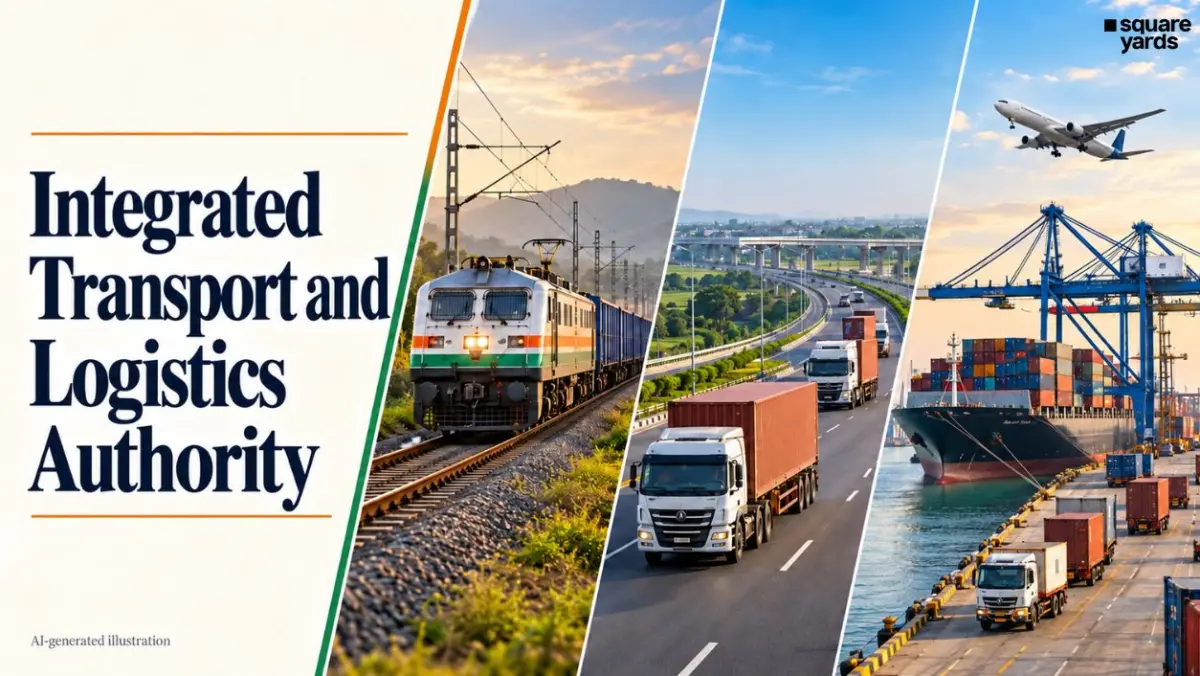
NEW DELHI — In a move designed to transition India from a period of massive infrastructure construction to one of hyper-efficient orchestration, the Union Cabinet, chaired by the Prime Minister, officially approved the creation of the Integrated Transport and Logistics Authority (ITLA) on October 6, 2026. This new "Special Purpose Vehicle" (SPV) is poised to become the ultimate referee for the nation’s sprawling network of roads, rails, and ports, marking the most significant shift in Indian infrastructure governance in over a decade.
For years, India’s infrastructure growth was defined by "silos"—railways planned in isolation from highways, and ports operating independently of inland waterways. The ITLA is the government’s definitive answer to this fragmentation. By acting as the apex body for transport and logistics planning, the ITLA is tasked with ensuring that every rupee of public investment contributes to a seamless, multimodal ecosystem.
I. The Core Mandate: An Apex Body for a Multimodal Future
The ITLA is not merely another advisory committee; it is a statutory-backed planning powerhouse. Its primary objective is the formulation and execution of the National Transport Master Plan (NTMP). Unlike previous sectoral plans that focused on five-year political cycles, the NTMP carries a long-term horizon of ten years or more.
The scope of the ITLA is exhaustive. It covers:
- Surface Transport: National highways and expressways.
- Railways: Dedicated freight corridors and high-speed passenger rail.
- Maritime: Major and minor ports, coastal shipping, and inland waterways.
- Aviation: Regional connectivity schemes and international hubs.
- Urban Mobility: Metro rail systems and integrated bus networks.
- Logistics: Multi-modal logistics parks (MMLPs) and warehousing zones.
A critical feature of the ITLA is its role as a technical gatekeeper. The authority will technically appraise and monitor all central infrastructure projects with a capital expenditure of Rs 500 crore or more. While financial appraisal remains with the Ministry of Finance, the ITLA will judge projects based on their "systemic utility"—how well they integrate with other modes of transport and their projected impact on reducing the national logistics cost.
Furthermore, the ITLA will serve as the custodian of the National Transport Data Repository. By synthesizing data from GST e-way bills, FASTag, Vahan, GPS-based trucking logs, and urban traffic sensors, the ITLA will have a "God’s eye view" of how goods and people actually move across the subcontinent.
II. Chronology: From Fragmentation to Integration (2014–2026)
The road to the ITLA has been paved by a decade of aggressive capital expenditure and incremental policy shifts. To understand the significance of this new authority, one must look at the timeline of India’s infrastructure evolution:
- 2014–2019: The Capex Surge. The government prioritized the physical expansion of the National Highway network and the modernization of railways. This era saw the launch of the Bharatmala and Sagarmala projects.
- 2019–2021: Digital Foundations. The launch of the National Common Mobility Card (2019) and the massive adoption of FASTag created the first reliable digital footprints of Indian movement.
- October 2021: PM Gati Shakti. The Prime Minister launched the Gati Shakti National Master Plan, a digital platform to bring 16 ministries together for integrated planning. This was the conceptual predecessor to the ITLA.
- 2022–2025: The Logistics Efficiency Phase. With the National Logistics Policy (2022), the focus shifted to reducing costs. During this period, India invested roughly $360 billion in infrastructure, successfully bringing logistics costs down from 13-14% of GDP to 10-10.7% by the end of FY26.
- October 6, 2026: The Birth of ITLA. Recognizing that a digital map (Gati Shakti) was not enough, the Cabinet approved the ITLA to provide the institutional "teeth" and human expertise required to enforce integrated planning.
III. Supporting Data: The Economic Logic of Coordination
The creation of the ITLA is driven by hard economic data. According to industry reports released in early 2026, India’s infrastructure investment of $360 billion over the last decade has yielded significant but uneven results.
| Metric | 2016 (Approx.) | 2026 (Reported) |
|---|---|---|
| Logistics Cost as % of GDP | 14% | 10.2% – 10.7% |
| Highway Construction Rate | 12-15 km/day | 35-40 km/day |
| Freight Share of Railways | ~27% | ~33% |
| Port Turnaround Time | ~44 hours | ~22 hours |
Despite these gains, "last-mile" inefficiencies remain the primary bottleneck. Industry data shows that while a truck can travel 800 km on a new expressway in record time, the final 20 km to a rail head or port can take up to 6 hours due to local congestion and poor planning. The ITLA’s mandate to review sectoral plans for "consistency" is designed to eliminate these "weakest link" scenarios that currently inflate costs.
Moreover, the growth of secondary hubs highlights the need for a national referee. While established hubs like Delhi-NCR and Bengaluru are maturing, cities like Ahmedabad and Kolkata are seeing logistics leasing growth exceeding 30% annually. Without the ITLA’s coordinated planning, these emerging markets risk being choked by the same unplanned urbanization that hindered their predecessors.
IV. Official Responses and Industry Perspectives
The announcement has elicited a range of responses from government officials, industry captains, and urban planners.
The Government View:
A senior official from the Cabinet Secretariat stated, "ITLA is the ‘nerve center’ that will ensure our infrastructure speaks one language. We are no longer just building roads; we are building a nervous system for the economy. The Rs 500 crore threshold ensures that every major project is scrutinized for its contribution to the National Master Plan."
The Industry Perspective:
Logistics developers have largely welcomed the move. "The biggest risk for a warehouse developer is ‘stranded assets’—building a facility based on a highway plan only to find the rail link has been delayed by five years," said a CEO of a leading industrial real estate firm. "If the ITLA can guarantee synchronization, it de-risks billions in private investment."
The Skeptic’s Corner:
Urban planning experts remain cautiously optimistic but wary of bureaucratic overlap. "India has a history of creating coordination bodies that lack the power to override individual ministries," noted a professor of urban engineering. "If ITLA remains purely advisory, it will simply be another layer of red tape. Its success depends on whether it can actually stop a poorly conceived project from being funded."
V. Implications: Property Markets and the "Connectivity Dividend"
The ITLA’s influence will be felt most acutely in the real estate sector. In the world of property, connectivity is the ultimate currency, and the ITLA now holds the mint.
1. The Reinforcement of "Super-Clusters"
Established logistics hubs—Delhi-NCR, Chennai, Mumbai, Pune, and Bengaluru—are set to benefit from the ITLA’s focus on intermodal links. By ensuring that freight moves seamlessly from rail terminals to warehouses, the ITLA will likely trigger a second wave of institutional investment in these "Tier 1" belts. Property values near multimodal hubs are expected to see a "reliability premium" as businesses flock to areas with guaranteed access.
2. The Rise of the "Transit-Oriented" Residential Market
The ITLA’s focus on urban mobility and the renewal of Unified Metropolitan Transport Authorities (UMTAs) in cities like Delhi will change the residential landscape. Homes located near well-integrated interchanges—where metro lines, bus rapid transit (BRT), and rail meet—will command significantly higher premiums. The ITLA’s role in ensuring these modes actually connect (unlike previous fragmented efforts) will make "commute time" a more predictable variable for homebuyers.
3. Speculative Risks in Emerging Corridors
With the ITLA preparing a 10-year Master Plan, the "connectivity dividend" will go to those who can interpret the plan early. However, there is a risk of speculative bubbles. As seen with the National Common Mobility Card (launched in 2019 but only partially functional by mid-2026), implementation can be slow. Investors must be wary of "paper projects" that may take a decade to materialize.
VI. The Fine Print: Navigating the Challenges Ahead
While the ITLA is a visionary step, its path is fraught with potential pitfalls that stakeholders must monitor:
- The "Advisory" Trap: In the Indian federal structure, land is a state subject, and transport is often split between center and state. If ITLA cannot compel state-level agencies or powerful central ministries to align their budgets, it risks becoming a "paper tiger."
- The Gati Shakti Overlap: There is a thin line between the digital mapping of PM Gati Shakti and the institutional planning of ITLA. Avoiding redundant layers of consultation will be the first administrative challenge.
- Data Privacy and Standards: Building a National Transport Data Repository involves sensitive GST and GPS data. Establishing robust data standards and privacy safeguards is essential to ensure industry participation.
- The "Local Road" Gap: Since ITLA focuses on projects over Rs 500 crore, the "micro-connectivity"—the local roads that a commuter uses to reach a metro station—remains outside its direct purview. This means local municipal efficiency remains as critical as ever for the average citizen.
Conclusion: The Sensible Path Forward
The Integrated Transport and Logistics Authority represents a maturing of the Indian state’s approach to economic development. It signals that the era of "building for the sake of building" is over, and the era of "building for efficiency" has begun.
For property buyers, developers, and logistics players, the message is clear: Follow the Plan. The next property boom will not necessarily occur where the most money is spent, but where the ITLA ensures that multiple modes of transport successfully converge. Success in the 2030s will belong to the regions where planning and execution finally move in lockstep. The ITLA is the referee; the market must now learn to play by its new, more disciplined rules.
