

Introduction
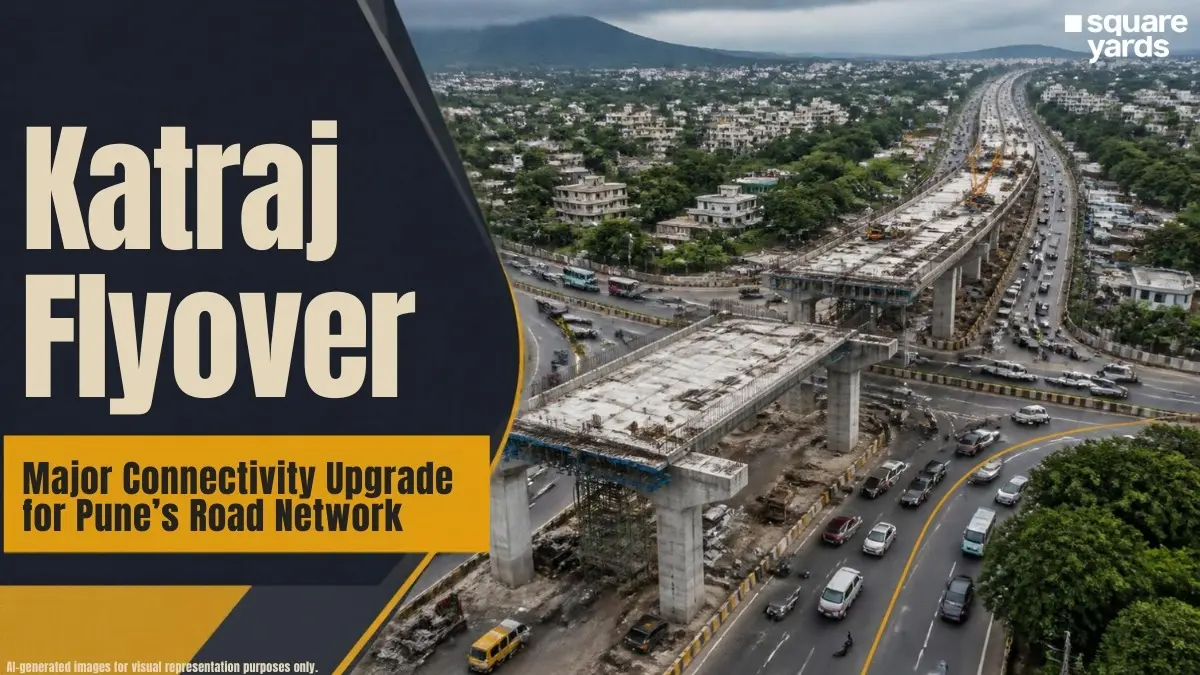
Pune, often referred to as the ‘Oxford of the East’ and a burgeoning IT and manufacturing hub, has long grappled with the growing pains of rapid urbanization. Nowhere is this more evident than in its southern corridors, where the intersection of local commuting and heavy highway transit creates a persistent bottleneck. However, a significant transformation is on the horizon. The Katraj Junction flyover, a critical six-lane infrastructure project, is currently progressing toward its revised completion deadline of December 2026.
This project, managed by the National Highways Authority of India (NHAI) in coordination with the Pune Municipal Corporation (PMC), represents more than just a bridge; it is a strategic link designed to decouple local traffic from interstate transit, effectively reshaping the real estate and logistical landscape of Southern Pune.
1. Main Facts: The Scope and Scale of the Katraj Infrastructure Project
The centerpiece of this regional upgrade is the six-lane flyover at Katraj Junction. Situated on National Highway 548DD (NH 548DD), the project is technically identified in government records at kilometer 3/880 of the expansive route connecting Vadgaon, Katraj, Kondhwa, Mantarwadi Chowk, Loni Kalbhor, Theur Phata, and Lonikand.
Key Technical Specifications:
- Structure: A high-capacity six-lane flyover designed to handle heavy-duty highway vehicles and passenger cars.
- Primary Objective: To provide a seamless link between the Katraj-Kondhwa Road and the Bengaluru-Mumbai bypass.
- Strategic Function: The flyover acts as a bypass within a bypass. It allows traffic arriving from the Pune-Solapur National Highway to transition toward the Pune-Mumbai and Pune-Satara corridors without navigating the congested inner-city arterial roads of Pune.
- The Wider Corridor: While the flyover is a specific junction-point solution, it is intrinsically linked to the 3.5-kilometer Katraj-Kondhwa Road widening project, which aims to expand the current bottlenecked stretch to a 50-meter-wide thoroughfare.
By elevating long-distance transit, the project aims to resolve the "choke point" status of Katraj Junction, which currently serves as a chaotic meeting point for local shoppers, office commuters, and massive multi-axle trucks.
2. Chronology: From Conception to the Revised 2026 Deadline
The timeline of the Katraj flyover has been subject to the typical complexities of large-scale Indian infrastructure projects, including land acquisition hurdles and inter-departmental coordination.
- Initial Projections (Late 2024 – Early 2025): In December 2025, a formal reply from the Ministry of Road Transport and Highways (MoRTH) indicated a target completion date of June 2026. At this stage, the project was viewed as a fast-track solution to the worsening traffic conditions in Southern Pune.
- The Shift to December 2026: Following a comprehensive review by NHAI Executive Engineer Shruti Naik, the deadline was officially moved to December 2026. This revision accounts for the technical complexities of building over an active junction and the lingering issues regarding land availability.
- September 2026 Site Inspection: A critical turning point occurred in September 2026 when high-ranking officials from both the PMC and NHAI conducted a joint site inspection. This review was essential to synchronize the flyover construction with the ongoing grade separator work and the broader road-widening efforts.
- Future Milestones: While the flyover is slated for a late 2026 opening, the 50-meter widening of the Katraj-Kondhwa Road is now scheduled for March 2027, with the ultimate 84-meter road development plan extending into March 2028.
3. Supporting Data: A Tale of Two Timelines
To understand the scale of the work remaining, one must distinguish between the flyover itself and the various stages of the Katraj-Kondhwa Road expansion. The following data highlights the bifurcated nature of these projects:
| Project Component | Current Target Deadline | Status/Focus Area |
|---|---|---|
| Six-lane Katraj Junction Flyover | December 2026 | Superstructure and Junction Integration |
| 50-meter Road Widening (3.5 km) | March 2027 | Surface paving and local lane segregation |
| 84-meter Ultimate Road Development | March 2028 | Final Land Acquisition and Utility Shifting |
Land Acquisition Data:
The September 2026 inspection revealed that 10 specific properties required for the road’s full development had not yet been integrated into the earlier acquisition phases. The PMC is currently fast-tracking negotiations with these property owners to prevent further "creep" in the 2027 and 2028 deadlines. Furthermore, the relocation of high-voltage electricity poles and transformers remains a critical dependency for the completion of the grade separator.
4. Official Responses and Procedural Hurdles
The project’s progress is a collaborative effort, yet it faces the friction of multi-agency governance. NHAI Executive Engineer Shruti Naik has been vocal about the necessity of the December 2026 target, citing it as a realistic window provided that land handover remains fluid.
The PMC’s Role:
The Pune Municipal Corporation is primarily responsible for the "ground-level" logistics—specifically land acquisition and the removal of encroachments. During the September review, PMC officials were directed to accelerate discussions with local landowners. The "10 missing properties" became a focal point of the meeting, with instructions issued to ensure these parcels are secured within the next fiscal quarter.
Technical Challenges:
Beyond land, the "grade separator" work—which involves creating multi-level crossings to prevent intersecting traffic flows—is currently hampered by utility lines. Officials have noted that the removal of transformers is not merely a matter of moving hardware but requires scheduled power shutdowns and the creation of new utility corridors, which must be done without causing prolonged disruption to the residents of Katraj and Kondhwa.
5. Implications: Real Estate, Economy, and Commuter Patterns
The completion of the Katraj flyover is expected to trigger a "ripple effect" across the socio-economic fabric of Southern Pune.
A. Real Estate Dynamics
Historically, areas like Undri and Mohammed Wadi were seen as affordable alternatives to the more expensive NIBM and Wanowrie pockets. However, their growth was always capped by the "Katraj Bottleneck."
- Katraj: As the immediate site of the flyover, Katraj will transition from a congested transit point to a high-accessibility hub. This is likely to spur redevelopment of older residential complexes into modern commercial-residential hybrids.
- Kondhwa & NIBM: These areas, known for their cosmopolitan population, will see a significant reduction in the "commute penalty." Residents heading toward the Mumbai-Pune Expressway will save an estimated 20–30 minutes during peak hours.
- Undri & Mohammed Wadi: These emerging suburbs stand to gain the most in terms of capital appreciation. Improved connectivity to the Bengaluru-Mumbai bypass makes these areas viable for professionals working in the Hinjewadi IT park who seek larger homes at lower price points than those found in Western Pune.
B. Logistics and the Highway Economy
For the logistics sector, the NH 548DD upgrade is a game-changer. By linking the Solapur Highway (East) to the Mumbai-Satara Highway (West/South) via the Katraj-Kondhwa corridor, the flyover creates a high-speed transit artery. This reduces fuel consumption and turnaround times for freight moving from Southern India toward the ports of Mumbai and the industrial belts of Chakan and Talegaon.
C. Quality of Life for Local Residents
Currently, the Katraj-Kondhwa Road is a site of frequent accidents and extreme air pollution due to idling vehicles. The separation of "through-traffic" (highway) from "local traffic" (city) will inherently make the surface roads safer for pedestrians and local two-wheeler commuters.
6. The Broader Vision: Pune’s Southern Ring and Beyond
The Katraj project does not exist in a vacuum. It is a vital cog in the larger machinery of Pune’s urban planning.
The Khadi Machine Chowk Extension:
The PMC is already planning a subsequent 9-kilometer road extension from Khadi Machine Chowk to Wadki Chowk. This extension is intended to further bridge the gap between the Mumbai-Satara and Solapur highway corridors, essentially creating a southern "semi-ring road."
Inter-connectivity:
When viewed alongside the proposed Pune Ring Road and the expansion of the Metro to Katraj, the flyover represents the first step in a multi-modal shift. The goal is to ensure that no single junction—be it Katraj, Chandni Chowk, or Hadapsar—becomes a point of failure for the city’s entire mobility network.
Conclusion
While the revision of the Katraj flyover deadline to December 2026 may be a source of temporary frustration for weary commuters, the rigor of the current review process suggests a shift toward realistic, sustainable delivery. The project is a complex puzzle of engineering, law, and urban sociology. Once the final girder is placed and the 50-meter road is paved, the "Katraj Bottleneck" will likely become a relic of the past, replaced by a modern corridor that fuels the next decade of growth for Southern Pune. For residents and investors alike, the message is clear: the short-term patience required for construction will likely be rewarded by long-term regional prosperity.
