

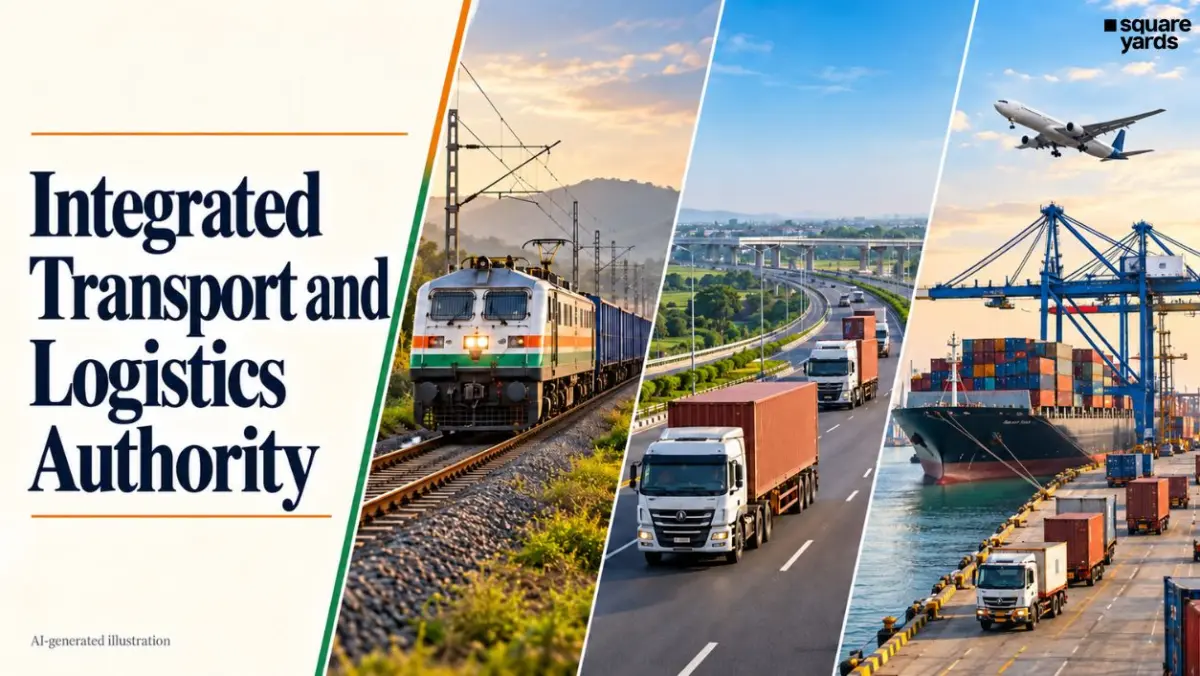
NEW DELHI — In a move designed to dismantle the silos of India’s infrastructure planning, the Union Cabinet, chaired by the Prime Minister, officially approved the establishment of the Integrated Transport and Logistics Authority (ITLA) on October 6, 2026. Structured as a Special Purpose Vehicle (SPV), the ITLA is envisioned as the nation’s apex body for transport and logistics planning, tasked with harmonizing the country’s sprawling network of roads, railways, ports, and airways into a singular, efficient machine.
The creation of the ITLA marks a departure from the fragmented planning of the past, aiming to solve the "last-mile" disconnects that have historically hindered India’s economic competitiveness. With an initial mandate to oversee projects exceeding a capital threshold of Rs 500 crore, the authority is set to become the central nervous system of India’s infrastructure ambitions.
The Core Mandate: Facts and Functional Scope
The ITLA is not merely an advisory committee; it is designed to be a technical powerhouse. Its primary objective is the formulation of the National Transport Master Plan (NTMP), a strategic roadmap with a minimum horizon of ten years. This plan will serve as the "North Star" for all transport-related ministries, ensuring that individual sectoral goals align with broader national interests.
Key Pillars of the ITLA’s Authority:
- Integrated Planning: The authority will cover eight critical sectors: roads, railways, ports, aviation, inland waterways, coastal shipping, urban mobility, and logistics.
- Sectoral Review: It will possess the power to review the five-year sectoral plans and annual budgets of individual transport ministries. If a ministry’s proposal deviates from the National Transport Master Plan, the ITLA will mandate adjustments to ensure consistency.
- Technical Appraisal and Monitoring: For all central infrastructure projects costing Rs 500 crore or more, the ITLA will conduct rigorous technical appraisals. While financial appraisal remains with the Ministry of Finance and existing mechanisms, the ITLA will monitor execution and, crucially, perform post-completion impact assessments to measure actual utility against projected goals.
- The Data Repository: Perhaps its most modern feature is the creation of the National Transport Data Repository. By synthesizing data from GST e-way bills, FASTag, Vahan, GPS tracking systems, and urban traffic sensors, the ITLA will create a real-time heat map of how people and goods move across the subcontinent.
Chronology: The Path to Institutionalized Integration
The road to the ITLA has been paved by a decade of incremental reforms aimed at lowering the cost of doing business in India.
- 2014–2021: The Investment Phase: India embarked on a massive infrastructure spending spree, investing approximately $360 billion into highway expansion, railway modernization, and port capacity.
- October 2021: Launch of PM Gati Shakti: The Prime Minister launched the Gati Shakti National Master Plan, a digital platform to bring 16 ministries together for integrated planning. This was the conceptual precursor to ITLA.
- September 2022: National Logistics Policy (NLP): The government introduced the NLP to set a technological and regulatory framework for reducing logistics costs.
- 2024–2025: Data Integration: Various systems like the Unified Logistics Interface Platform (ULIP) began integrating data from different transport modes.
- October 6, 2026: The Birth of ITLA: Recognizing that a digital platform (Gati Shakti) needed a statutory and institutional "anchor," the Cabinet approved the ITLA as an SPV to provide permanent oversight and technical authority.
Supporting Data: The Economic Imperative
The push for the ITLA is driven by compelling economic data. According to recent industry reports for the Fiscal Year 2026, India’s logistics costs have successfully fallen to between 10% and 10.7% of GDP. This is a significant improvement from the 13% to 14% range seen a decade ago.
However, to reach the global benchmark of 8% seen in many developed economies, structural "mismatches" must be eliminated. For example, while road connectivity has improved, the "modal shift" toward more cost-effective rail and water transport has been slow. Currently, over 60% of India’s freight moves by road, which is significantly more expensive and carbon-intensive than rail. The ITLA’s data-driven approach aims to rebalance this mix, potentially saving the economy billions in annual fuel and maintenance costs.
Official Responses and Expert Perspectives
Government officials have hailed the ITLA as the "missing link" in India’s growth story. A senior official from the NITI Aayog stated, "We have built the hardware—the roads and the tracks. The ITLA is the software that will make them run in sync. It ensures that we don’t build a world-class port only to find that the connecting railway line is two years behind schedule."
However, industry experts maintain a degree of cautious optimism. Logistics consultants point out that the success of the ITLA depends entirely on its "teeth."
"India has a history of creating coordination bodies that end up as mere consultation layers," says Dr. Arpan Malik, an infrastructure analyst. "The real test for ITLA will be whether it can actually stall a project that doesn’t fit the Master Plan. If it can influence the flow of funds, it will be revolutionary. If it only writes reports, it will be just another office in New Delhi."
Implications for Real Estate: The ‘Connectivity Dividend’
In the world of real estate, value is a function of accessibility. The ITLA’s mandate to solve the "weakest link" problem has profound implications for property markets.
1. Strengthening Established Logistics Clusters
The primary beneficiaries will be the existing "Big Five" hubs: Delhi-NCR, Chennai, Mumbai, Pune, and Bengaluru. These regions already dominate warehouse leasing. With ITLA-led coordination, the peripheral belts of these cities—such as Luhari in NCR or Bhiwandi near Mumbai—will see enhanced value as freight links to ports and dedicated freight corridors (DFCs) become more reliable.
2. The Rise of Emerging Freight Corridors
Data shows that cities like Ahmedabad and Kolkata are seeing logistics leasing growth of over 30% year-on-year. However, infrastructure in these regions has often been reactionary rather than proactive. ITLA’s ten-year planning horizon allows developers to build large-scale industrial parks in these emerging cities with the confidence that the necessary rail and road links are officially mandated, not just promised.
3. Residential Premiums and Transit-Oriented Development (TOD)
In urban centers, the ITLA’s focus on "urban mobility" and its push for Unified Metropolitan Transport Authorities (UMTAs) will redefine residential valuations. In cities like Delhi, which is renewing efforts to integrate its bus, metro, and rail networks, homes located near "well-connected interchanges" are expected to command a 15–20% premium. For the modern homebuyer, the trade-off between price and commute time is the deciding factor; ITLA’s goal is to make that commute predictable.
The Fine Print: Navigating Potential Pitfalls
Despite the ambitious goals, the ITLA faces significant structural headwinds that investors and developers must monitor.
The Authority Gap: Historically, UMTAs have remained advisory because the agencies that control the money and the operations (like the Railways or State Transport Corporations) are protective of their autonomy. If ITLA cannot bridge the gap between "planning" and "funding," it may struggle to enforce its Master Plan.
The NCMC Precedent: The National Common Mobility Card (NCMC) serves as a cautionary tale. Launched in 2019 to provide a "One Nation, One Card" system for all public transport, it was functional in only 13 metro projects and 11 bus corporations by July 2026. The pace of technological integration often lags far behind the policy announcement.
Speculation Risks: For property buyers, the ITLA introduces a new layer of speculative risk. A National Transport Master Plan is a public document; once a region is marked for a future multimodal hub, land prices often skyrocket long before a single brick is laid. With the ITLA focusing on projects over Rs 500 crore, the "local" infrastructure—the neighborhood roads that affect daily life—remains outside its direct purview, meaning a project could be "nationally connected" but "locally congested."
Conclusion: A Strategy of Patience and Data
The Integrated Transport and Logistics Authority represents the institutionalization of "Gati Shakti." It is a signal to the world that India is moving away from ad-hoc infrastructure development toward a synchronized, data-led strategy.
For the real estate sector and industrial investors, the "connectivity dividend" will go to those who can read the National Transport Master Plan with a discerning eye. The sensible approach is to watch for the ITLA’s first major project appraisals. Will it prioritize the completion of existing bottlenecks, or will it succumb to the allure of new, headline-grabbing mega-projects?
In the coming decade, the most valuable real estate will not necessarily be in the center of the city, but at the intersection of the modes. As the ITLA begins its work, the message to investors is clear: follow the data, watch the interchanges, and remember that in a modern economy, connectivity is only as strong as its weakest link.
