

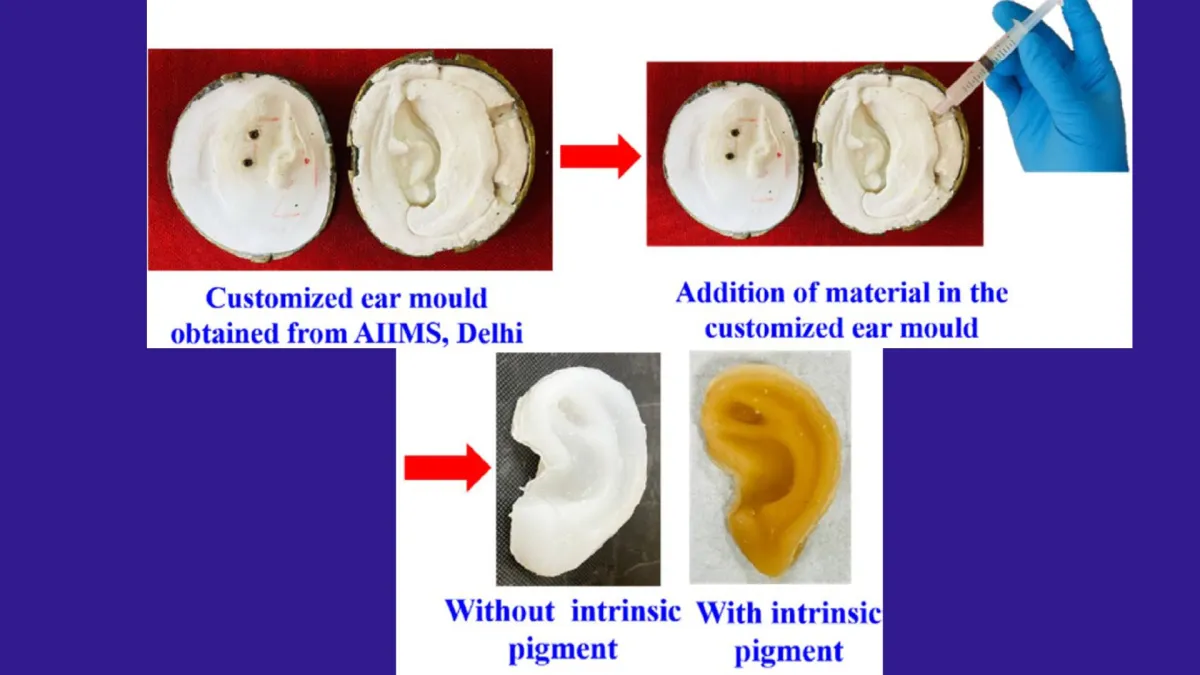
NEW DELHI — In the burgeoning field of medical materials science, a "one-size-fits-all" approach often leaves patients in tropical regions literally in the heat. For decades, individuals requiring maxillofacial prosthetics—artificial replacements for ears, noses, or oral structures lost to congenital defects or trauma—have relied on materials engineered for the temperate climates of Europe and North America. However, a groundbreaking collaboration between the Indian Institute of Technology (IIT) Delhi and the All India Institute of Medical Sciences (AIIMS) New Delhi is changing that narrative, developing a new class of silicone elastomers specifically designed to survive the rigors of the Indian environment.
Main Facts: A Breakthrough in Material Longevity
The core of the breakthrough lies in the development of a room-temperature vulcanized (RTV) silicone optimized for high temperatures and intense ultraviolet (UV) radiation. While standard medical-grade silicones, primarily polydimethylsiloxane (PDMS), are prized for their biocompatibility and skin-like texture, they have historically failed in the Indian subcontinent. In regions where summer temperatures frequently breach 45°C to 50°C, these imported materials degrade rapidly, becoming brittle, discolored, and prone to tearing within six months.
The new study, recently published and conducted by a multidisciplinary team of engineers and clinicians, introduces a formulation that maintains its mechanical integrity and aesthetic appeal far longer than existing standards. By employing a systematic "Design of Experiments" (DoE) approach, the researchers fine-tuned the chemical composition of the silicone to balance softness—essential for patient comfort—with the rugged durability required for daily outdoor use in a tropical climate.
Chronology: From Regional Mapping to Molecular Engineering
The drive toward localized scientific solutions in India has seen a significant uptick in recent years, spanning various disciplines from ecology to high-end medical engineering. This trend is exemplified by a parallel effort in conservation; a recent eight-year survey across 7,680 kilometers of the Ganga River Basin highlighted the extreme fragility of local ecosystems, identifying that a mere 0.26% of the region remains a "safe haven" for the vulnerable Smooth-coated otter.

Just as ecologists are mapping the "shadows" of the Ganga to protect aquatic predators, materials scientists at IIT Delhi and AIIMS began their journey years ago to map the degradation patterns of synthetic polymers in the urban "heat islands" of New Delhi.
- Phase I: Identification of Failure (2020-2022): Clinicians at AIIMS New Delhi observed a recurring pattern where patients returned with degraded prostheses significantly earlier than the 18-to-24-month lifespan cited in Western medical literature.
- Phase II: Chemical Optimization (2023): The team at IIT Delhi began experimenting with platinum-catalyzed addition reactions. They focused on varying the ratios of hydride-functional polymethylhydrosiloxane crosslinkers and vinyl-terminated PDMS.
- Phase III: Environmental Testing (Late 2023 – 2024): The researchers subjected their new formulations to a six-month "natural weathering" trial in New Delhi, exposing the materials to the brutal transition from the dry heat of May to the high humidity of the monsoon season.
- Phase IV: Biocompatibility Validation (2025-2026): Final laboratory tests were conducted to ensure that the chemical additives, specifically UV absorbers, did not compromise the safety of the material when in contact with human skin.
Supporting Data: The Science of Durability
The research team utilized the Taguchi L25 orthogonal array, a statistical method used to determine the optimal combination of variables with a limited number of experiments. This allowed them to analyze how three critical components interacted: crosslinkers, silica fillers, and UV absorbers.
Mechanical Integrity
The study identified five optimized formulations that mirrored the mechanical properties of human skin. The data revealed:
- Tensile Strength: The materials exhibited strengths between 2.8 and 5.5 MPa.
- Tear Strength: Recorded between 11.7 and 14.6 N/mm, ensuring the prosthetics would not rip during daily cleaning or application.
- Hardness: All optimized samples maintained a Shore A hardness below 40. This is a critical threshold; anything harder feels "plastic" and causes discomfort to the sensitive tissue of the face, while anything softer lacks the structural integrity to hold its shape.
Weathering Resistance
In the six-month New Delhi trial, the "control" formulation (standard silicone used in many clinics today) saw a 30% increase in hardness and tensile strength. This hardening is a result of UV-induced crosslinking, which makes the material brittle. In contrast, the IIT-AIIMS formulations showed mechanical changes limited to just 10% to 15%, with significantly less yellowing (discoloration).

Molecular Protection
The secret to this stability was the incorporation of Chimassorb 81, a solid UV absorber that acts as a molecular shield, and AEROSIL R972, a reinforcing silica filler. To prevent structural weaknesses, the team used a unidirectional vacuum mixing process. This removed microscopic air bubbles which, in a tropical climate, act as "stress concentrators" and sites for moisture accumulation, leading to internal rot and mechanical failure.
Official Responses and Research Perspectives
The researchers emphasize that this work is not merely about creating a "tougher" plastic, but about "localizing" medical care.
"The restoration of facial form is a cornerstone of reconstructive surgery," the study authors noted. "When a patient receives a prosthetic ear or nose, they aren’t just receiving a medical device; they are regaining their identity. If that device fails every few months due to the weather, the financial and psychological burden becomes unsustainable."
Clinicians at AIIMS highlighted that the biocompatibility results were particularly surprising. In vitro tests on fibroblast (skin) cells showed that the optimized formulations were not only non-toxic but actually supported high cell viability. One formulation, labeled C7, reached 200% viability compared to the control after seven days. This suggests that the surface chemistry of the new silicone is exceptionally conducive to cell metabolic activity, a vital feature for devices worn for 12 to 14 hours a day against damaged or sensitive skin.

However, the team remains cautious. They acknowledge that while the six-month data is promising, a comprehensive assessment of long-term durability in clinical practice would require observation over a one-to-two-year cycle to fully guarantee the material’s lifespan.
Implications: A Shift Toward Regional Healthcare Sovereignty
The implications of this research extend far beyond the laboratory. By developing a material that can be manufactured and utilized effectively within India, the study paves the way for several socio-economic benefits:
1. Economic Accessibility
Most high-quality prosthetic silicones are currently imported, making them expensive. By localizing the formulation and production, the cost of maxillofacial rehabilitation can be significantly reduced, making it accessible to lower-income populations who often suffer the most from untreated trauma or congenital anomalies.
2. Reduced Clinical Burden
With prosthetics that last two to three times longer than current versions, the frequency of clinical visits for replacements is halved. This reduces the load on overstretched government hospitals like AIIMS and saves patients from the logistical challenges of frequent travel to urban medical centers.

3. Psychological and Social Reintegration
Facial disfigurement often leads to social isolation. A prosthesis that maintains its color and texture—rather than turning yellow and rigid—allows patients to move through society with greater confidence. The "lifelike" tactile feel ensured by the Shore A hardness optimization is crucial for this psychological comfort.
4. A Template for Tropical Medicine
This study serves as a blueprint for how engineering and materials science can be tailored to solve regional challenges. It moves the medical community away from a "one-size-fits-all" approach and encourages the development of "climate-resilient" medical devices.
As India continues to grapple with the effects of climate change and rising temperatures, the need for such localized scientific interventions will only grow. From the conservation of otters in the Ganga to the engineering of prosthetics in New Delhi, the message from the Indian scientific community is clear: solutions must be as resilient as the environments they are meant to serve. The work of the IIT Delhi and AIIMS team is a testament to this philosophy, offering a more durable, cost-effective, and human-centric future for reconstructive medicine in the tropics.
