

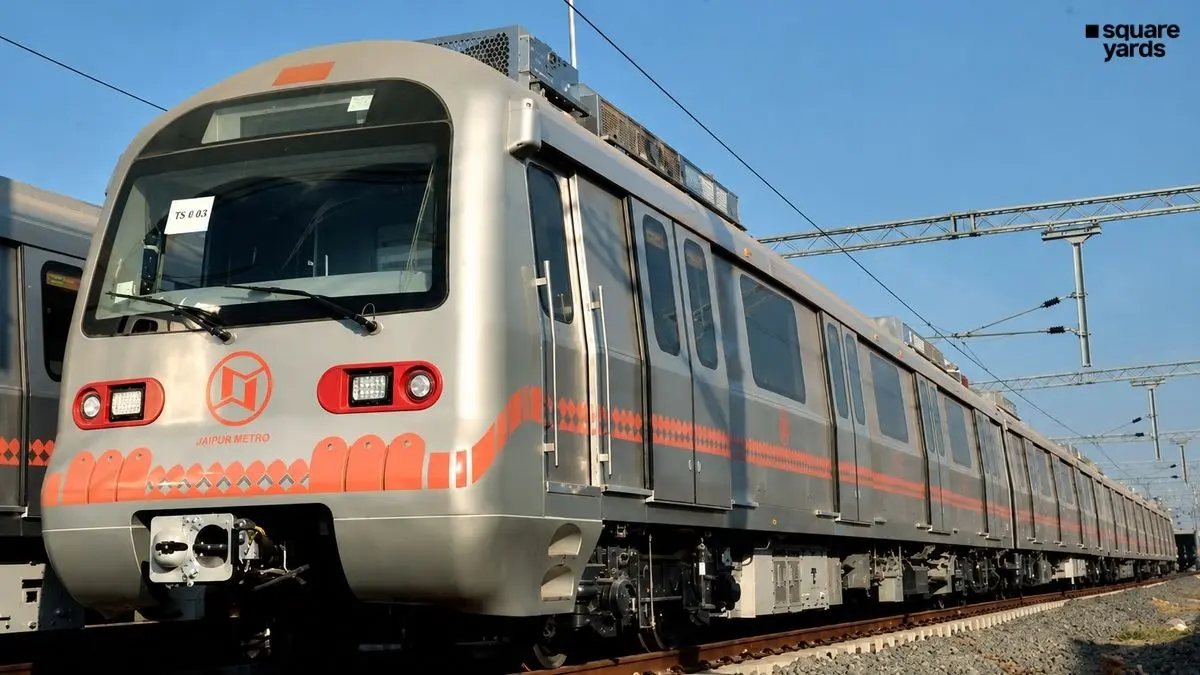
JAIPUR — In a move destined to redefine the geographical and economic landscape of Rajasthan’s capital, the Jaipur Metro Rail Corporation (JMRC) is moving forward with its most ambitious infrastructure undertaking to date: Phase-2 of the Jaipur Metro. This 41-kilometer North-South corridor, stretching from Prahladpura to Todi Mod, represents a seismic shift in the city’s transit philosophy, transitioning from a singular east-west line to a comprehensive grid.
With a staggering investment of Rs 13,037 crore, the project aims to bridge the gap between Jaipur’s sprawling industrial outskirts, its burgeoning international gateway, and its historic residential cores. As the city prepares for a decade of construction leading up to a 2031 completion, stakeholders from real estate developers to industrial magnates are closely watching the project’s trajectory.
I. Main Facts: The Blueprint of a Modern Metropolis
The Jaipur Metro Phase-2 is not merely an extension of the existing rail network; it is a vital artery designed to carry the lifeblood of the city’s economy. The corridor is strategically planned to link the far southern industrial reaches of Sitapura with the northern residential and industrial hubs of Vidhyadhar Nagar and Vishwakarma (VKI).
Key Project Specifications:
- Total Length: Approximately 41 Kilometers.
- Corridor Orientation: North-South (Prahladpura to Todi Mod).
- Total Stations: 36 planned, with a 37th under consideration.
- Estimated Cost: Rs 13,037 Crore.
- Nature of Construction: Primarily elevated, with critical underground sections near Jaipur International Airport.
- Interchange Hub: Khasa Kothi will serve as the primary junction between Phase-1 (East-West) and Phase-2 (North-South).
The route is meticulously designed to serve several high-traffic landmarks. These include the SMS Hospital and Stadium—medical and sporting hubs that draw thousands daily—and the Jaipur International Airport, which currently lacks high-speed mass transit connectivity. By integrating these hubs, the JMRC aims to alleviate the chronic congestion on Tonk Road and the B2 Bypass, which have long been bottlenecks for the city’s commuters.
The Proposed 37th Station: Taroon Ki Khoot
A significant addition currently on the drawing board is the 37th station at Taroon Ki Khoot on Tonk Road. Positioned strategically between the Jaipur Airport and B2 Bypass stations, this stop is intended to serve the upcoming "Unity Mall" and "Rajasthan Mandapam." This proposal highlights the government’s intent to align transit infrastructure with new-age commercial developments, ensuring that "footfall-heavy" destinations are accessible without reliance on private vehicles.
II. Chronology: From Conception to 2031 Completion
The journey of Phase-2 has been one of long-term planning and rigorous financial auditing. While the idea of a North-South corridor has existed for years, the current iteration gained momentum only recently.
- April 2026: The Union Cabinet formally approved the Phase-2 project, marking the official greenlighting of the Rs 13,037 crore budget. This approval was a watershed moment, securing the necessary federal support and clearing the path for international funding agencies.
- Late 2026: Detailed Project Reports (DPRs) were finalized, and the bidding process for various construction packages commenced. The focus remained on technical feasibility, particularly the underground tunneling required near the airport.
- 2027–2030 (Projected): This period will see the peak of construction activity. Given the length of the 41-km corridor, work is expected to occur in multiple simultaneous phases to ensure the timeline remains intact.
- September 2031: The targeted operational date. By this time, the JMRC expects the entire line from Prahladpura to Todi Mod to be fully functional, integrating seamlessly with the existing Pink Line.
III. Supporting Data: Property Market Dynamics and Economic Indicators
The announcement and approval of Phase-2 have already begun to ripple through Jaipur’s real estate sector. The corridor connects diverse micro-markets, each with its own price point and growth trajectory.
1. The Industrial Powerhouse: Jaipur South
The southern end of the line—Prahladpura and Sitapura—is the city’s industrial engine.
- Current Market Price: Average asking price of Rs 4,600 per sq. ft.
- Economic Context: Below the city average of Rs 4,950 psf.
- Metro Impact: The introduction of the metro is expected to democratize the workforce. Currently, workers often face grueling commutes from the city center to Sitapura. The Metro will make this belt a viable residential option for middle-income professionals, potentially closing the price gap with the city average.
2. The Premium Corridor: Tonk Road and Durgapura
Tonk Road remains the most prestigious stretch of the Phase-2 route.
- Tonk Road Pricing: Currently averages Rs 5,400 psf.
- Durgapura Pricing: An established luxury market with rates hovering around Rs 13,000 psf.
- Metro Impact: For Durgapura, the Metro offers "convenience over capital appreciation." With prices already at a peak, the Metro provides an alternative to traffic-heavy roads rather than a primary driver for price hikes. However, for Tonk Road, the proximity to the airport and the new 37th station could catalyze a transition from residential to high-end commercial and hospitality use.
3. The Northern Residential Hub: Vidhyadhar Nagar
- Current Market Price: Rs 5,900 psf.
- Economic Context: Already priced above the city average due to its planned layout and proximity to the Vishwakarma Industrial Area (VKI).
- Metro Impact: The Metro will provide a critical link for residents of Vidhyadhar Nagar to the rest of the city, especially the airport and SMS Hospital. It solidifies the area’s status as a premium residential district for the industrial elite of VKI.
IV. Official Responses: The Vision for JMRC
Officials at the Jaipur Metro Rail Corporation and the state government have emphasized that Phase-2 is more than just a rail project; it is a "Transit-Oriented Development" (TOD) initiative.
A senior official from the JMRC, speaking on the condition of anonymity, noted: "Phase-2 is the missing piece of the puzzle. While Phase-1 gave Jaipur its first taste of metro life, Phase-2 connects the places where people actually work and travel—the airport, the industrial zones, and the major hospitals. Our focus is not just on the tracks, but on the ecosystem around the stations."
The state government has also hinted at "Value Capture Financing" (VCF) strategies. By leveraging the increase in land value around the 36 stations, the government hopes to recoup a portion of the Rs 13,037 crore investment. This includes selling air rights over stations for commercial use and implementing a specialized cess on new developments along the corridor.
V. Implications: A City Reimagined
The long-term implications of Jaipur Metro Phase-2 are four-fold:
1. Bridging the "Industrial-Residential" Divide
For decades, Jaipur’s geography was split: the south for work (Sitapura) and the center/north for living. This led to massive traffic surges during peak hours. Phase-2 effectively bridges this divide, allowing for a more fluid movement of human capital. It allows the southern belt to develop its own residential identity, supported by high-speed connectivity to the city’s cultural and commercial heart.
2. The "Airport-Side" Commercial Explosion
Connecting the Jaipur International Airport to the Metro is a game-changer for the hospitality and retail sectors. The area around the airport, including the proposed Unity Mall and Rajasthan Mandapam, is poised to become a secondary Central Business District (CBD). This will likely attract international hotel chains and corporate offices that prioritize proximity to both the airport and mass transit.
3. Environmental and Infrastructure Relief
Tonk Road is currently one of the most polluted and congested stretches in Rajasthan. By shifting a significant percentage of daily commuters from private vehicles and buses to the electric Metro, the city can expect a measurable reduction in its carbon footprint and road-traffic accidents.
4. Real Estate Gentrification
While established areas like Durgapura may see stable prices, the "fringe" areas like Prahladpura and Todi Mod are set for significant gentrification. As accessibility improves, these areas will likely see a shift from low-density housing to high-rise apartments, fundamentally changing the skyline of Jaipur.
Conclusion
The Jaipur Metro Phase-2 is a bold bet on the future of the Pink City. At Rs 13,037 crore, it is a high-stakes investment intended to transform Jaipur from a historic tourist destination into a modern, hyper-connected metropolis. While the 2031 completion date seems distant, the project’s influence on land prices, urban planning, and commercial strategy is already being felt. As the city moves toward this new era, the North-South corridor stands as a testament to Jaipur’s aspirations on the national stage.
