

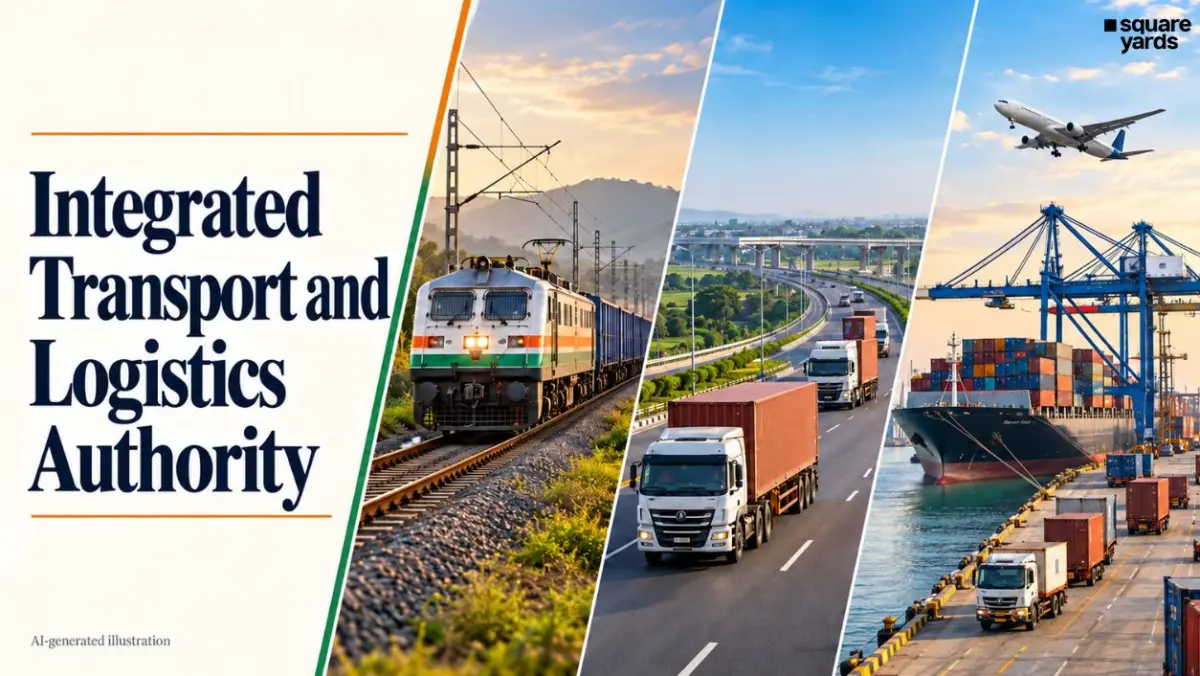
NEW DELHI — In a move designed to dismantle decades of departmental silos and streamline the nation’s infrastructure trajectory, the Union Cabinet, chaired by the Prime Minister, officially approved the establishment of the Integrated Transport and Logistics Authority (ITLA) on October 6, 2026. Conceived as a high-powered Special Purpose Vehicle (SPV), the ITLA is set to become the apex body for all transport and logistics planning in India, signaling a paradigm shift in how the country builds, monitors, and optimizes its connectivity networks.
The creation of the ITLA comes at a critical juncture as India seeks to solidify its position as a global manufacturing hub. By centralizing the planning of roads, railways, ports, aviation, and inland waterways, the government aims to ensure that the trillions of rupees invested in infrastructure yield maximum economic dividends.
Main Facts: The Mandate of the ITLA
The Integrated Transport and Logistics Authority is not merely another regulatory body; it is designed as a technical powerhouse with a mandate to synchronize the country’s vast and often disjointed transport sectors.
The National Transport Master Plan
The cornerstone of the ITLA’s mission is the formulation of a National Transport Master Plan. This document will carry a long-term horizon of ten years or more, providing a strategic roadmap for the development of roads, railways, ports, aviation, inland waterways, coastal shipping, and urban mobility. Unlike previous planning efforts, the ITLA has the authority to review the five-year sectoral plans and annual budgets of individual transport ministries to ensure they align strictly with the overarching national vision.
Technical Oversight and Appraisal
The ITLA will serve as a rigorous gatekeeper for large-scale infrastructure. It is mandated to technically appraise and monitor all central infrastructure projects with a capital expenditure of ₹500 crore or more. While financial appraisals will remain within existing ministerial mechanisms, the ITLA will focus on "technical viability" and "multimodal synergy." Furthermore, the body is tasked with conducting post-completion impact assessments to determine if projects have met their intended socio-economic goals.
The Data-Driven Edge
In an era where data is the new oil, the ITLA will host the National Transport Data Repository. This digital backbone will integrate real-time data from various sources, including GST e-way bills, FASTag transactions, Vahan (vehicle registration) databases, GPS-based tracking systems, and urban traffic sensors. By synthesizing this data, the ITLA will gain an unprecedented view of how goods and people move across the country, allowing for "demand-driven" infrastructure planning rather than "supply-led" construction.
Chronology: From Gati Shakti to ITLA
The journey toward the ITLA began years ago, rooted in the realization that India’s logistics costs were a major hurdle to global competitiveness.
- 2014–2021: The government initiated a massive infrastructure push, focusing on the Bharatmala (roads) and Sagarmala (ports) projects. However, these remained largely departmentalized.
- October 2021: The PM Gati Shakti National Master Plan was launched. It introduced a digital platform for integrated planning across 16 ministries. While successful in mapping assets, it lacked a central statutory authority to enforce synchronization.
- FY 2024–2025: Significant investments totaling approximately $360 billion over the previous decade began to show results. Logistics costs, which stood at 13-14% of GDP a decade ago, began a steady decline.
- July 2026: Reports indicated that logistics costs had fallen to an impressive 10-10.7% of GDP in FY26, nearing the single-digit targets seen in developed economies.
- October 6, 2026: The Union Cabinet officially approves the ITLA as the permanent institutional framework to carry forward the momentum of Gati Shakti and institutionalize integrated planning.
Supporting Data: The Economic Imperative
The economic rationale for the ITLA is backed by compelling data regarding India’s logistics evolution. The reduction of logistics costs to 10-10.7% of GDP represents a massive saving for the Indian economy, potentially freeing up billions of dollars for further investment or consumer spending.
Industry reports highlight that the efficiency gains are not uniform across the country, which is why a central planning body is required. For instance:
- Established Hubs: Regions like Delhi-NCR, Mumbai, and Bengaluru continue to lead in logistics leasing, but they face diminishing returns due to congestion and "last-mile" bottlenecks.
- Emerging Markets: Cities such as Ahmedabad and Kolkata are currently witnessing a growth rate exceeding 30% in logistics demand. These "emerging freight corridors" often possess thin infrastructure that cannot keep pace with rapid industrialization.
- Investment Scale: The ₹500 crore threshold for ITLA oversight is significant. It ensures that the authority focuses on "macro-connectors"—projects that bridge states and connect major industrial clusters to international gateways.
Official Responses: Breaking the Silos
While formal statements from individual ministers are expected in the coming weeks, the Cabinet’s briefing emphasized a "Whole-of-Government" approach.
A senior official within the Ministry of Commerce and Industry, speaking on the condition of anonymity, noted: "For too long, the Railways planned for rail, and the Road Ministry planned for roads, often in isolation. The ITLA ensures that a new expressway doesn’t end five kilometers away from a dedicated freight corridor terminal without a connecting link. It is about the ‘connective tissue’ of our economy."
Government advisors have also pointed out that the ITLA will provide a "single version of truth" through its data repository. By using GST and FASTag data, the government can identify exactly where bottlenecks occur in real-time, allowing for targeted interventions rather than broad, speculative investments.
Implications: Real Estate, Logistics, and Urban Living
The establishment of the ITLA has profound implications for the private sector, particularly in the realms of real estate and supply chain management.
1. The Real Estate "Connectivity Dividend"
In real estate, value is a function of accessibility. The ITLA’s focus on reducing "mismatches"—such as a port without a rail link or a housing project without a transit connection—improves the odds for developers.
- Logistics Clusters: Better freight links will strengthen existing warehouse belts in Chennai, Pune, and Delhi-NCR. As the ITLA streamlines port-to-hinterland connectivity, land values around major rail-road interchanges are expected to appreciate.
- Residential Premiums: The move toward Unified Metropolitan Transport Authorities (UMTAs) in cities like Delhi, supported by the ITLA’s framework, will favor "Transit-Oriented Development." Properties near well-connected multimodal hubs will likely command higher premiums as commute times become more predictable.
2. Strategic Signals for Investors
The National Transport Master Plan will serve as a "cheat sheet" for institutional investors. By reading the plan, warehouse developers and industrial giants can identify which regions the government intends to prioritize over the next decade, reducing the risk of "stranded assets."
3. The "Fine Print" and Potential Risks
Despite the optimism, analysts urge caution. India has a history of creating coordination bodies that struggle to exert authority over powerful, independent ministries.
- The Advisory Trap: If the ITLA remains a purely advisory body without the power to veto poorly planned projects, it risks becoming another layer of bureaucracy.
- The Implementation Gap: The National Common Mobility Card (NCMC) serves as a cautionary tale. Launched in 2019 to unify transit payments, it was functional in only 13 metro projects and 11 bus corporations by July 2026. The ITLA must overcome similar inertial forces in data integration and departmental resistance.
- Speculative Bubbles: There is a risk that speculative land pricing will outpace actual project execution. Since the ITLA focuses on projects over ₹500 crore, local "last-mile" roads—which often dictate daily quality of life—may still fall through the cracks of local governance.
Conclusion: A Future Defined by Alignment
The Integrated Transport and Logistics Authority represents a bold attempt to synchronize the moving parts of the Indian economy. If successful, it will do more than just build roads and rails; it will create a seamless ecosystem where goods move faster, costs stay low, and urban living becomes more sustainable.
For property buyers and industrial stakeholders, the message is clear: the era of speculative "location, location, location" is being joined by "planning, planning, planning." The greatest dividends will go to those who study the National Transport Master Plan and position themselves where the ITLA’s multimodal visions eventually meet the ground. As the government moves from the approval phase to implementation, the focus will now shift to whether this new apex body can truly master the complex geometry of Indian infrastructure.
