

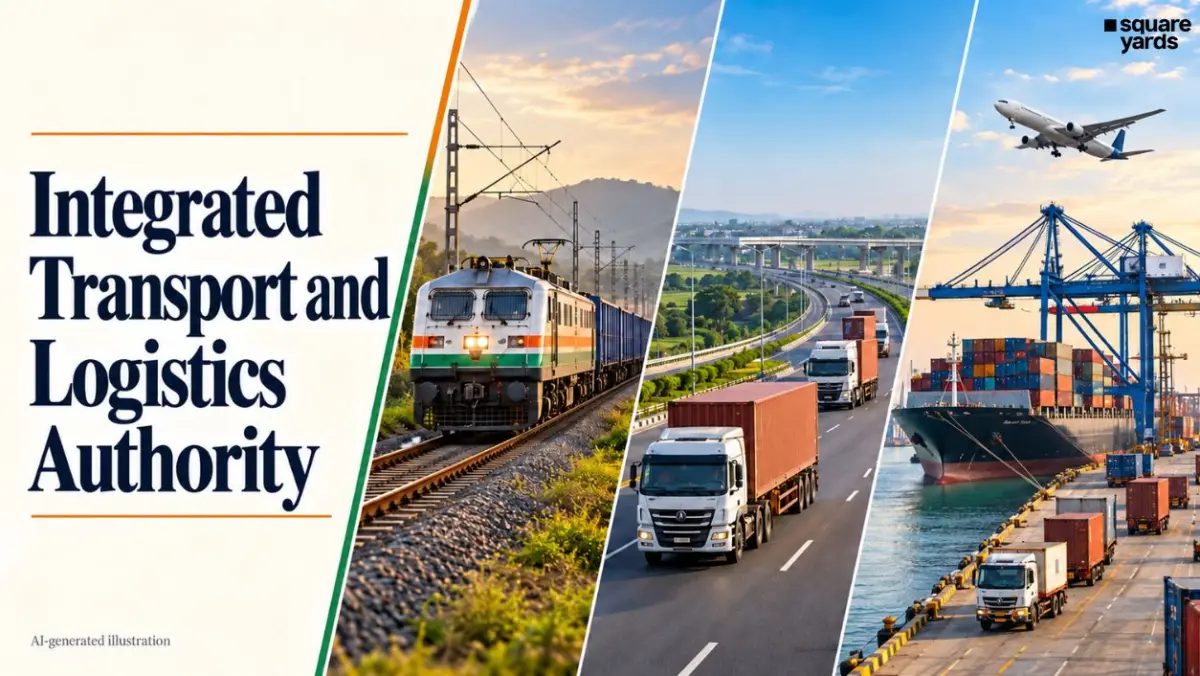
NEW DELHI – In a move signaling a paradigm shift in how the world’s fastest-growing major economy builds and moves, the Union Cabinet, chaired by the Prime Minister, officially approved the establishment of the Integrated Transport and Logistics Authority (ITLA) on October 6, 2026. This new Special Purpose Vehicle (SPV) is designed to serve as the apex body for all transport and logistics planning in India, effectively ending decades of siloed departmental planning that has often led to infrastructure mismatches and economic inefficiencies.
The creation of ITLA marks a transition from a project-centric approach to a network-centric strategy. By centralizing the planning of roads, railways, ports, aviation, and inland waterways under a single technical authority, the government aims to further slash logistics costs and enhance the global competitiveness of Indian exports.
Chronology of a Logistics Transformation
The road to ITLA has been paved by a decade of aggressive infrastructure spending and policy reform. To understand the significance of this new authority, one must look at the timeline of India’s logistical evolution:
- 2014–2021: A period of massive capital expenditure where India focused on "hard" infrastructure—doubling the rate of highway construction and revitalizing the railway network.
- October 2021: The launch of the PM Gati Shakti National Master Plan. This digital platform brought 16 ministries together to ensure integrated planning and synchronized implementation of projects.
- 2022–2025: The National Logistics Policy (NLP) was rolled out, focusing on "soft" infrastructure, digital integration, and human resources. During this time, logistics costs began their steady descent from the 13–14% of GDP range.
- October 6, 2026: The Union Cabinet formalizes ITLA. While Gati Shakti provided the digital mapping tool, ITLA provides the institutional teeth—a dedicated authority to mandate consistency across all transport ministries.
The Mandate: A Ten-Year Vision for Connectivity
The primary objective of ITLA is the creation and maintenance of the National Transport Master Plan (NTMP). Unlike previous plans that focused on five-year political cycles, the NTMP will operate on a horizon of ten years or more.
This master plan is not merely a map; it is a comprehensive blueprint covering:
- Multimodal Integration: Ensuring that a new expressway is not built in isolation but is synchronized with rail-side warehouses and port connectivity.
- Sectoral Oversight: ITLA is empowered to review the five-year and annual plans of individual ministries (Railways, MoRTH, Civil Aviation, etc.) to ensure they do not deviate from the overarching national strategy.
- Technical Appraisal: For the first time, any central infrastructure project costing Rs 500 crore or more will undergo a rigorous technical appraisal by ITLA. While financial approvals remain with the Ministry of Finance, ITLA will judge whether a project is technically viable and strategically necessary within the national network.
Supporting Data: The Digital Backbone of Logistics
The effectiveness of ITLA rests on its ability to process real-time data. The authority is tasked with building and managing the National Transport Data Repository (NTDR). This repository will be a "data lake" fed by several existing digital ecosystems:
- GST e-Way Bills: Providing real-time insights into the volume and destination of goods.
- FASTag & Vahan: Monitoring vehicle movement and fleet health across the national highway network.
- GPS & Urban Traffic Data: Analyzing congestion patterns to optimize last-mile delivery and urban commuting.
- LDB (Logistics Data Bank): Tracking container movement across ports and dry ports.
The Economic Impact:
According to recent industry reports, India’s logistics costs have already seen a significant decline, falling to approximately 10%–10.7% of GDP in FY26. This is a stark improvement from the 13%–14% levels seen a decade ago. This reduction is attributed to roughly $360 billion in cumulative infrastructure investment. ITLA’s goal is to bring this figure down to single digits, aligning India with the logistics efficiency of developed economies like the US and Germany.
Implications for the Real Estate Market
In the world of real estate, there is an old adage: "Value follows the road." However, ITLA changes this to: "Value follows the connected road." Real estate experts suggest that ITLA will act as a de-risking agent for developers and investors.
1. Strengthening Established Clusters
The "Big Five" logistics hubs—Delhi-NCR, Mumbai, Bengaluru, Pune, and Chennai—are expected to see a consolidation of value. As ITLA prioritizes "the weakest link," the gaps in last-mile rail connectivity to existing Grade-A warehouses in these regions will be bridged. This ensures that the premium on well-connected industrial land remains high.
2. The Rise of the "30% Growth" Cities
Data indicates that Ahmedabad and Kolkata are currently witnessing a leasing growth rate of over 30%. These cities have historically suffered from "thin" infrastructure—fast demand growth but slow infrastructure response. ITLA’s coordinated planning is expected to unlock massive value in the peripheral belts of these cities, turning them into primary freight corridors.
3. Transit-Oriented Development (TOD)
For residential buyers, the focus shifts to Metro and Transit Nodes. In cities like Delhi, the push for Unified Metropolitan Transport Authorities (UMTAs) is gaining steam. ITLA’s oversight of urban mobility means that future housing projects near multimodal interchanges (where bus, metro, and rail meet) will command a significant price premium. The "commute-time-to-price" tradeoff will become the primary metric for home buyers.
Official Responses and Industry Sentiment
While official government spokespeople have hailed the move as the "final piece of the infrastructure puzzle," industry reaction is a mix of optimism and "cautious observation."
Government Perspective:
"ITLA is not just another layer of bureaucracy; it is a layer of intelligence," stated a senior official from the NITI Aayog. "By using data from GST and FASTag, we are moving away from ‘build and they will come’ to ‘build where the demand already is.’ This ensures every rupee of the taxpayer’s money is spent on high-impact projects."
Industry Experts:
Logistics consultants point out that the success of ITLA depends on its authority over autonomy. "India has a history of creating coordination bodies that end up being merely advisory," says a lead analyst at a global real estate firm. "If ITLA cannot veto a poorly planned ministerial project, then it risks becoming a ‘consultation shop.’ The Rs 500 crore threshold is a good start, but the real test is whether it can influence the local ‘last-mile’ roads that are often under state jurisdiction."
The Fine Print: Why Caution is Warranted
Despite the ambitious scope, several "bottlenecks" remain that investors and property buyers must consider:
- The Gati Shakti Overlap: There is a potential for jurisdictional friction between the PM Gati Shakti portal (the tool) and ITLA (the authority). Clear demarcations of power will be required to avoid "analysis paralysis."
- The NCMC Precedent: The National Common Mobility Card (NCMC), launched in 2019, serves as a cautionary tale. As of July 2026, it was fully functional in only 13 metro projects and 11 bus corporations. Integration across India’s diverse and fragmented transport operators is notoriously slow.
- Speculative Pricing Risks: For property buyers, the announcement of a "Master Plan" often leads to immediate price spikes. However, ITLA’s plans have a 10-year horizon. There is a high risk that speculative pricing will outpace actual infrastructure delivery, leaving some investors "stranded" in projects that won’t see true connectivity for a decade.
- The Central vs. Local Gap: ITLA focuses on projects over Rs 500 crore. While this covers major highways and rail corridors, it does not cover the municipal roads that determine the daily quality of life for a homeowner.
Conclusion: The Connectivity Dividend
The establishment of the Integrated Transport and Logistics Authority is a bold admission by the Indian government that "more" infrastructure is not enough; it must be "smarter" infrastructure.
For the economy, ITLA promises a future of lower costs and faster turnarounds. For the real estate sector, it provides a more reliable North Star for investment. However, the true "connectivity dividend" will go to those who can distinguish between a speculative map and an executed project.
The sensible approach for stakeholders is a combination of patience and rigorous study of the forthcoming National Transport Master Plan. In the coming decade, the most valuable real estate will not necessarily be in the center of the city, but at the intersection of the most modes of transport. As ITLA begins its work, the message to investors is clear: Watch the data, follow the plan, and mind the "last mile."
