

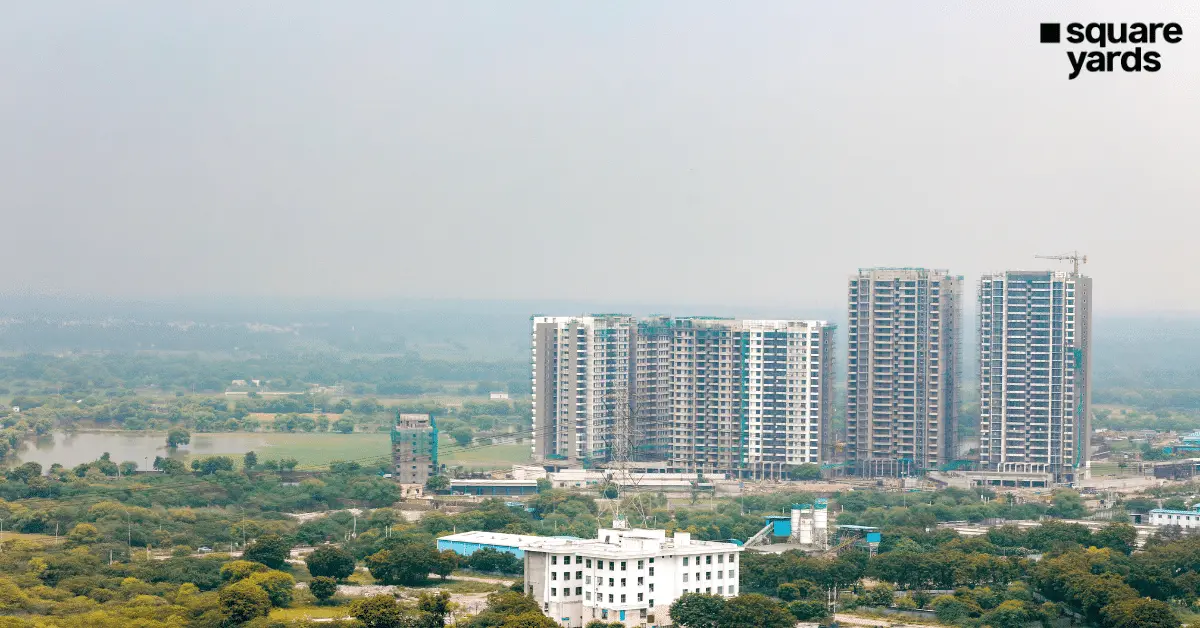
The landscape of the National Capital Region (NCR) is undergoing a seismic shift. For decades, Noida (New Okhla Industrial Development Authority) has served as the gold standard for planned urban growth in North India. However, success has brought the city to a physical standstill. With approximately 90% of its 168 sectors fully developed, Noida is effectively running out of land. This scarcity has triggered a predictable economic response: skyrocketing property prices and a pivot toward ultra-luxury developments that are increasingly out of reach for the middle-class homebuyer.
In response, the Uttar Pradesh government has unveiled its most ambitious urban expansion project to date: the Dadri-Noida-Ghaziabad Investment Region (DNGIR), colloquially known as "New Noida." This master plan aims to add 20,000 hectares of fresh urban land, effectively doubling Noida’s current footprint and creating a secondary economic engine to absorb the spillover of industrial and residential demand.
I. Main Facts: The Blueprint of New Noida
The New Noida Master Plan is not merely a residential extension; it is a strategic industrial corridor designed to compete with global manufacturing hubs. The plan is governed by a long-term vision that integrates logistics, heavy industry, and high-density residential zones.
1. Scale and Geography
The DNGIR spans 20,000 hectares, a massive allocation compared to the existing, saturated Noida sectors. This new territory is positioned to bridge the gap between Noida, Greater Noida, and the industrial clusters of Ghaziabad and Dadri. By doing so, the state is creating a contiguous economic zone that leverages the existing infrastructure of the Eastern Peripheral Expressway and the upcoming Noida International Airport at Jewar.
2. Economic and Employment Targets
The state government has set aggressive targets for the region. By 2030, New Noida is projected to generate between 500,000 and 600,000 jobs. This is supported by a massive influx of capital; as of mid-2024, Rs 35,000 crore has already been "grounded" across 120 distinct projects. Unlike Memorandum of Understanding (MoU) stages, "grounded" investment refers to projects where site work has physically commenced, signaling a high level of execution certainty.
3. The Price Equilibrium
The primary driver for New Noida is the "price push" from Core Noida. Currently, average asking prices in Core Noida sit at approximately Rs 12,650 per square foot (psf). However, new luxury launches—driven by the scarcity of land and the UP Model Building Regulations 2026—are touching Rs 19,650 psf. New Noida and Greater Noida West provide a necessary "safety valve," offering entry points between Rs 8,500 and Rs 8,750 psf.
II. Chronology: The Road to 2030
The development of New Noida is part of a multi-decade planning sequence. To understand the future of DNGIR, one must look at the regulatory timeline that brought the region to its current state.
- 2021–2023: The Saturation Phase: Noida Authority officially recognizes that land banks in the original 168 sectors have dwindled to less than 10%. Prices in sectors like 150, 144, and 128 begin to appreciate at 20-30% annually.
- Late 2023: The DNGIR Conceptualization: The Master Plan for New Noida is drafted, focusing on a 40% industrial, 15% residential, and 45% green/institutional/logistical land use split.
- July 2024: Compensation Breakthrough: In a landmark move to prevent the land acquisition delays that historically plagued Greater Noida, the authority hiked farmer compensation to Rs 6,459 per square meter—a 53% increase. This move was designed to ensure "clean" land titles for developers.
- July 2025: Metro Expansion Approvals: The central government approves the 2.6 km Aqua Line extension from Depot Station to the Bodaki Multimodal Hub, a critical link for the New Noida logistics sector.
- February 2026: The Botanical Garden Link: The Union Cabinet approves the Rs 2,254 crore corridor connecting Sector 142 to Botanical Garden, promising to unify the Aqua and Blue lines.
- 2030: The Target Horizon: The deadline for the first phase of industrial operations and the realization of the 5-lakh-job target.
III. Supporting Data: The Economics of Scarcity vs. Expansion
The financial logic of the New Noida expansion is best understood through a comparative analysis of property costs and investment distribution.
Table 1: Property Valuation Disparity (2024-2026 Estimates)
| Location | Avg. Rate (psf) | Base Cost (1,200 sq. ft.) | Market Segment |
|---|---|---|---|
| Core Noida (New Launch) | Rs 19,650 | Rs 2.36 Crore | Ultra-Luxury / HNIs |
| Core Noida (Average) | Rs 12,650 | Rs 1.52 Crore | Premium Mid-Segment |
| Greater Noida West | Rs 8,750 | Rs 1.05 Crore | Mid-Segment / Affordable |
| New Noida (Projected) | Rs 6,500 – 7,500 | Rs 78L – 90L | Early Investors / Industrial |
Table 2: Investment Distribution (The Rs 35,000 Crore Grounded Fund)
- Manufacturing & Heavy Industry: 55% (Focus on electronics and EV components)
- Data Centers & IT: 25% (Positioning Noida as the Data Capital of North India)
- Logistics & Warehousing: 20% (Leveraging the Bodaki Multimodal Hub)
The data suggests a widening gap of nearly Rs 7,000 psf between established Noida sectors and new launches. For a family with a budget of Rs 1 crore, Core Noida has effectively become a closed market. This demographic—the backbone of the Indian middle class—is the primary target for the Greater Noida West and New Noida residential corridors.
IV. Official Responses and Infrastructure Commitments
Government officials and the Noida Authority have emphasized that New Noida will not repeat the "residential-first" mistakes of previous decades. The strategy is "Jobs First, Housing Second."
The Focus on Connectivity
The Noida Authority has made it clear that the Aqua Line extensions are the "circulatory system" of this new region. Three specific corridors are being prioritized to ensure that the 20,000-hectare expansion does not become an isolated island:
- The Gaur City/Char Murti Node: By linking Sector 51 to Greater Noida West Sector 4, the authority is addressing the primary grievance of lakhs of existing residents who currently rely on congested road networks.
- The Bodaki Multimodal Hub: This is the crown jewel of the New Noida logistics plan. Officials state that by connecting the Metro to the Bodaki railway terminal and the logistics hub, they are creating a seamless transit point for both freight and labor.
- The Botanical Garden Interchange: This 11.56 km link is a direct response to the "interchange fatigue" faced by commuters. By allowing Aqua Line users to switch to the Blue and Magenta lines at a single hub, the state expects a 40% increase in daily metro ridership by 2027.
Farmer Relations
A senior official from the Noida Authority noted, "The 53% hike in compensation to Rs 6,459 psm is a strategic investment in time. By paying a premium to the farmers now, we avoid the decade-long litigations that stalled projects in the early 2000s. We are buying peace and speed."
V. Implications: What This Means for Stakeholders
The emergence of New Noida and the saturation of the core city have distinct implications for different market participants.
For the Homebuyer: The Search for Value
The "Rs 1 Crore Ceiling" has moved. While it once bought a 3BHK in Sector 75 or 78, it now barely covers a 2BHK in the secondary market of those sectors. Homebuyers must now look toward Greater Noida West for immediate possession or New Noida for long-term appreciation. The proximity to the proposed metro stations in Greater Noida West remains the single most important factor for end-users. Pockets near Gaur City and the Char Murti roundabout are expected to see the highest rental demand as the 5-lakh-job target begins to materialize.
For the Investor: Timing the Cycle
Investors should look at New Noida through the lens of the "Yamuna Expressway Model." Those who invested in land or apartments near the Jewar Airport site when it was just a proposal saw 2x to 3x returns once construction became visible. New Noida is currently at that "visible construction" stage. With Rs 35,000 crore in grounded investment, the risk of the project being a "paper-only" plan has vanished. The strategic move for investors is to align their holding periods with the 2030 industrial commissioning dates.
For the Industrialist: A New Manufacturing Base
With 40% of land dedicated to industry, New Noida is set to become a rival to Gurgaon’s Manesar belt. The availability of large, contiguous land parcels with direct access to the Eastern Peripheral Expressway makes it an ideal site for electronics manufacturing (ESDM), EV battery plants, and massive data center parks.
Risks to Monitor
Despite the optimism, challenges remain.
- Execution Delays: While the metro lines are approved, the actual "wheels on tracks" timeline often exceeds government estimates.
- Infrastructure Lag: There is a risk that residential towers may come up before the promised schools, hospitals, and sewage treatment plants are operational.
- Regulatory Shifts: Future changes in Floor Area Ratio (FAR) or building bylaws could impact the density and livability of the new sectors.
Conclusion: The Center of Gravity Shifts
The New Noida Master Plan represents a maturing of the NCR real estate market. It is a recognition that the "old Noida" has reached its zenith and that the future of the region lies in a more expansive, industrially-focused, and transit-oriented model.
As Core Noida transforms into a high-priced luxury enclave, the DNGIR and Greater Noida West will emerge as the true engines of growth, offering the elusive combination of affordability, employment, and connectivity. For those watching the skyline of Uttar Pradesh, the message is clear: the city is no longer just growing upward; it is growing outward, with 20,000 hectares of new possibility.
