

Kolkata, West Bengal – Barely four months into the tenure of the Suvendu Adhikari-led Bharatiya Janata Party (BJP) government in West Bengal, the nascent administration finds itself navigating a tempest of controversies. Facing challenges not only from a resurgent Opposition but also from within its own ranks, the BJP is struggling to project an image of stable governance amidst escalating ideological and political skirmishes. The latest incidents, including the alleged vandalism of a prominent Kolkata newspaper office and a contentious proposal to rename Jadavpur University, have thrust the party into a defensive posture, prompting its state president, Samik Bhattacharya, to publicly disavow any party or government involvement.
The controversies strike at a critical juncture for the BJP, which swept to power in the 2026 Assembly elections on a promise of "poriborton" (change) and good governance, ending decades of Left and then Trinamool Congress rule. The incidents have not only provided fresh ammunition to the Opposition but have also amplified internal anxieties within the broader Sangh Parivar regarding the rapid expansion of the party and the integration of diverse elements into its fold.
Main Facts: A Government Under Scrutiny
The Suvendu Adhikari government, inaugurated with high hopes and a significant mandate, has encountered a series of early challenges that threaten to overshadow its stated agenda of development and progress. These initial months have been marked by a notable uptick in political friction, both on the streets and within the corridors of power.
At the heart of the current maelstrom are two distinct yet interconnected events. First, a highly publicized clash erupted at the venerable Jadavpur University, a historical bastion of Leftist student activism, involving the Akhil Bharatiya Vidyarthi Parishad (ABVP), the student wing of the Rashtriya Swayamsevak Sangh (RSS), and various Left-aligned student organizations. This campus skirmish quickly escalated when Sharbari Mukherjee, the BJP MLA representing Jadavpur, publicly called for the university to be renamed after Sri Aurobindo, citing his historical association with the institution as one of its founders. This proposal immediately ignited a fierce debate, seen by many as an attempt to saffronize academic institutions and erase their established identities.
The second, and perhaps more inflammatory, incident involved a demonstration outside the office of a leading Kolkata daily. During this protest, a section of the newspaper’s white building was reportedly painted saffron by alleged BJP supporters, triggering widespread condemnation and raising serious questions about press freedom and political intimidation in the state.
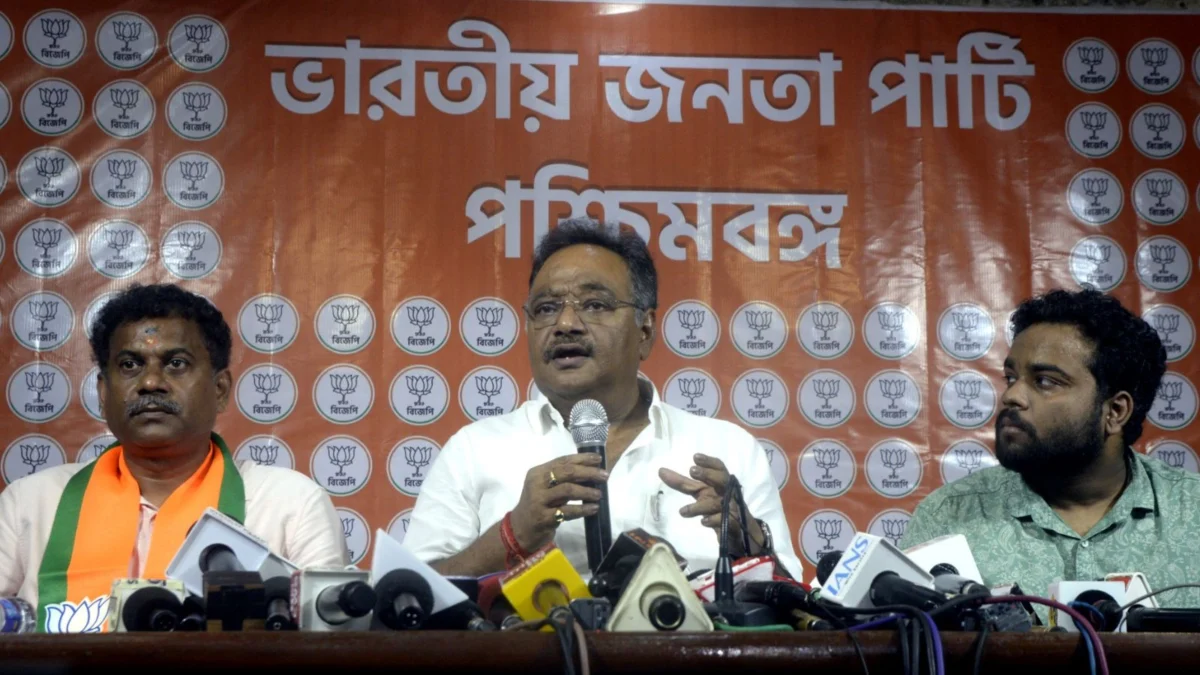
In response to these burgeoning crises, BJP state president Samik Bhattacharya swiftly moved to distance both the party and the government from the contentious actions. He emphatically stated that the perpetrators of the vandalism were not BJP workers and that the party had no involvement in the episode. Similarly, he dismissed MLA Mukherjee’s renaming proposal as a "personal opinion" not reflecting the BJP’s official agenda. However, these attempts at damage control have been met with skepticism from the Opposition and have done little to quell the growing unease, particularly within the Sangh Parivar itself. The incidents have forced the BJP to confront the delicate balance between ideological assertion and the practical demands of governance, all while managing a newly expanded and diverse cadre.
A Chronology of Conflict and Contradiction
The recent controversies have unfolded in a rapid sequence, each event adding to the mounting pressure on the fledgling BJP administration. Understanding the chronological progression is crucial to grasping the depth of the challenges faced by the government.
The Jadavpur University Flashpoint (Late August 2026)
The first significant sign of internal and external strife emerged in the closing days of August 2026 at Jadavpur University (JU). Known for its vibrant and often fiercely independent student politics, JU has historically been a stronghold of Left-leaning thought and activism. The campus became the scene of heightened tension following a series of confrontations between the ABVP and various Left student bodies. While the exact trigger for the latest clashes remains debated, they are widely understood as part of a broader ideological struggle for influence over academic spaces in West Bengal.
In the immediate aftermath of these skirmishes, Sharbari Mukherjee, the BJP MLA from the Jadavpur constituency, made a provocative public statement. She proposed that Jadavpur University be renamed after Sri Aurobindo, the renowned philosopher, yogi, guru, and poet, who was once associated with the institution (then the Bengal National College) as its first principal. Mukherjee argued that this renaming would honor a significant historical figure and reconnect the university with its nationalist roots. However, critics, particularly from the Left and liberal intellectual circles, viewed the proposal as a direct assault on the university’s autonomous character and a thinly veiled attempt to impose a specific ideological narrative on a cherished educational institution. The proposal sparked immediate outrage among students, faculty, and alumni, who saw it as an unwelcome political interference in academic affairs.
The Saffron Stain on Press Freedom (Early September 2026)
Just days after the Jadavpur University controversy began to simmer, another incident erupted, casting a shadow over press freedom in the state. In the first week of September 2026, a group of individuals, widely identified by onlookers and local media as "BJP supporters," staged a demonstration outside the office of a prominent daily newspaper in Kolkata. The protest reportedly escalated beyond peaceful demonstration when parts of the newspaper’s pristine white building were deliberately defaced with saffron paint.
The act of painting a media house’s office in the color historically associated with the BJP and Hindu nationalist movements was immediately interpreted as an act of intimidation and a threat to the independent functioning of the press. The incident drew sharp condemnation from journalist bodies, civil society groups, and the Opposition, who decried it as an attack on democratic institutions and a dangerous precedent in a state where political discourse has often been volatile. The image of the saffron-splashed building quickly circulated across social media and news channels, becoming a potent symbol of the rising tensions between political forces and critical media.
BJP’s Defensive Stance (September 6, 2026)
Faced with a dual crisis that threatened to derail the government’s focus on governance, BJP state president Samik Bhattacharya stepped forward on September 6, 2026, to articulate the party’s official position. In a series of statements, Bhattacharya sought to unequivocally distance both the BJP as a political party and the Suvendu Adhikari-led state government from the two controversial incidents.
Regarding the newspaper office vandalism, Bhattacharya was resolute: "I am representing a specific political party. People voted for a change in Bengal. This government’s target is not to change the colour of a particular place. Some controversies have cropped up. Some people changed the colour of a newspaper office. This is not the agenda of our party or government. Our target is to ensure the development of the theatre or film industry. The government is ready to help with that." He further elaborated, making the party’s position explicitly clear: "Those who did this are not BJP workers. The BJP is not involved in this." This strong denial aimed to sever any perceived link between the party’s official machinery and the act of vandalism, portraying it as an isolated incident by unauthorized individuals.
Similarly, Bhattacharya addressed the Jadavpur University renaming proposal. He firmly rejected MLA Sharbari Mukherjee’s suggestion, stating: "This is not our party’s agenda. What the MLA said is her personal opinion." By framing Mukherjee’s statement as a personal view, Bhattacharya attempted to neutralize the controversy and prevent it from being seen as an official policy direction of the government or the party. His overarching message was a pivot back to the BJP’s core electoral promise: focusing on development and governance rather than symbolic changes or divisive cultural issues.
Supporting Data: The Shifting Sands of Bengal Politics
To fully comprehend the gravity of these controversies, one must consider the broader political landscape of West Bengal and the unique circumstances surrounding the BJP’s ascendance to power.
The Mandate for Change and Mounting Expectations
The 2026 Assembly elections marked a historic turning point in West Bengal politics. After decades of Left Front rule and fifteen years under the Trinamool Congress (TMC), the BJP, under the leadership of Suvendu Adhikari, secured a decisive victory. This mandate was not merely a rejection of the incumbent TMC but a powerful expression of public desire for profound "poriborton" – a fundamental shift towards transparent governance, economic development, and an end to the perceived political violence and corruption that had plagued the state. Voters had high expectations that the BJP would usher in an era of stability, progress, and a departure from the divisive political culture of the past. The current controversies, barely four months into the new government’s term, thus represent a significant test of its ability to meet these expectations and maintain public trust. The fragility of this mandate is such that any perceived misstep or deviation from its core promises could quickly erode voter confidence.
Jadavpur University: A Bastion of Dissent
Jadavpur University holds a unique and often contentious place in Bengal’s intellectual and political firmament. Established in 1955, it evolved from the Bengal National College, founded in 1906, which was itself a product of the Swadeshi movement and a symbol of indigenous education. Historically, JU has been synonymous with intellectual ferment, progressive thought, and robust student activism, often serving as a crucible for Leftist and anti-establishment movements. Its campus is renowned for its vibrant political debates, protests, and a strong culture of academic autonomy.
Given this history, any attempt to alter JU’s character, whether through ideological clashes or proposals for renaming, is met with fierce resistance. The ABVP-Left clashes are not just isolated incidents but symptomatic of a larger struggle for ideological dominance over a campus that has long resisted mainstream political interference. BJP MLA Sharbari Mukherjee’s proposal to rename it after Sri Aurobindo, while presented as a tribute, is widely perceived by its critics as an attempt to saffronize a secular institution and erase its distinct identity, further fueling concerns about academic freedom and institutional autonomy under the new regime.
Press Freedom and Political Symbolism
The vandalism of a newspaper office with saffron paint carries profound symbolic weight in any democracy, particularly in a state with a rich history of media engagement like West Bengal. The act is not merely property damage; it is seen as an attempt to intimidate the media, stifle dissent, and send a chilling message to journalists who may be critical of the ruling establishment. In a country where press freedom indices have been a subject of international scrutiny, such incidents raise serious concerns about the state of democratic institutions. The choice of saffron, a color deeply intertwined with the BJP’s identity, further politicizes the act, suggesting an organized attempt to assert ideological dominance and silence critical voices. This incident directly contradicts the BJP’s promises of transparent governance and adherence to democratic norms, creating a perception that the new government might be tolerating, if not tacitly encouraging, actions that undermine media independence.
The Sangh Parivar’s Internal Alarm Bells
Perhaps the most revealing insight into the BJP’s current predicament comes from within the Sangh Parivar itself. The RSS-linked Bengali weekly, ‘Swastika,’ known for reflecting the broader ideological concerns of the Hindu nationalist ecosystem, published a scathing critique in its latest issue. The article sounded a stark note of caution against what it bluntly termed "thugs entering the party." This phrase is not merely metaphorical; it refers to the significant influx of individuals from other political parties, particularly the Trinamool Congress, into the BJP fold following its electoral success. Many of these turncoats, often with questionable past records, were seen as opportunistic entries rather than ideologically committed cadres.
The ‘Swastika’ article explicitly argued that the BJP’s biggest challenge was no longer merely defeating political opponents, which it claimed had become negligible forces in Bengal, but rather meeting the expectations of its voters. "The challenge is not political parties becoming powerful… There is no opposition party to fight the BJP… but the pressure is about facing the people," the article stated, underscoring the shift from electoral battle to governance accountability.
The weekly went on to issue a dire warning: "The corrupt govt of 15 years (Trinamool Congress-led government) has been devastated. The Left Front and Congress have become negligible forces in (Bengal) politics." It then delivered its most potent caution: "If even 2% voters feel that the present BJP is a replica of the thugs (Trinamool Congress) who governed the state for 15 years, 90% voters will shift away from the BJP." This stark reminder of Bengal’s history of decisively rejecting ruling parties (like the Left Front after 34 years and TMC after 15) serves as a potent internal warning against complacency and ideological dilution.
A senior BJP leader, speaking on condition of anonymity, corroborated these internal concerns, acknowledging the organizational challenges posed by rapid expansion. "We came to power because people voted for us. We don’t have a proper organisation in all sectors and areas. Now many people are entering the party and they don’t know the functioning of the BJP and RSS. Some people are thinking they will do exactly what the TMC did, and a few others think they can make the leadership happy by changing colours or making statements," the leader confided. This admission highlights the tension between the imperatives of electoral victory, which often requires welcoming diverse elements, and the need to maintain ideological purity and cadre discipline, which are hallmarks of the RSS-BJP organizational structure. The ‘Swastika’ article, therefore, represents a significant internal pushback and a call for introspection from the ideological fount of the party.
Official Responses: Navigating the Narrative
The immediate aftermath of these controversies saw the BJP leadership, particularly state president Samik Bhattacharya, engage in a crucial exercise of narrative control and damage limitation.
Samik Bhattacharya’s Balancing Act
Samik Bhattacharya’s response to the crises has been a carefully calibrated attempt to balance ideological messaging with the practical demands of governance. His explicit distancing of the party and government from both the vandalism and the renaming proposal underscores a strategy to project the BJP as a responsible, rule-of-law adhering entity, distinct from any radical elements operating under its banner. By asserting that the perpetrators of the vandalism were "not BJP workers" and that the party had "no involvement," Bhattacharya sought to deflect direct responsibility and prevent the incidents from being perceived as officially sanctioned.
His emphasis on the government’s development agenda – highlighting priorities such as the film and theatre industry – was a deliberate effort to redirect public discourse away from cultural skirmishes and back towards the core promises of the BJP’s election manifesto. This strategic pivot aims to reassure the electorate that the government remains focused on substantive issues rather than symbolic or divisive changes. However, this "balancing act" presents its own challenges. The party’s rapid expansion and the presence of diverse elements within its ranks make it difficult for the leadership to fully control grassroots actions or the public statements of all its elected representatives. Bhattacharya’s dismissal of MLA Mukherjee’s proposal as "personal opinion" illustrates the tightrope walk required to manage ideological impulses from within while maintaining a unified, governance-focused public image.
Government’s Stance on Development
Beyond Bhattacharya’s statements, the Suvendu Adhikari government itself has been keen to re-emphasize its commitment to development and good governance. Sources within the Chief Minister’s office indicate that there is a concerted effort to push forward key infrastructure projects, industrial investments, and social welfare schemes. The strategy is to demonstrate tangible progress and concrete achievements, thereby countering the narrative that the government is either distracted by or complicit in cultural conflicts. Senior ministers and bureaucrats have been instructed to highlight the government’s proactive steps in various sectors, from healthcare and education to employment generation. The aim is to present a stable and growth-oriented administration that prioritizes the welfare of the people over political skirmishes, hoping that substantial achievements will eventually overshadow early controversies.
Implications: A Test of Governance and Unity
The unfolding controversies carry significant implications for the Suvendu Adhikari government, the BJP in West Bengal, the Opposition, and the broader political and social fabric of the state.
For the Suvendu Adhikari Government: Early Hurdles
For the Suvendu Adhikari government, these early months are proving to be a critical test of its administrative prowess and political maturity. The incidents highlight the immense challenge of governing a diverse and politically charged state like West Bengal, especially after a historic electoral victory. The perceived lack of internal discipline, as evidenced by the vandalism and the MLA’s unsolicited proposal, could undermine public confidence and create an impression of a government struggling to get its house in order. The administration must now address the delicate task of balancing ideological goals with practical governance, managing an expanded cadre, and ensuring that grassroots actions do not contradict the party’s official narrative. Failure to effectively navigate these early hurdles could significantly impact its long-term viability and public acceptance.
For the BJP in West Bengal: Organisational Growing Pains
The ‘Swastika’ article and the anonymous BJP leader’s comments underscore a deeper organizational crisis within the BJP’s West Bengal unit. The rapid expansion following the 2026 victory, while electorally successful, has brought with it significant challenges of integration and ideological alignment. The tension between accommodating new members and maintaining the core values and discipline of the RSS-BJP ideology is palpable. The warning against "thugs entering the party" is a critical self-reflection point for the party leadership, urging them to prioritize cadre training, ideological orientation, and strict adherence to organizational norms. If left unaddressed, these "growing pains" could lead to internal factionalism, a dilution of the party’s distinctive identity, and a perception that it is merely a new iteration of the very political culture it promised to replace.
Opposition’s Renewed Vigor
The Opposition, despite its diminished strength after the 2026 elections, has seized upon these controversies with renewed vigor. Both the CPI(M) and the TMC have dismissed Samik Bhattacharya’s attempts to distance the BJP from the incidents, portraying them as hypocritical and disingenuous. CPI(M) central committee member Sujan Chakraborty alleged, "Some of them are BJP’s faces and some of them are masks of the BJP. There are many types of masks in the BJP. They are not taking the BJP president’s words seriously and doing what they want to." This statement suggests a deliberate strategy by the Opposition to paint the BJP as a party that, despite its claims, either tacitly endorses or is incapable of controlling its more extreme elements.
TMC MLA Kunal Ghosh, representing the faction led by former Chief Minister Mamata Banerjee, similarly attacked the BJP, stating: "This is not a matter of any use. In the BJP, there is only renaming, changing colours, threatening with police, and switching parties." This narrative aims to portray the BJP government as superficial, divisive, and focused on cultural battles rather than substantive governance, thereby galvanizing its own base and potentially attracting disillusioned voters. These controversies provide a crucial opportunity for the Opposition to rebuild momentum and challenge the BJP’s dominant narrative.
Broader Societal Impact: Culture Wars and Civil Liberties
Beyond the immediate political implications, these incidents have a broader societal impact, raising concerns about fundamental civil liberties and the deepening of "culture wars" in West Bengal. The vandalism of a media office threatens press freedom, a cornerstone of any democracy. The attempt to rename Jadavpur University impinges upon academic autonomy and the right to maintain institutional identity. These actions contribute to an environment where dissent may be stifled, and critical voices intimidated. They signal a potential shift towards a more ideologically charged public sphere, where symbolic gestures and cultural battles could take precedence over inclusive development. The long-term impact could be a chilling effect on freedom of expression and a further polarization of society along ideological lines.
The Road Ahead: Balancing Ideology and Governance
The current juncture is critical for the BJP government in West Bengal. To overcome these early setbacks, the Suvendu Adhikari administration must demonstrate strong leadership, clear communication, and a tangible commitment to its development agenda. This involves not only delivering on its electoral promises but also effectively managing internal dissent, enforcing party discipline, and unequivocally upholding democratic values such as press freedom and academic autonomy. The challenge lies in balancing the ideological aspirations of its core base with the practical demands of inclusive governance for all citizens of West Bengal. The government’s ability to consolidate its base and deliver on its promises will determine whether these early controversies remain isolated incidents or become harbingers of deeper, more systemic challenges to its rule. The next few months will be crucial in shaping the trajectory of BJP’s historic tenure in West Bengal.
