

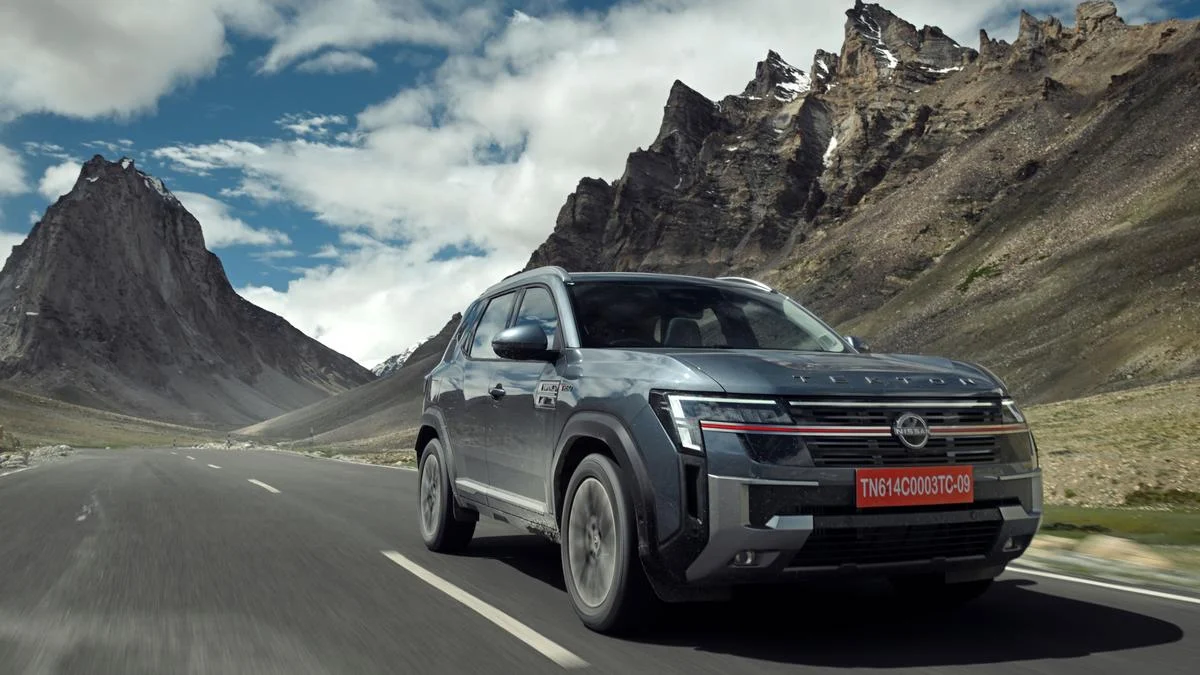
The mid-size SUV segment in India is perhaps the most scrutinized and competitive arena in the global automotive landscape. For a manufacturer to succeed here, a product must offer more than just utility; it requires a distinct identity, robust engineering, and a touch of premium aspiration. Enter the Nissan Tekton.
The immediate narrative surrounding the Tekton is one of shared lineage. Is it merely a Renault Duster in a different suit? While the two SUVs share the CMF-B platform, powertrains, and underlying skeletal architecture, a 700-kilometer expedition from the plains of Chandigarh to the high-altitude passes of Leh reveals a more nuanced story. The Tekton is not a simple exercise in badge engineering; it is a calculated, premium reinterpretation of a proven mechanical foundation, designed to challenge the status quo of the Indian SUV market.
1. Main Facts: Positioning the Tekton in a Crowded Market
The Nissan Tekton arrives with a clear mandate: to offer a sophisticated alternative to the utilitarian charm of its cousin, the Renault Duster, while taking the fight directly to established leaders like the Hyundai Creta and Kia Seltos. Launched with an aggressive price bracket ranging from ₹10.49 lakh to ₹18.59 lakh (ex-showroom), the Tekton seeks to capture both the value-conscious buyer and the premium enthusiast.
Key Specifications at a Glance:
- Platform: Shared CMF-B architecture.
- Engine Options: 1.0L Turbo (T160) and 1.3L Turbo (T280).
- Performance: Up to 163PS and 280Nm of torque.
- Ground Clearance: A segment-leading 212mm.
- Safety: 5-star Bharat NCAP rating with six airbags as standard.
- Key Rivals: Hyundai Creta, Kia Seltos, Skoda Kushaq, Volkswagen Taigun, and the Honda Elevate.
The Tekton distinguishes itself through a design philosophy heavily influenced by Nissan’s global icons, most notably the Nissan Patrol. By leveraging this "big SUV" DNA, Nissan has managed to give the Tekton a visual gravity that belies its mid-size dimensions.

2. Chronology: From the Streets of Chandigarh to the Gates of Ladakh
To truly test the mettle of a vehicle that claims to be more than a "soft-roader," a standard city test drive is insufficient. Our evaluation spanned three days and over 700 kilometers, traversing some of the most demanding terrains in the world.
Phase I: The Highway Sprint (Chandigarh to Manali)
The journey began on the smooth blacktop of the Himalayan Expressway. This segment allowed the T280 engine—a 1.3-litre four-cylinder direct-injection turbo-petrol—to showcase its cruising capabilities. Paired with a six-speed Dual Clutch Transmission (DCT), the Tekton felt composed at triple-digit speeds. The focus here was on NVH (Noise, Vibration, and Harshness) levels, which Nissan has significantly improved over the platform’s previous iterations. The cabin remained a quiet sanctuary, even as the wind speeds picked up near the foothills.
Phase II: The Ascent (Manali to Jispa)
As the gradient steepened, the Tekton’s mechanical heart was put to the test. The climb toward the Atal Tunnel and beyond into the Lahaul Valley introduced sharp hairpins and thinning air. Here, the 280Nm of torque became the vehicle’s greatest asset. While the 1.0-litre T160 variant would have struggled under full load, the T280 pulled with authority once past the initial turbo lag. The "Heavy" steering mode was engaged to provide more feedback through the winding mountain passes, offering the driver a sense of precision often lacking in this segment.
Phase III: The Trial by Fire (Jispa to Leh)
The final leg involved broken tarmac, water crossings, and the infamous "Gata Loops." This is where the Tekton’s 212mm ground clearance and suspension tuning shone. Unlike many rivals that feel brittle over sharp ruts, the Tekton’s chassis—honed through its Duster ancestry—absorbed punishment with a level of compliance that felt almost "old-school" in its ruggedness, yet modern in its control. By the time the vehicle rolled into Leh, it had proven that its "premium" badge was backed by genuine mechanical endurance.

3. Supporting Data: Engineering and Interior Sophistication
The Tekton’s appeal is rooted in a data-driven approach to what Indian consumers value: presence, features, and performance.
Design and Aesthetics
Nissan’s designers have moved away from the rounded, soft edges of the previous generation. The Tekton features:
- C-Shaped DRLs: A signature lighting element that widens the visual stance.
- Sculpted Bonnet: Adds a muscularity that mirrors the Patrol.
- 18-inch Alloys: Available on higher trims, these fill the chunky wheel arches perfectly, contributing to the 212mm clearance.
- Pillar-Mounted Handles: A nod to Nissan’s design heritage, maintaining a clean side profile.
The "Purple" Interior Strategy
Inside, Nissan has taken a bold risk with color palettes. Moving away from the ubiquitous "beige and black" or "all-black" interiors, the Tekton introduces deep purple detailing. While polarizing, the data suggests that younger buyers are looking for "personality" over "predictability."
Technological Suite:

- Infotainment: A 10.1-inch high-resolution touchscreen with wireless smartphone integration.
- Driver Display: A 10.25-inch digital cluster providing real-time navigation and ADAS alerts.
- Connectivity: Google built-in connectivity allows for seamless integration of maps and voice commands without relying solely on a tethered phone.
Powertrain Analysis
The T280 engine is the clear standout. Performance data shows a 0-100kph sprint in 9.51 seconds for the manual and 9.89 seconds for the DCT. Despite the performance, the claimed efficiency remains competitive at 18.5kpl (DCT). However, the data also highlights a weakness: turbo lag. Below 2,000 RPM, the engine feels muted, requiring the driver to downshift or wait for the boost to kick in—a characteristic that is particularly noticeable when starting on steep inclines.
4. Official Responses: Nissan’s Strategic Differentiation
While Nissan officials emphasize the "independent spirit" of the Tekton, they acknowledge the strategic benefits of the Renault-Nissan-Mitsubishi Alliance. The official stance is that the Tekton represents the "Premiumization of a Proven Platform."
By utilizing the CMF-B platform, Nissan saved years in research and development, allowing them to reinvest those resources into "customer-facing touchpoints." This includes the ADAS (Advanced Driver Assistance Systems) suite, the 3D Around View Monitor, and the localized suspension tuning.
Nissan’s spokesperson noted during the drive that the Tekton is aimed at the "adventurous professional"—someone who needs a vehicle for the daily commute but refuses to be limited by the city’s boundaries on weekends. This explains the decision to skip a hybrid powertrain for now, focusing instead on high-output turbo-petrols that offer the "thrill of the drive" over the "efficiency of the commute."

5. Implications: Reshaping the Mid-Size SUV Hierarchy
The arrival of the Tekton has significant implications for the Indian automotive market and the Nissan brand specifically.
For the Consumer
The Tekton provides a "third way." For a long time, buyers had to choose between the feature-rich but somewhat "soft" Korean SUVs or the rugged but "feature-poor" European counterparts. The Tekton attempts to bridge this gap. It offers the ride quality of a Duster with the tech-savviness of a Creta.
For the Competition
The Tekton’s 5-star Bharat NCAP rating puts immense pressure on rivals who have historically struggled with safety perceptions. Furthermore, its 518-litre boot space and genuine rough-road capability make it a more practical choice for the growing "touring" culture in India.
The Missing Piece: The Hybrid Gap
Despite its strengths, the lack of a hybrid or diesel option is a glaring omission. As fuel prices fluctuate and urban congestion grows, rivals like the Maruti Suzuki Grand Vitara and Toyota Hyryder offer a fuel-sipping alternative that the Tekton cannot currently match. Nissan is betting that the "performance and presence" of the T280 will outweigh the "frugality" of hybrids for their target demographic.

Conclusion: A Purpose-Built Contender
The road to Leh is a graveyard for vehicles that are all style and no substance. By the end of our 700km journey, the Nissan Tekton had earned its place among the elite. It successfully navigates the fine line between being a "badge-engineered" twin and a standalone premium product.
While the turbo lag and the lack of a hybrid powertrain are legitimate points of contention, they are overshadowed by the vehicle’s exceptional ride quality, commanding design, and robust build. At ₹10.49 lakh to ₹18.59 lakh, it offers a compelling value proposition for those who view their vehicle not just as a tool for transportation, but as a partner in exploration.
Nissan may have borrowed the foundations from Renault, but with the Tekton, they have built a house that is uniquely, and impressively, their own. For the driver who values the confidence to venture where the tarmac ends, the Tekton isn’t just a choice—it’s a recommendation.
Motorscribes, in association with The Hindu, brings you the latest in cars and bikes. Follow them on Instagram @motorscribes for more in-depth reviews and automotive news.
