

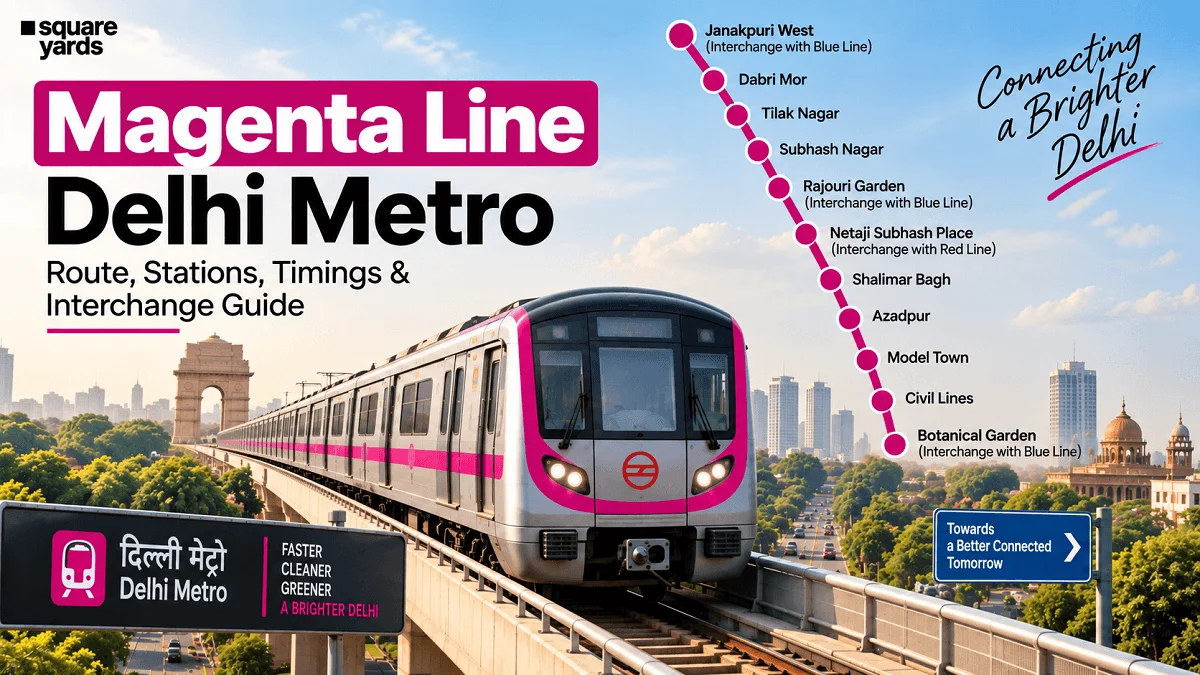
New Delhi — As of late 2026, the Delhi Metro Magenta Line (Line 8) has solidified its position as one of the most technologically advanced and strategically vital arteries in the National Capital Region (NCR). Stretching across 58.6 kilometers and serving 25 key stations, the line acts as a high-speed bridge connecting the residential hubs of West Delhi, the premium corridors of South Delhi, and the burgeoning commercial expressway of Noida.
This comprehensive report explores the current state of the Magenta Line, its operational efficiency, its profound impact on real estate, and its role in the broader Phase IV expansion of the Delhi Metro Rail Corporation (DMRC).
1. Main Facts: The "Knowledge Corridor" of Delhi
The Magenta Line is frequently referred to by urban planners as the "Knowledge Corridor" due to its direct connectivity to premier educational institutions, including the Indian Institute of Technology (IIT) Delhi and Jamia Millia Islamia.
Operational Overview
Identified by its deep pink/magenta color on the official map, Line 8 operates as a semi-orbital corridor. Unlike the radial lines that converge at the city center (Rajiv Chowk), the Magenta Line allows commuters to bypass the congested heart of the city, significantly reducing travel time between the western and eastern suburbs.
- Total Distance: 58.6 km
- Total Stations: 25
- Terminals: Janakpuri West (West) and Botanical Garden (East)
- Interchanges: 4 major junctions (Janakpuri West, Hauz Khas, Kalkaji Mandir, Botanical Garden)
- Unique Feature: Implementation of Unattended Train Operation (UTO) or "driverless" technology, which has enhanced frequency and safety standards by 2026.
2. Chronology: From Phase III Milestone to Phase IV Integration
The evolution of the Magenta Line is a testament to Delhi’s rapid infrastructure growth.
- 2017: The first section between Botanical Garden and Kalkaji Mandir was inaugurated, providing the first-ever direct link between Noida and South Delhi.
- 2018–2019: The full corridor to Janakpuri West became operational, introducing the deepest station in the network at Hauz Khas (29 meters underground) and the tallest escalator at Janakpuri West.
- 2023–2025: DMRC focused on upgrading signaling systems and integrating the line with the first stages of Phase IV.
- 2026 Status: The Magenta Line is now being extended as part of Phase IV, with the Janakpuri West to RK Ashram Marg extension nearing completion. This 28.92 km extension will add 22 more stations, eventually making Line 8 a massive circular-style loop that touches North Delhi.
3. Supporting Data: Stations, Timings, and Fare Guide
For the daily commuter in 2026, the Magenta Line offers a blend of speed and affordability. Below is the detailed breakdown of the current route and operational logistics.
Full Station List and Interchange Points
| # | Station Name | Area / Locality | Interchange |
|---|---|---|---|
| 1 | Janakpuri West | Janakpuri / Vikaspuri | Blue Line / Phase IV Extension |
| 2 | Dabri Mor – Janakpuri South | Dabri / Dwarka | None |
| 3 | Dashrathpuri | Palam | None |
| 4 | Palam | Palam Village | None |
| 5 | Sadar Bazar Cantonment | Delhi Cantonment | None |
| 6 | Terminal 1 IGI Airport | Domestic Airport | Domestic Terminal Access |
| 7 | Shankar Vihar | NH-8 / Vasant Kunj | None |
| 8 | Vasant Vihar | Vasant Vihar / RK Puram | None |
| 9 | Munirka | Munirka / JNU Periphery | None |
| 10 | R.K. Puram | RK Puram Sectors | None |
| 11 | IIT Delhi | IIT Campus / SDA | None |
| 12 | Hauz Khas | Hauz Khas / Enclave | Yellow Line |
| 13 | Panchsheel Park | Panchsheel / Soami Nagar | None |
| 14 | Chirag Delhi | Chirag Delhi / Sheikh Sarai | None |
| 15 | Greater Kailash | GK 1 & 2 | None |
| 16 | Nehru Enclave | Nehru Place / Kalkaji | None |
| 17 | Kalkaji Mandir | Kalkaji / CR Park | Violet Line |
| 18 | Okhla NSIC | Okhla Phase III | None |
| 19 | Sukhdev Vihar | Sukhdev Vihar | None |
| 20 | Jamia Millia Islamia | Jamia Campus | None |
| 21 | Okhla Vihar | Okhla / Abul Fazal | None |
| 22 | Jasola Vihar Shaheen Bagh | Jasola / Shaheen Bagh | None |
| 23 | Kalindi Kunj | Kalindi Kunj | None |
| 24 | Okhla Bird Sanctuary | Noida Sector 94/95 | None |
| 25 | Botanical Garden | Noida Sector 37/18 | Blue Line |
2026 Timings and Frequency
The DMRC has optimized the Magenta Line to handle massive peak-hour surges, particularly at the Hauz Khas and Janakpuri West interchanges.
- First Train: 05:30 AM (from terminal stations).
- Last Train: 11:30 PM (Janakpuri West) / 11:00 PM (Botanical Garden).
- Peak Hours (08:00 – 10:00 / 17:00 – 20:00): Trains every 4 to 5.5 minutes.
- Off-Peak Hours: Trains every 7 to 10 minutes.
Fare Structure
The fare remains consistent with the DMRC’s distance-based criteria. As of 2026, the maximum fare for a single journey on this line is Rs. 60.
| Distance (km) | Token Fare (Rs) | Smart Card Fare (Rs) |
|---|---|---|
| 0–2 | 10 | 9 |
| 2–5 | 20 | 18 |
| 5–12 | 30 | 27 |
| 12–21 | 40 | 36 |
| 21–32 | 50 | 45 |
| Above 32 | 60 | 54 |
4. Official Responses: Safety and Innovation
The DMRC has maintained a proactive stance regarding the Magenta Line’s unique technological requirements. In official statements released in mid-2026, the DMRC emphasized that the Magenta Line serves as a "testing ground" for future automated systems across India.
"The Magenta Line’s success in Unattended Train Operation (UTO) has allowed us to increase the throughput of passengers without compromising safety," a DMRC spokesperson stated. "With the integration of the Phase IV extension, we expect the Janakpuri West hub to become one of the busiest transit points in Asia, rivaling the footfalls of Rajiv Chowk."
Furthermore, safety measures have been enhanced at Terminal 1 IGI Airport station, with improved underground tunnel ventilation and high-speed elevators to facilitate elderly travelers and those with heavy luggage.
5. Implications: Real Estate and Urban Mobility
The Magenta Line has done more than just move people; it has fundamentally reshaped the real estate geography of Delhi and Noida.
The Rise of "Metro-Centric" Living
Localities that were once considered "isolated" or "congested" in West Delhi, such as Palam and Dabri, have seen a 35-45% appreciation in property values since the line became fully operational. The ease of reaching South Delhi in 20 minutes from Palam has made these areas highly desirable for mid-income professionals.
South Delhi’s Premium Surge
In South Delhi, the Magenta Line provides a "backdoor" entry to posh colonies like Greater Kailash, Vasant Vihar, and Panchsheel Park. While these areas were always premium, the presence of the metro has increased the rental yield for "builder floors," as young professionals working in Noida’s IT sectors or Gurugram’s corporate hubs (via the Yellow Line interchange) prefer these central locations.
The Noida-Expressway Connection
The Botanical Garden interchange is the gateway to the Noida Expressway. This has spurred a massive commercial boom in Noida Sectors 125, 126, and 135. Professionals can now live in the more affordable pockets of South-East Delhi (like Jasola or Kalkaji) and commute to Noida in under 15 minutes.
Airport Connectivity: A Game Changer
The Terminal 1 IGI Airport station on the Magenta Line is perhaps its most significant contribution to city logistics. By providing a direct link for domestic flyers, the line has decongested the Rao Tula Ram Marg and the Outer Ring Road. For travelers from Noida or South Delhi, the Magenta Line is now the preferred choice over the expensive Airport Express Line or unpredictable cab services.
6. Conclusion: The Future of Line 8
As we look toward the end of 2026 and into 2027, the Magenta Line is poised for its next transformation. The completion of the Phase IV extension will turn this line into a 87-km mega-corridor, reaching deep into North Delhi and connecting with the Red Line and the Pink Line at multiple points.
The Magenta Line is no longer just a "new addition" to the Delhi Metro; it is the backbone of a modern, decentralized Delhi. It represents the shift from a city that travels to a center to a city that travels around its vibrant, interconnected neighborhoods. For property buyers, commuters, and students alike, the Magenta Line is the definitive pulse of the capital’s movement.
Frequently Asked Questions (FAQ)
1. How long does it take to travel from Janakpuri West to Botanical Garden?
The end-to-end journey takes approximately 65 to 75 minutes, covering 58.6 km.
2. Can I reach the International Airport (T3) via the Magenta Line?
The Magenta Line directly serves Terminal 1 (Domestic). For Terminal 3 (International), passengers should take the Airport Express Line (Orange Line) from New Delhi Station or Dwarka Sector 21. However, a shuttle service often connects T1 and T3.
3. Which is the deepest station on the Magenta Line?
Hauz Khas is the deepest station on the entire Delhi Metro network, situated 29 meters below ground level to accommodate the interchange with the Yellow Line.
4. Is the Magenta Line fully driverless?
Yes, as of 2026, the Magenta Line utilizes the Unattended Train Operation (UTO) system, though roaming attendants are often present for passenger assistance and emergency overrides.
5. How does the Magenta Line benefit students?
It provides direct access to IIT Delhi (IIT station) and Jamia Millia Islamia (Jamia station), while also making South Campus (via the Durgabai Deshmukh South Campus interchange on the Pink Line, accessible through a short hop) much easier to reach from West Delhi and Noida.
