

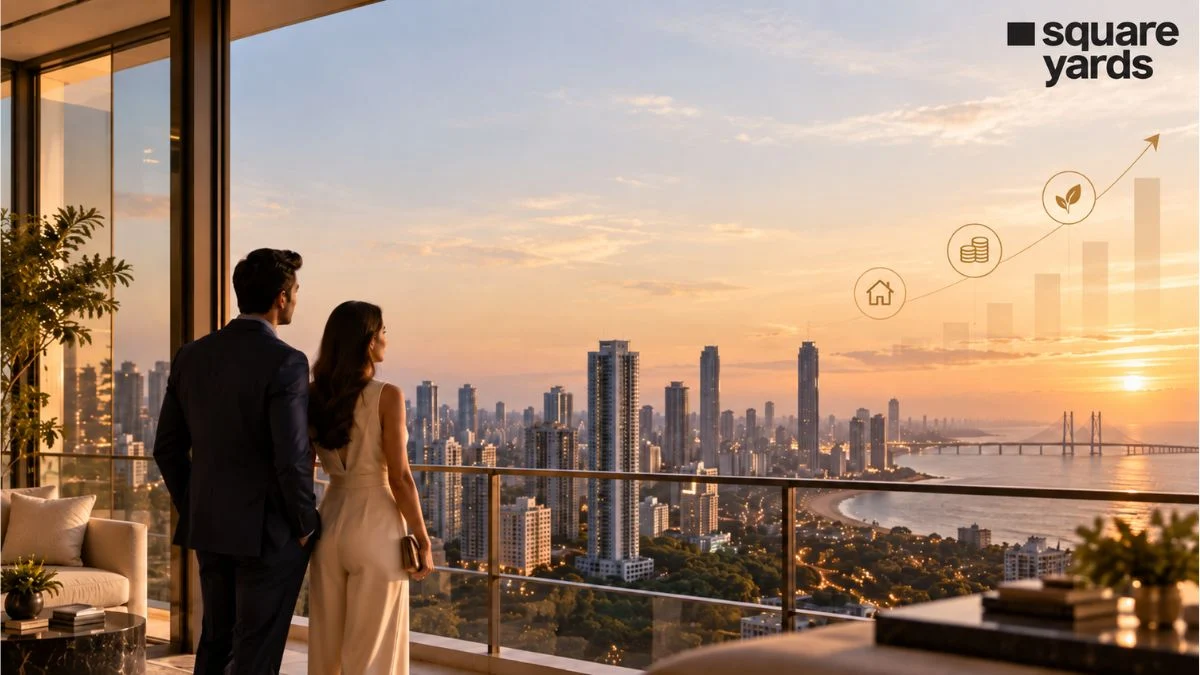
MUMBAI – The skyline of India’s financial capital is undergoing a transformation that transcends mere height and glass facades. As of September 2026, the Mumbai luxury housing market—specifically the segment comprising residences priced at Rs 10 crore and above—is witnessing a fundamental paradigm shift. No longer content with the mere prestige of a PIN code, Mumbai’s ultra-high-net-worth individuals (UHNWIs) are redefining "luxury" through the lenses of long-term value, architectural integrity, and holistic liveability.
According to recent market data for the first half of the calendar year 2026 (H1 CY26), the city has seen a staggering 26% year-on-year growth in luxury sales. However, the narrative is not just about the volume of transactions; it is about a sophisticated change in buyer psychology. The modern Mumbai affluent buyer is moving away from "conspicuous consumption" toward "conscious investment," prioritizing how a home functions as both a sanctuary and a legacy asset.
Main Facts: A Market in Surge
The first half of 2026 has solidified Mumbai’s position as the premier destination for luxury real estate in South Asia. The data reveals several key pillars of this current market state:
- Sales Velocity: Luxury housing sales (Rs 10 Cr+) have surged by 26% compared to H1 2025, defying global headwinds and proving the resilience of the Indian domestic economy.
- The Value Transition: Buyers are moving beyond the "address-only" mentality. While South Mumbai and North Worli remain iconic, the criteria for purchase now include construction technology, sustainability certifications, and the reputation of the developer.
- Investment Parity: For the first time in recent years, the gap between "end-use" and "investment" has narrowed significantly. Data from India Sotheby’s International Realty indicates that 53% of luxury buyers are motivated by capital appreciation, while 47% buy for personal use.
- Branded Dominance: The "Branded Residence" model has moved from a niche offering to a market leader, as buyers seek the institutional trust and service standards associated with global hospitality or luxury design brands.
Chronology of the Luxury Evolution (2021–2026)
To understand the 2026 landscape, one must look at the five-year trajectory that reshaped the Mumbai property market.
- 2021–2022: The Post-Pandemic Expansion. Following the global lockdowns, the primary driver was "size." Wealthy families sought to exit cramped older apartments for larger footprints where home offices and private gyms were possible. The secondary market began its steady climb, averaging 30% of total luxury transactions.
- 2023–2024: The Amenity Arms Race. Developers responded to the demand for space by adding "clubhouse" features—infinity pools, spas, and cigar lounges. However, the market began to saturate with "cookie-cutter" luxury, leading buyers to start looking for more unique architectural expressions.
- 2025: The Rise of Infrastructure. With the completion of major connectivity projects like the Mumbai Trans Harbour Link (MTHL) and the expansion of the Coastal Road, the definition of "prime" began to expand. New micro-markets emerged, offering luxury at a better value proposition than the traditional "Old Money" belts.
- 2026 (Current): The Value-Driven Era. As reported in The Wealth Report 2026 by Knight Frank, luxury consumption has shifted from "acquisition" to "experience." Buyers now demand "optimized" space rather than just "excessive" space.
Supporting Data: The Concentration of Wealth
The concentration of luxury sales in Mumbai remains highly localized, yet the internal dynamics of these micro-markets are changing.
Micro-Market Dominance
In H1 CY26, the top 10 localities in Mumbai—including Worli, Malabar Hill, BKC, and the emerging luxury clusters in Juhu and Versova—contributed a massive 80% of the total primary luxury sales value. This suggests that while buyers are value-conscious, they still prefer established or rapidly appreciating hubs over speculative peripheral locations.
The Secondary Market Stability
The resale or secondary market for luxury homes has maintained a consistent share of approximately 30% of transactions since 2021. This stability indicates that luxury real estate in Mumbai is being viewed as a "hold" asset. Sellers are not exiting in panic; rather, they are trading up, further fueling the cycle of wealth creation within the real estate sector.
Valuation and Appreciation
Year-on-year, luxury housing prices in Mumbai have seen a steady upward climb for five consecutive years. This consistent growth has validated the 53% of buyers who view their home as a capital appreciation vehicle. The "home-as-an-asset" philosophy is now the dominant driver for the Rs 10 crore-plus segment.
Official Responses and Expert Insights
Industry leaders suggest that the current trend is a sign of a maturing market. Manan Joshi, Founder at Sarvam Properties, provides a nuanced perspective on this evolution. According to Joshi, the shift is deeply tied to the changing physical and financial landscape of the city.
"The affluent buyer today is more evaluative than ever," Joshi notes. "They are looking at the ‘overall proposition.’ It’s no longer just about the gold leafing in the lobby; it’s about the approvals in place, the construction quality, and the delivery timelines. In Mumbai, the scarcity of land will always keep prices high, but the modern buyer is asking: ‘What is this property doing for my lifestyle and my portfolio?’"
Joshi further emphasizes that connectivity is a major catalyst. "As infrastructure development across the region improves, the ‘value’ of a property is being recalculated. A luxury home is now seen as an enabler of lifestyle upgrades—it’s a business zone, a wellness retreat, and an inter-generational legacy asset all rolled into one."
Financial advisors to the UHNWI segment also report a move toward "streamlining." Wealthy families are increasingly seeking professional advisors to manage their real estate holdings, treating their property portfolios with the same rigor as their equity or debt portfolios.
Deep Dive: The New Standards of "Value-Driven" Luxury
What does "value" actually look like in a Rs 50 crore or Rs 100 crore apartment? The 2026 market has identified several non-negotiable features:
1. Wellness and Biophilic Design
The 2026 buyer views health as the ultimate luxury. This has translated into a demand for:
- Advanced Air Filtration: Hospital-grade HEPA filtration systems integrated into the HVAC.
- Circadian Lighting: Systems that mimic natural light cycles to improve sleep and productivity.
- Private Greenery: Not just a balcony, but "sky gardens" and biophilic walls that bring nature into the high-rise environment.
2. Privacy and Low Density
As Mumbai becomes more crowded, "silence and space" have become the rarest commodities. Value is now found in "low-density" projects—buildings with fewer units per floor, private elevators that open directly into the foyer, and sophisticated acoustic engineering to block out the city’s cacophony.
3. The Branded Residence Assurance
The rise of branded residences in Mumbai is a direct response to the "trust deficit" in high-ticket transactions. By associating with brands like Ritz-Carlton, Four Seasons, or renowned designers, developers provide an implicit guarantee of maintenance and service. For the buyer, the "value" lies in the ease of ownership and the higher resale premium that branded properties typically command.
4. Functional Optimization
The "dead space" of 2010s-era mansions is being replaced by "smart" layouts. This includes:
- Multipurpose Studios: Spaces that can transition from a yoga room to a high-tech podcast studio.
- Business Zones: With the permanent shift toward hybrid work for C-suite executives, home offices are now designed with professional-grade video conferencing and soundproofing.
Implications: The Road Ahead for H2 2026 and Beyond
The shift toward value-driven luxury has significant implications for all stakeholders in the Mumbai ecosystem.
For Developers: The days of selling "glamour" alone are over. To capture the H2 2026 market, developers must establish a clear value proposition. This means transparency in construction milestones, adopting sustainable building practices (which are increasingly linked to property valuation), and offering post-sales property management services.
For Investors: Real estate has reclaimed its spot as a core asset for capital preservation. With 53% of buyers looking for appreciation, the focus will remain on "scarcity value." Properties in land-locked South Mumbai or high-demand hubs like BKC will continue to see the highest "prestige premium."
For the City: The demand for "higher-quality surrounding infrastructure" puts pressure on urban planners. The luxury buyer of 2026 is not just buying a home; they are buying the neighborhood. This will likely lead to more public-private partnerships to improve the "last-mile" aesthetics and functionality of luxury micro-markets.
Conclusion
As Mumbai moves into the latter half of 2026, the luxury housing market stands as a testament to the city’s economic maturity. The transition from status-driven to value-driven buying marks the end of an era of excess and the beginning of an era of intentionality. In this high-stakes environment, the question for the affluent is no longer "How much does it cost?" but rather "What does it truly offer?" For the Mumbai developer, the challenge is clear: build not just for the eyes, but for the legacy of the inhabitant.
