

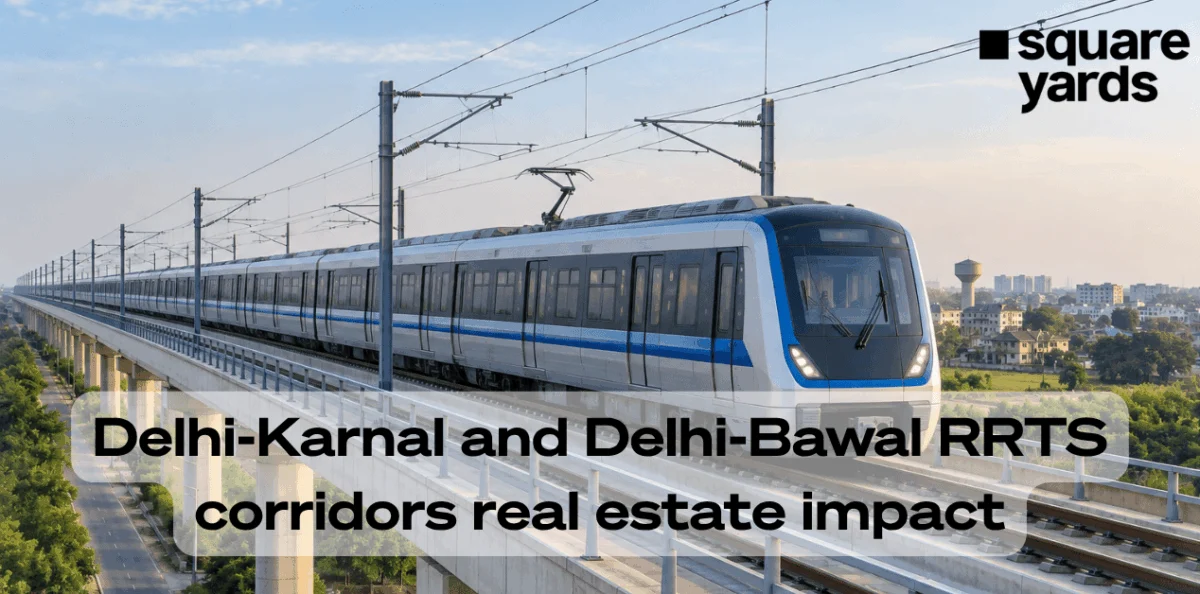
New Delhi | September 15, 2026 — In a move set to fundamentally redefine the geography of the National Capital Region (NCR), the Central Government has accelerated the review process for two massive extensions of the Namo Bharat Regional Rapid Transit System (RRTS). These new corridors—the Delhi-Karnal and Delhi-Bawal routes—aim to stitch together the industrial, residential, and agricultural heartlands of Haryana with the national capital, effectively shrinking travel times and catalyzing a new wave of urban development.
As the National Capital Region Transport Corporation (NCRTC) moves closer to securing final clearances, the project promises to transition the NCR from a collection of satellite towns into a highly integrated mega-region. With high-speed rail technology capable of reaching 160 kmph, the corridors are poised to offer a sustainable, efficient alternative to the increasingly congested national highways.
1. Main Facts: A Dual-Pronged Connectivity Revolution
The proposed expansion focuses on two primary axes of growth: the northern corridor toward Karnal and the southwestern corridor toward Bawal.
The Delhi-Panipat-Karnal Corridor
This ambitious route spans approximately 136.30 km, originating from the multi-modal hub at Sarai Kale Khan in Delhi and terminating in the historic city of Karnal.
- Total Stations: 22
- Key Stops: Sonipat, Gannaur, Samalkha, and Panipat.
- Financial Outlay: The project is estimated to cost approximately ₹33,051 crore.
- Travel Efficiency: The journey from Delhi to Karnal, which currently takes nearly three hours by road depending on traffic at the Singhu border, is expected to be slashed to just 90 minutes.
The Delhi-Gurugram-Bawal Corridor
Extending 107 km, this corridor targets the industrial backbone of Haryana. It starts at Sarai Kale Khan and traverses the corporate and manufacturing powerhouses of the state.
- Key Stops: Gurugram, Manesar, Rewari, and Bawal.
- Strategic Importance: This route serves the Manesar-Bawal Investment Region (MBIR), a critical node for the automotive and manufacturing sectors.
- Travel Efficiency: Commuters can expect to travel from Delhi to Bawal in approximately 67 minutes, a fraction of the time currently required via the NH-48.
2. Project Chronology: From Concept to Detailed Project Reports
The evolution of the RRTS in India has been rapid, spurred by the success of the initial priority section of the Delhi-Meerut corridor.
- 2019–2023: The Foundation Phase: Following the approval of the first RRTS corridor (Delhi-Ghaziabad-Meerut), the NCRTC began identifying other high-density traffic corridors within the NCR. The "Namo Bharat" branding was adopted, signaling a new era of indigenous, high-speed regional rail.
- 2024–2025: Drafting and Submission: The NCRTC conducted extensive topographical surveys and demand assessments. Detailed Project Reports (DPRs) for the Delhi-Panipat (later extended to Karnal) and Delhi-Alwar (the first phase of which includes Delhi-Bawal) were drafted.
- Early 2026: Expansion of Scope: Responding to regional demands and economic projections, the Panipat corridor was extended to Karnal to include the educational and agricultural hub in the high-speed network.
- September 2026 (Current Status): The Union Ministry of Housing and Urban Affairs (MoHUA) and the Union Cabinet are currently reviewing the finalized DPRs. Preliminary work, including utility shifting and land identification, has commenced in several segments.
3. Supporting Data: Technical Specifications and Real Estate Dynamics
The Namo Bharat system is not merely a "faster train" but a sophisticated technological ecosystem designed for high-frequency, high-capacity transit.
Technical Prowess
- Design Speed: 180 kmph (Operational speed of 160 kmph).
- Frequency: Trains are scheduled to run every 15 minutes during the initial phase, with the capability to increase frequency to every 5–10 minutes based on demand.
- Multimodal Integration: The Sarai Kale Khan terminus acts as a "Grand Central," linking the RRTS to the Delhi Metro (Pink Line), the Inter-State Bus Terminus (ISBT), and the Indian Railways network.
Real Estate Impact and Price Insights
The "RRTS Effect" is already being felt in the real estate markets of peripheral cities. By bringing these towns within a 60-to-90-minute commute of Delhi, the RRTS is transforming them into viable residential options for the capital’s workforce.
According to data from Square Yards Research, the following price brackets define the current market across the proposed corridors:
| City | Average Residential Price (per sq. ft.) | Strategic Profile |
|---|---|---|
| Sonipat | ₹4,300 – ₹5,800 | Emerging education and residential hub. |
| Gannaur | ₹3,500 – ₹5,000 | Logistic and warehouse potential. |
| Panipat | ₹7,300 – ₹12,000 | Industrial/Textile hub with premium pockets. |
| Manesar | ₹9,000 – ₹12,000 | High-demand industrial and corporate zone. |
| Rewari | ₹5,500 – ₹8,000 | Residential expansion for industrial workforce. |
| Bawal | ₹2,000 – ₹3,500 | Industrial frontier with high growth potential. |
| Karnal | ₹5,000 – ₹15,000 | Established city with diverse residential options. |
Source: Square Yards Research
4. Official Responses: The Vision for a "Polycentric" NCR
Officials from the NCRTC and the Ministry of Housing and Urban Affairs have emphasized that these corridors are central to the government’s "Gati Shakti" vision.
A senior official from the NCRTC, speaking on the condition of anonymity, stated: "The goal is to move away from a monocentric model where everyone must live in Delhi to work in Delhi. By providing a reliable, airline-like experience on rails, we are encouraging a polycentric NCR. You can live in Karnal or Bawal and work in Gurugram or Central Delhi without the fatigue of a three-hour drive."
Urban planning experts have also lauded the move toward multimodal connectivity. The integration of RRTS stations with existing metro lines and bus stands ensures "last-mile connectivity," which has historically been the Achilles’ heel of Indian public transport.
Government representatives have also highlighted the environmental benefits. The shift from private vehicles to the RRTS is expected to significantly lower the carbon footprint of the NCR, reducing the number of cars on the perennially choked NH-44 (Delhi-Chandigarh) and NH-48 (Delhi-Jaipur).
5. Implications: Economic, Social, and Environmental
The arrival of the Namo Bharat corridors in Karnal and Bawal carries implications that extend far beyond simple transit.
Economic Transformation
The Delhi-Gurugram-Bawal corridor will act as a lifeline for the Manesar-Bawal Investment Region. By facilitating the easy movement of skilled labor from Delhi and Gurugram to the industrial plants in Bawal, the project is expected to boost manufacturing output. Similarly, the Karnal corridor will provide the textile industry of Panipat and the agricultural markets of Karnal with faster access to the national capital’s consumer base.
The "Commuter Shift" and Housing
As property prices in Delhi and Gurugram continue to skyrocket, the middle class is being pushed further out. The RRTS makes cities like Sonipat and Rewari "liveable" for those working in Delhi’s CBD or Gurugram’s Cyber City. We are likely to see a surge in "Transit-Oriented Development" (TOD), where high-density residential and commercial complexes are built within walking distance of RRTS stations.
Decongesting the Highways
The Delhi-Karnal route is one of the busiest road corridors in Northern India. The RRTS will provide a massive relief to the Singhu and Murthal bottlenecks. For the Bawal route, it offers an alternative to the Gurugram-Manesar expressway stretch, which is notorious for traffic gridlocks.
Socio-Cultural Integration
Improved connectivity often leads to better access to healthcare and education. Students from Karnal or Panipat will find it easier to attend universities in Delhi, while residents in smaller towns can access specialized medical facilities in the capital without the logistical nightmare of an overnight stay.
Challenges Ahead
Despite the optimism, challenges remain. Land acquisition in high-value areas like Gurugram and the massive capital expenditure required for the ₹33,000+ crore Karnal project will require seamless coordination between the Haryana state government and the Centre. Furthermore, maintaining the 15-minute frequency will require a high level of operational discipline and consistent power supply.
Conclusion
The expansion of the Namo Bharat RRTS to Karnal and Bawal represents a bold step toward a more mobile and economically vibrant India. By bridging the gap between industrial hubs and residential centers, the government is not just building a railway; it is building a corridor of opportunity. For the millions of commuters who currently spend hours in traffic, the promise of a 90-minute journey from the outskirts to the heart of the capital is a glimpse into a more efficient, less stressful future. As the proposals move through the final stages of approval, the eyes of the real estate industry, the corporate sector, and the common citizen remain fixed on the tracks ahead.
