

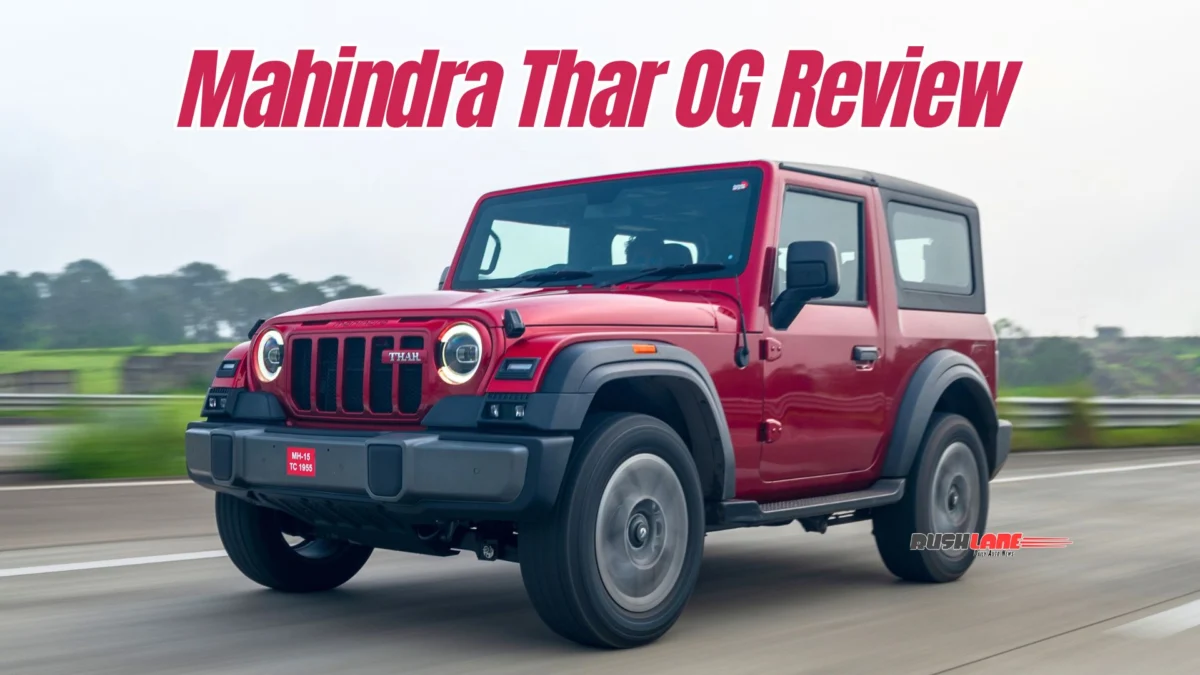
The Indian automotive landscape has witnessed several success stories, but few have captured the collective imagination of the public quite like the Mahindra Thar. What began as a utilitarian descendant of the Willys Jeep has transformed into a lifestyle phenomenon. In a strategic move to preserve the heritage of the three-door variant while introducing modern mechanicals, Mahindra has launched the facelifted model under a new moniker: the Mahindra Thar OG.
This update is far more than a cosmetic exercise. It represents a fundamental shift in the vehicle’s architecture, borrowing heavily from the engineering advancements seen in the five-door Thar Roxx. With a revised platform, sophisticated suspension geometry, and a repositioned trim hierarchy, the Thar OG aims to maintain its dominance in the lifestyle SUV segment.
1. Main Facts: The "OG" Rebirth
The Mahindra Thar OG serves as the spiritual and literal successor to the 2020 second-generation Thar. The "OG" (Original Gangster) suffix is a nod to its status as the original three-door short-wheelbase off-roader that revitalized the segment.

Pricing and Variants
Mahindra has structured the pricing to cater to both entry-level enthusiasts and those seeking a premium rugged experience. The range starts at Rs 10.32 lakh for the base AXT 1.5 Diesel Manual Transmission with Rear-Wheel Drive (RWD). At the summit sits the all-new ZXT trim, powered by the 2.2L Diesel engine with an Automatic Transmission and 4WD, priced at Rs 18.99 lakh (all prices ex-showroom).
Key Mechanical Changes
While the silhouette remains familiar, the "under-the-skin" changes are radical:
- Platform: Shifted to the M_Glyde 4G platform.
- Suspension: Introduction of a penta-link rear suspension with Watts linkage.
- Damping: Inclusion of DaVinci Frequency Dependent Dampers (FDD).
- Steering: Transition from hydraulic to Electric Power Steering (EPS).
- Braking: All-four disc brakes are now standard on higher trims.
2. Chronology: The Path to the OG Facelift
To understand the significance of the Thar OG, one must look at the timeline of its development:

- October 2020: Mahindra launches the second-generation Thar. It moves away from the bare-bones nature of the first generation, offering a crash-tested cabin, automatic transmissions, and a petrol engine for the first time. It becomes an overnight sensation with waiting periods extending beyond a year.
- 2023: Mahindra introduces the RWD (Rear-Wheel Drive) variants. By using a smaller 1.5L diesel engine and qualifying for "small car" tax benefits, the price point drops significantly, making the Thar accessible to a much wider audience.
- Early 2024: A minor "feature bump" update is released, adding basic amenities and new color options to keep the model fresh.
- August 2024: The launch of the Thar Roxx (5-door). This vehicle introduces a new level of luxury and mechanical sophistication to the Thar brand.
- September 2024: Mahindra integrates the learnings and hardware from the Roxx back into the 3-door model, officially rebranding it as the Thar OG. This ensures that the 3-door remains technologically relevant alongside its larger sibling.
3. Supporting Data: Aesthetics, Performance, and Interior
Exterior Design: Subtle Refinement
The Thar OG retains the iconic boxy proportions that owners love to customize. However, the factory refinements are notable. The front fascia features a revised six-slot grille with prominent "Thar" branding. The lighting system has been modernized with LED projector headlamps and C-shaped LED DRLs.
A significant aesthetic and functional upgrade is the move to 19-inch alloy wheels. These wheels, combined with the visible all-four disc brakes, give the SUV a more planted and premium stance. The rear remains largely unchanged, maintaining the signature split tailgate and spare-wheel mount, though the LED tail lamps have received a new internal signature.
Interior and Features
The cabin sees a mix of "more of the same" and "much-needed upgrades." The introduction of 6 airbags as standard is a massive leap forward for safety.

What’s New:
- Truffle Brown Leatherette Upholstery: Provides a more premium feel compared to the previous all-black cabin.
- Wireless Charging & Push-Button Start: Modern conveniences that were sorely missing.
- Rear Comfort: Passengers now get soft-touch armrests and a USB Type-C charging port.
What’s Missing:
Despite the "OG" branding, the 3-door model lacks several features found in the Thar Roxx. There is no Level-2 ADAS, no 360-degree camera, and no ventilated seats. Furthermore, the audio system remains a weak point, lacking the depth and clarity found in Mahindra’s other premium offerings like the XUV700 or the Roxx.
Powertrain and Performance
The Thar OG continues with the proven 2.0L mStallion Turbo Petrol and 2.2L mHawk Turbo Diesel engines. However, they have been recalibrated for better NVH (Noise, Vibration, and Harshness) levels.

| Engine | Displacement | Power (Approx) | Torque (Approx) |
|---|---|---|---|
| mStallion Petrol | 2.0L | 150 PS | 320 Nm |
| mHawk Diesel | 2.2L | 132 PS | 300 Nm |
| D117 Diesel (RWD) | 1.5L | 118 PS | 300 Nm |
The addition of Terrain Modes (Snow, Sand, Mud) and an Electronically Locking Rear Differential significantly enhances its off-road prowess, making the vehicle more forgiving for novice off-roaders while providing more control for experts.
4. Driving Dynamics: On-Road and Off-Road
The Electric Steering Revolution
The most immediate change for returning Thar owners is the steering. The old hydraulic unit was heavy and vibrated over bumps (kickback). The new Electric Power Steering is incredibly light, making city maneuvers and three-point turns effortless. While some purists might miss the "heft," the reduction in driver fatigue is undeniable.
Ride Quality and the "Watts" Factor
By utilizing the M_Glyde 4G platform and a penta-link rear suspension with a Watts linkage, Mahindra has attempted to tame the Thar’s legendary "bounciness." On broken tarmac, the DaVinci dampers work to absorb high-frequency vibrations.

However, physics cannot be entirely rewritten. Being a short-wheelbase, tall, ladder-frame SUV, the Thar OG still exhibits body roll. It is not a vehicle designed for high-speed cornering. Where it shines is its "indestructible" feel; you can maintain speeds over potholes and ruts that would force a premium monocoque crossover to a crawl.
5. Official Responses and Market Positioning
Mahindra’s decision to name this the "OG" is a calculated marketing masterstroke. By doing so, they have prevented the 3-door model from being viewed as "the old one" or "the cheap one" compared to the 5-door Roxx.
Targeting the "Purest"
In official communications, Mahindra emphasizes that the Thar OG is for the "purist"—the individual who values the maneuverability and classic proportions of a short-wheelbase vehicle. By keeping the 3-door alive with modern mechanicals, Mahindra is acknowledging that a significant portion of their fan base uses the Thar as a second or third vehicle specifically for its "cool factor" and off-road capability, rather than family practicality.

The Pricing Strategy
Industry analysts have noted the widening price gap between petrol and diesel variants. While the hardware remains largely consistent with the 2020 model, the price delta has grown to nearly Rs 1.4 lakh in some trims. Mahindra justifies this through the increased costs of meeting stricter emission norms and the inclusion of more sophisticated electronics and safety hardware.
6. Implications: The Future of the Lifestyle Segment
The launch of the Thar OG has several long-term implications for the Indian automotive market:
1. Cannibalization vs. Co-existence
There was concern that the Thar Roxx would kill the 3-door Thar. However, by upgrading the 3-door to the same platform, Mahindra has ensured that the two models serve different psychological needs. The Roxx is a primary family car; the OG is a statement piece and a weekend toy.

2. Pressure on Competition
The Maruti Suzuki Jimny, while a global legend, has struggled in India due to its smaller dimensions and less powerful engine. The Thar OG, with its 19-inch wheels and massive road presence, continues to overshadow the Jimny in the "desirability" index. Similarly, the Force Gurkha remains a niche choice for extreme off-roaders, lacking the service network and daily-driver refinement of the Thar OG.
3. The Customization Economy
The Thar OG remains a "blank canvas." The aftermarket industry for Thar accessories is worth hundreds of crores. By keeping the exterior design largely the same, Mahindra ensures that the existing ecosystem of bumpers, snorkels, and interior mods remains compatible, further fueling the vehicle’s popularity.
4. A Missed Opportunity?
The lack of a Soft-top Convertible option in the new OG lineup is a point of contention among enthusiasts. The convertible roof was a unique selling proposition that allowed for a "wind-in-the-hair" experience. Its absence suggests Mahindra is moving toward a more "civilized" and weather-sealed ownership experience, perhaps at the cost of some old-school charm.

Final Verdict
The Mahindra Thar OG is a triumph of evolution over revolution. It addresses the primary complaints of the previous model—heavy steering, primitive suspension, and lack of safety—while doubling down on the rugged charm that made it a household name.
While the pricing has crept into a territory where customers might expect more luxury features (like ADAS or a premium sound system), the Thar OG offers something no spec sheet can quantify: unmatched road presence and a sense of adventure. For those who want the definitive Indian off-roader, the "OG" remains the undisputed king of the hill. If you were already planning to buy a Thar, the OG facelift doesn’t just cement that decision—it rewards it with a vehicle that is finally as good to drive as it is to look at.
