

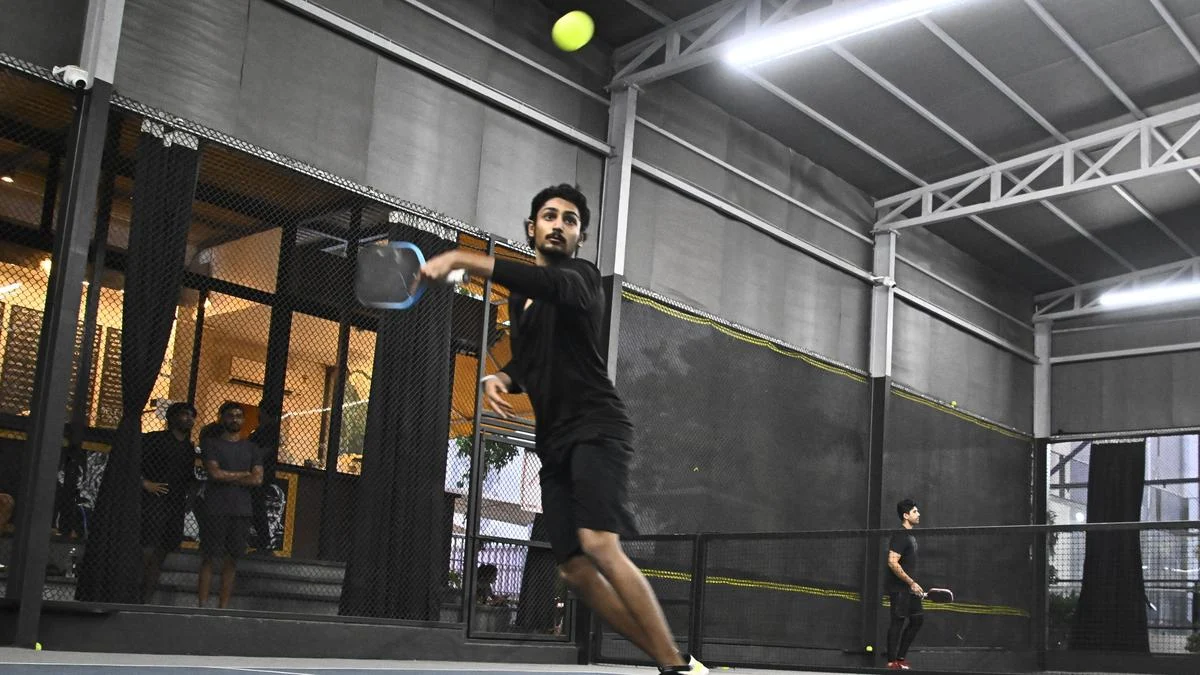
Hyderabad, India – The rhythmic snap of plastic balls against paddles, punctuated by the calls of players and the whir of a circulating crowd, has become an increasingly common soundtrack to weekday evenings across Hyderabad. What began as a niche social sport has rapidly evolved into a significant recreational phenomenon, with pickleball courts across the city buzzing with activity well past sunset. From the upscale environs of Jubilee Hills to the bustling IT hubs of Madhapur, the sport is attracting a diverse demographic, from corporate professionals seeking a post-work diversion to seasoned athletes looking for a new challenge. This surge in popularity, however, is also bringing to light a growing concern: an uptick in injuries, particularly among younger adults transitioning from sedentary desk jobs to the demands of the court.
The Unfolding Pickleball Landscape in Hyderabad
Hyderabad Paddle Park, a hub for the sport, exemplifies the game’s burgeoning appeal. Even on a typical weekday evening, its courts are rarely empty, showcasing a steady influx of players by 5 PM. The scene is characterized by a constant flow of action – the swift ascent and descent of paddles, the precise volleys across the net, and the efficient rotation of players moving between moments of intense play and brief periods of anticipation.
Dorlodhu Pradeep, a part-time coach at Hyderabad Paddle Park, has witnessed this transformation firsthand. "When pickleball first started gaining traction here, there were only about eight to ten courts available in the entire city," he notes. "Now, you can find dedicated courts in numerous localities, reflecting the immense demand."
This expansion has led to the emergence of distinct pickleball enclaves within the city. Jubilee Hills has become a prominent center, with Hyderabad Paddle Park and The Kitchen drawing consistent crowds during evening hours. In Madhapur, the Ayyappa Society’s Pickle Yard has become a favored destination for IT professionals, offering a convenient and accessible venue. For those seeking a more expansive sports campus environment, Gandipet’s Cross Court Sports provides a larger setting. Other frequently patronized locations include Dink N Dash and the Pullela Gopichand Academy, further solidifying pickleball’s widespread presence.
A significant development in the provision of these facilities has been the shift towards indoor courts. This transition has been driven by a dual imperative: to mitigate the effects of Hyderabad’s often-scorching climate and to meet the escalating demand for playable hours. The introduction of air-conditioned courts, while enhancing player comfort and extending playing opportunities, has also inadvertently positioned pickleball within a more premium bracket, reflecting the investment in these sophisticated facilities.
Demystifying the Game: What Exactly is Pickleball?
At its core, pickleball is a paddle sport that ingeniously blends elements from tennis, badminton, and table tennis. Played on a court that mirrors the dimensions of a badminton doubles court – considerably smaller than a tennis court – it utilizes solid paddles rather than stringed rackets. The game’s unique characteristic lies in its ball: a perforated plastic sphere that exhibits an often unpredictable trajectory after bouncing. A key rule in most pickleball formats dictates that the ball must bounce once before a volley can be executed. Scoring is typically exclusive to the serving side, adding a strategic layer to each point.

Doubles play is the most prevalent format in Hyderabad, with four players sharing a single court. This communal structure lends itself exceptionally well to social gatherings and casual play, contributing significantly to its accessibility and widespread adoption.
The origin of the sport’s distinctive name, "pickleball," is shrouded in various competing narratives, adding a layer of folklore to its burgeoning identity. One widely circulated explanation links the name to a dog named Pickles, who purportedly belonged to one of the sport’s co-inventors and would often fetch the errant balls. Another popular theory traces the name to the term "pickle boat" in rowing, which refers to a crew assembled from leftover members of different teams. Both of these explanations are frequently exchanged in online discussions and community forums, underscoring the sport’s growing cultural footprint.
Hyderabad’s Affinity for the Game: A Meteoric Rise
The initial spark for pickleball’s adoption in Hyderabad can largely be attributed to its pervasive presence on short-form video platforms across social media. These visually engaging snippets showcased the sport’s dynamic nature and apparent simplicity, quickly capturing the attention of a digitally-connected populace. Corporate groups, actively seeking novel team-building activities and employee engagement initiatives, were among the first to embrace the trend.
However, the initial perception of simplicity often belies the game’s underlying complexities. Many players discover this nuance within minutes of stepping onto the court. Darla Jyotirmayi, a finance professional hailing from Nanakramguda who makes the regular commute to Jubilee Hills to play, recalls her first encounter: "We kept seeing it online and finally decided to try it. Though it seemed simple at first, we soon discovered it wasn’t." This realization often stems from the challenge of accurately anticipating the ball’s bounce, a skill that requires practice and refinement.
Garikapati Madhavi, an engineer from Kukatpally who was trying the sport for the first time, echoed this sentiment of surprise. "Online videos never truly convey how difficult it is to judge the bounce," she remarked. "You think you know where the ball will go, and then you completely miss it." This inherent gap between the perceived ease of the game and the reality of its technical demands has, paradoxically, fueled its growth. Players, intrigued by the challenge and eager to improve their skills, find themselves returning to the courts, drawn by the desire to master the intricacies of pickleball.
The Diverse Tapestry of Pickleball Players
A casual evening spent observing pickleball courts across Hyderabad reveals a striking diversity in its player base. One encounters corporate teams embarking on their inaugural pickleball experiences, IT professionals arriving directly from their workplaces, and even teenagers with established tennis backgrounds approaching the game with a keen competitive spirit.

Gaurav Jha, a digital marketer from Ayyappa Society, Madhapur, first encountered pickleball during a corporate outing. "My boss explained the rules, and I just joined in," he recounted. "Soon, I realized the complexities of the game as I kept missing the ball. I struggled to connect with it initially." It took him a considerable five to six matches before he began to feel comfortable and proficient on the court.
Chandravela Yash, a dedicated player from KPHB, undertakes a commute of 30 to 50 minutes to reach The Kitchen in Jubilee Hills. As a competitive tennis player, he found the transition to pickleball relatively swift. However, he remains pragmatic about the sport’s challenges. "Tennis certainly helped me adjust," he stated. "But the ‘dink’ shot is the hardest to master, and consistency is paramount."
Kannur Gopi, from Begumpet, represents the more deeply committed segment of the pickleball community. A regular player at The Kitchen, he has rapidly progressed from casual play to participating in competitive tournaments within the span of less than a year. His dedication comes with a significant financial investment; he estimates spending upwards of ₹40,000 on court bookings, equipment, and shared costs. His high-performance carbon fiber paddles, priced at around ₹6,000, require replacement every three to four months due to the aggressive nature of his play. "Most other sports are cheaper," he admitted. "But once you start playing pickleball, it’s hard to stop."
The Financial Footprint of the Sport
The cost of engaging in pickleball varies considerably, influenced by factors such as the venue and the time of play. Smaller, more basic facilities may charge approximately ₹700 per hour for court rental. However, this figure escalates at premium indoor venues, which offer enhanced amenities and climate control. At Hyderabad Paddle Park, for instance, court time can cost around ₹1,500 per hour, while The Kitchen charges approximately ₹1,600 per hour for the same duration.
Beyond court fees, the acquisition of equipment represents another significant expenditure. Entry-level paddles typically range from ₹1,500 to ₹2,000, while advanced carbon fiber paddles, offering superior performance and durability, command a higher price point. The common practice of splitting court costs among four players helps to mitigate the individual financial burden, though it necessitates coordination among players or a willingness to join existing rotating groups.
Navigating the Learning Curve and Injury Prevention
The nuances of pickleball extend to the equipment itself. Experienced players often differentiate between indoor and outdoor balls, noting that indoor balls tend to be slower and lighter, while outdoor balls are faster and heavier. Neither behaves as intuitively as one might expect for newcomers. Wrist control emerges as an initial hurdle for many, with small technical errors significantly impacting consistency more than raw power.

To enhance safety and performance, the use of specialized court shoes is strongly recommended due to the constant lateral movements involved in the game. Standard running shoes, while offering cushioning, can increase the risk of ankle strains and sprains.
Dorlodhu Pradeep, from Hyderabad Paddle Park, emphasizes a universal principle applicable to all sports and fitness routines: "Most injuries occur when players skip warm-ups. People only take it seriously after they get hurt." He highlights that even a simple correction in wrist movement can dramatically transform a beginner’s game and reduce the likelihood of strain.
For individuals with prior racket sport experience, becoming comfortable with pickleball typically requires two to three sessions. Those without such a background may require a longer period to adapt. A deeper understanding and mastery of the game’s intricacies, however, generally develop over weeks of consistent play.
Currently, pickleball sessions in Hyderabad are evolving beyond mere sporting activities. They are transforming into vibrant community events, fostering social connections and a shared passion that revolves around the shared enthusiasm for the game played on the court. This communal aspect, coupled with the sport’s engaging blend of accessibility and challenge, suggests that pickleball’s trajectory in Hyderabad is poised for continued growth and deepening integration into the city’s recreational fabric.
