

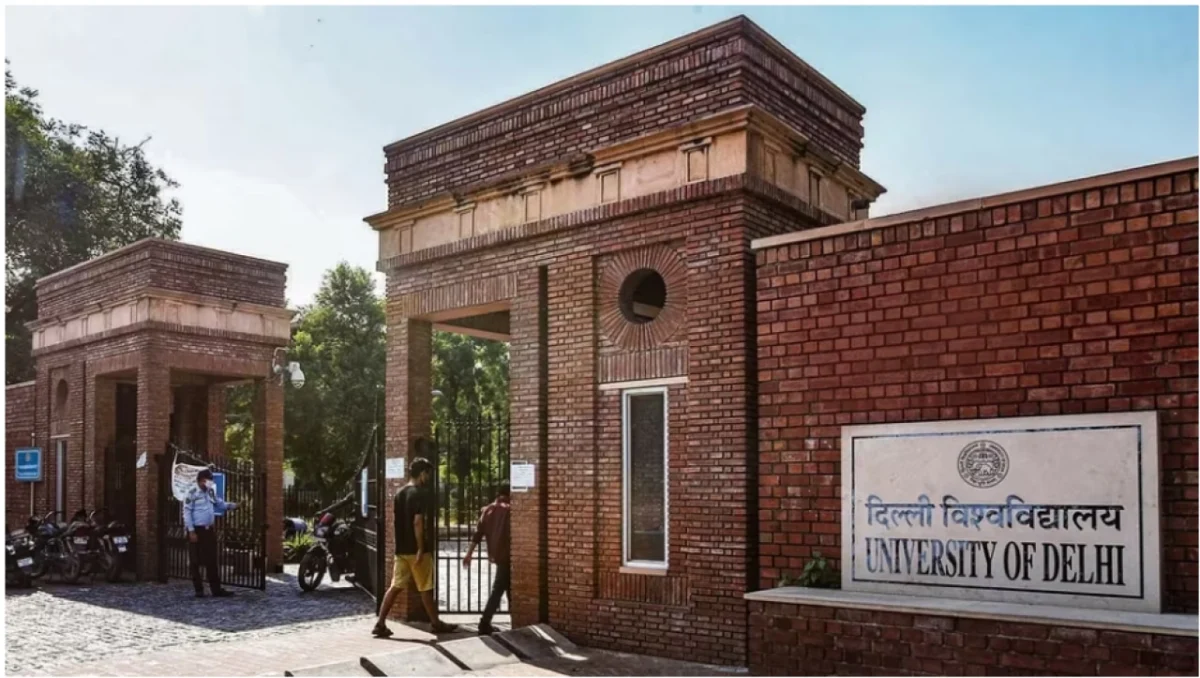
New Delhi – The Delhi University Students’ Union (DUSU), a vibrant hub of student politics and a barometer of campus sentiment, has undergone a remarkable transformation since its nascent stages in the immediate pre-independence era. What began as a modest proposal for a student union, envisioned with a mere Rs 150 grant in 1947, has burgeoned into one of India’s most closely watched and influential student bodies. Its journey mirrors the evolving landscape of student activism, institutional governance, and the increasing politicization of higher education in the nation.
The story of DUSU is not merely a chronicle of elections and office-bearers; it is a testament to the enduring power of student voice, its struggles for financial autonomy, its adaptation to changing constitutional frameworks, and its ultimate emergence as a significant platform for addressing critical issues facing students across the country.
The Genesis of a Union: A Vision for Student Representation
The foundational moments of DUSU are etched in the annals of Delhi University’s history, dating back to August 6, 1947, just weeks before India’s independence. On this pivotal date, the university’s Vice-Chancellor informed the Executive Council of a burgeoning desire among students to establish a formal representative body. This proposal, born out of a need for a collective voice, was readily accepted in principle. The university administration, acknowledging the significance of student participation, committed to forming a committee tasked with drafting the union’s constitution and outlining its operational procedures. A modest financial allocation of Rs 150 was earmarked to cover the initial expenses once the union was formally constituted. This seemingly small sum, however, represented a significant commitment to fostering student leadership and engagement within the university.
What commenced as a nascent institutional idea, driven by the aspiration of student representation, gradually evolved into a formidable platform. This platform now serves as a crucial conduit for students hailing from diverse colleges and faculties across the sprawling Delhi University network. The initial grant, though minimal by today’s standards, laid the groundwork for a structure that would eventually amplify student concerns and aspirations on a much larger scale.
)
Navigating Early Challenges: The Financial Tightrope Walk
The formative years of DUSU were not without their significant hurdles, particularly concerning financial stability. The union, like many nascent organizations, grappled with the challenge of securing adequate and consistent funding. Records from March 27, 1953, reveal a plea from the University Students’ Union for financial assistance. The university, while acknowledging the request, noted that Rs 500 had already been disbursed that year and emphasized the union’s imperative to strive for financial self-sufficiency. This early emphasis on fiscal responsibility underscored the university’s intention to foster an independent and sustainable student body.
The financial deficit, however, became more pronounced in the subsequent year. Data from March 14, 1954, starkly illustrated the disparity between expenditure and income. The union had incurred expenses totaling Rs 1,995, against an income of only Rs 815. This substantial shortfall highlighted the ongoing financial vulnerability of the organization.

Crucially, these records also marked a significant milestone: the formal adoption of a constitution for DUSU and the successful conduct of its inaugural elections. To navigate the immediate financial challenges and ensure continuity, a caretaker committee was proposed to manage the union’s affairs until the commencement of the following academic year. Furthermore, a directive was issued to restrict further spending, and a grant of up to Rs 1,100 was proposed to cover existing incurred expenses, contingent upon the approval of the submitted bills. These measures, while aimed at stabilizing the union, also underscored the delicate balance between institutional support and the pursuit of financial independence for student organizations.
A New Constitutional Framework: Structuring for Growth and Governance
The organizational and financial architecture of DUSU underwent a significant revision nearly two decades later. On August 2, 1973, the Executive Council deliberated on the need to supersede the existing constitution with a new, interim framework. This constitutional overhaul was a strategic move to introduce more robust financial controls and clearly define administrative roles within the union.
)
Under the new constitution, any expenditure exceeding Rs 100 required explicit approval from the union’s Executive Committee. This measure aimed to enhance accountability and prevent unbudgeted expenditures. The role of the Delhi University Vice-Chancellor was formally designated as the union’s patron, bestowing upon them an overarching advisory and supervisory capacity. Furthermore, the constitution stipulated the appointment of a Staff Advisor and a Treasurer, individuals to be drawn from the university’s teaching faculty and appointed by the patron, respectively. These appointments were intended to provide a link between the university administration and the student union, ensuring alignment with broader institutional objectives.
The revised constitution also clearly delineated the elected leadership structure. It provided for four key elected office-bearers: the President, Vice-President, Secretary, and Assistant Secretary. These positions were to be directly elected by the DUSU members, thereby reinforcing the democratic mandate of the union’s leadership. This constitutional reform marked a critical step in formalizing DUSU’s governance, laying the groundwork for its future operations and its role as a representative body.
)
The Pillars of Power: Key Posts within DUSU
The electoral landscape of DUSU is defined by four central positions, each carrying distinct responsibilities and wielding significant influence within the student community.
- President: The President serves as the chief spokesperson and primary representative of the DUSU. This role involves articulating student concerns to university authorities, engaging with external stakeholders, and leading the union’s initiatives.
- Vice-President: The Vice-President acts as a crucial support to the President, stepping into their shoes and assuming their duties in their absence. This role often involves deputizing for the President in meetings and representing the union at various forums.
- Secretary: The Secretary is primarily responsible for the administrative machinery of the union. This includes managing official correspondence, maintaining records, organizing meetings, and ensuring the smooth functioning of the union’s day-to-day operations.
- Joint Secretary: Under the current constitutional framework, the Joint Secretary plays a vital role in coordinating communication, facilitating events, and addressing student grievances. This position often serves as a bridge between the student body and the executive committee, ensuring that student issues are effectively channeled and addressed.
The current DUSU constitution further solidifies the Vice-Chancellor’s role as the patron, underscoring the university’s vested interest in the union’s activities. The constitution also articulates the union’s core objectives, which include effectively representing student interests before the university administration and actively promoting student welfare across all spheres of campus life.
)
The Evolving Cost of Representation: DUSU Membership Fees
The subscription fee for DUSU membership has remained remarkably consistent for several decades, reflecting a commitment to ensuring accessibility for all students. For an extended period, students were required to pay a nominal fee of Rs 5. This modest sum remained the standard until the 2012-13 academic year. Recognizing the need for increased resources to support the union’s growing activities and to keep pace with inflation, the fee was subsequently raised to Rs 20 for the 2013-14 academic year. More recently, on June 21, 2024, university officials confirmed a further increase to Rs 40, a move aimed at bolstering the union’s financial capacity to serve the student community more effectively. While these increases are proportionate, they signify the ongoing efforts to balance affordability with the operational needs of a large and dynamic student organization.
From Campus Polls to National Discourse: DUSU Elections as a Major Event
Over the decades, the Delhi University Students’ Union elections have transcended their role as mere internal campus polls to become significant events in the broader political and social fabric of Delhi. These elections have traditionally been characterized by the active participation of student groups with strong affiliations to national political organizations. Prominent among these are the Akhil Bharatiya Vidyarthi Parishad (ABVP) and the National Students’ Union of India (NSUI), the student wings of the Bharatiya Janata Party (BJP) and the Indian National Congress, respectively. Alongside these major players, Left-backed student groups, such as the All India Students’ Association (AISA) and the Students’ Federation of India (SFI), and a host of independent candidates consistently vie for these coveted positions.
)
The 2026 DUSU elections, for instance, witnessed a spirited contest for the four central posts, with the ABVP, NSUI, and the AISA-SFI alliance emerging as the primary contenders. The voting process, held on September 18, was followed by the counting of votes on September 19, commencing at 8 am at the Multipurpose Hall of the University Sports Stadium in North Campus. The election registered a voter turnout of 40.46%, a figure that, while not universally high, signifies active engagement from a significant segment of the student population. The intensity of the campaigning and the close nature of the results underscore the high stakes and the deep-rooted political engagement that characterizes these elections.
The Crucial Issues Defining the DUSU Elections
The discourse surrounding the 2026 DUSU elections was dominated by a spectrum of critical issues directly impacting the lives and well-being of students. Foremost among these were concerns related to student safety, the pressing need for affordable accommodation, and the enhancement of campus facilities.
)
A particularly poignant and tragic incident that brought student safety and accommodation issues into sharp focus was the collapse of a five-storey building in Satya Niketan, South Delhi. This building, which housed a boys’ Paying Guest (PG) accommodation, tragically resulted in the deaths of seven individuals, including students. The incident served as a stark reminder of the precarious living conditions faced by many students and amplified calls for stricter regulations and improved safety standards in off-campus student housing.
Beyond safety and accommodation, candidates and student organizations also vociferously raised issues pertaining to public transportation, the development and maintenance of campus infrastructure, and the overall security measures within the university premises. These issues reflect a growing maturity in student politics, with a greater emphasis on tangible aspects of student life and welfare, moving beyond purely ideological debates.
)
The Contenders in the 2026 DUSU Election Arena
The 2026 DUSU elections saw a robust field of candidates representing the major student political factions. The ABVP nominated Yash Dabas for the post of President, Ishu Maurya for Vice-President, Riya Chhawadi for Secretary, and Lakshya Raj Singh for Joint Secretary.
The NSUI fielded Vijay Shankar Meena as their presidential candidate, accompanied by Vir Chatrath for Vice-President, Namrata Chaudhary for Secretary, and Gopal Choudhary for Joint Secretary.
)
The AISA-SFI alliance presented a unified front with Ananya Raturi vying for the presidency, Akshat Shikhar for Vice-President, Stanzin Deskyong for Secretary, and B Parijaat for Joint Secretary.
As the counting of votes progressed on September 19, the leads in the four key races experienced dynamic shifts, painting a picture of a highly competitive and closely contested election. This ebb and flow of results highlighted the deeply engaged electorate and the nuanced preferences of the student voters, making the outcome a subject of intense speculation and analysis.
)
From a Rs 150 Proposal to a Nationally Watched Election: The Enduring Legacy of DUSU
The trajectory of the Delhi University Students’ Union is a powerful narrative of institutional evolution and the growing significance of student representation in India. What began in 1947 as a modest proposal for a student union, bolstered by a minimal grant, has, over nearly eight decades, transformed into a structured, democratically elected body with a comprehensive framework of office-bearers and a broad representation across the university.
Today, DUSU elections command attention that extends far beyond the confines of the Delhi University campus. The platform provided by DUSU has become instrumental for student organizations to articulate and champion critical issues concerning education policy, student safety, the accessibility of affordable accommodation, and the broader spectrum of student rights. The union’s journey is a compelling case study in how student activism, when channeled through robust institutional mechanisms, can evolve from a nascent aspiration into a powerful force for change, shaping not only campus life but also contributing to national discourse on higher education and youth empowerment.
