

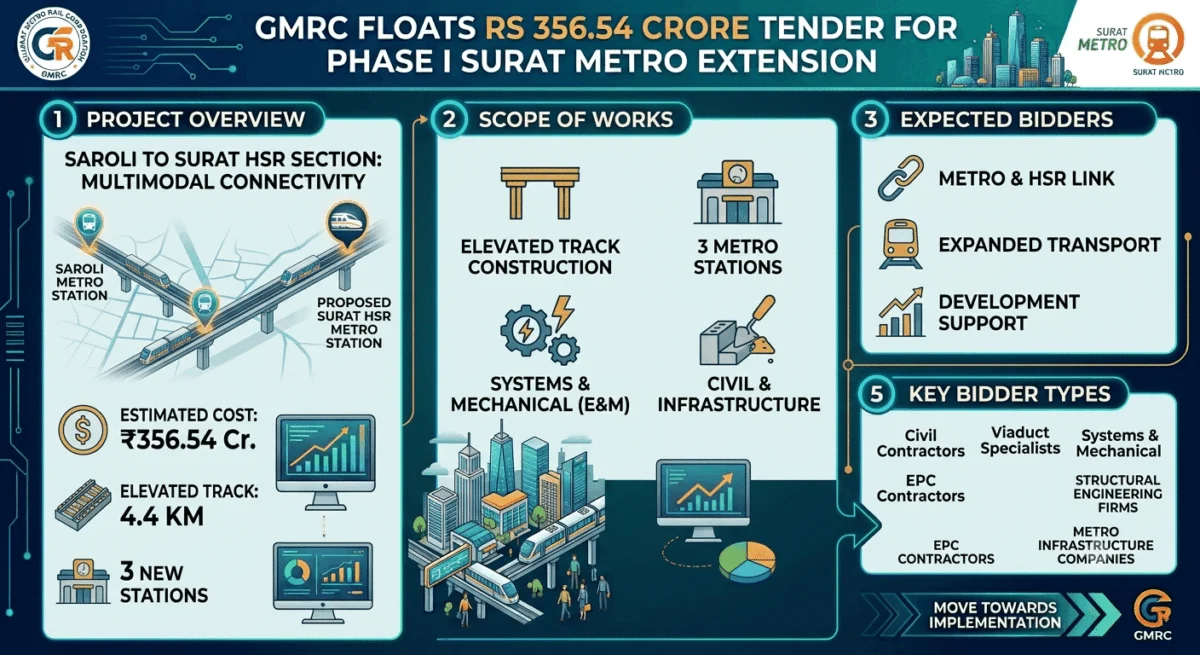
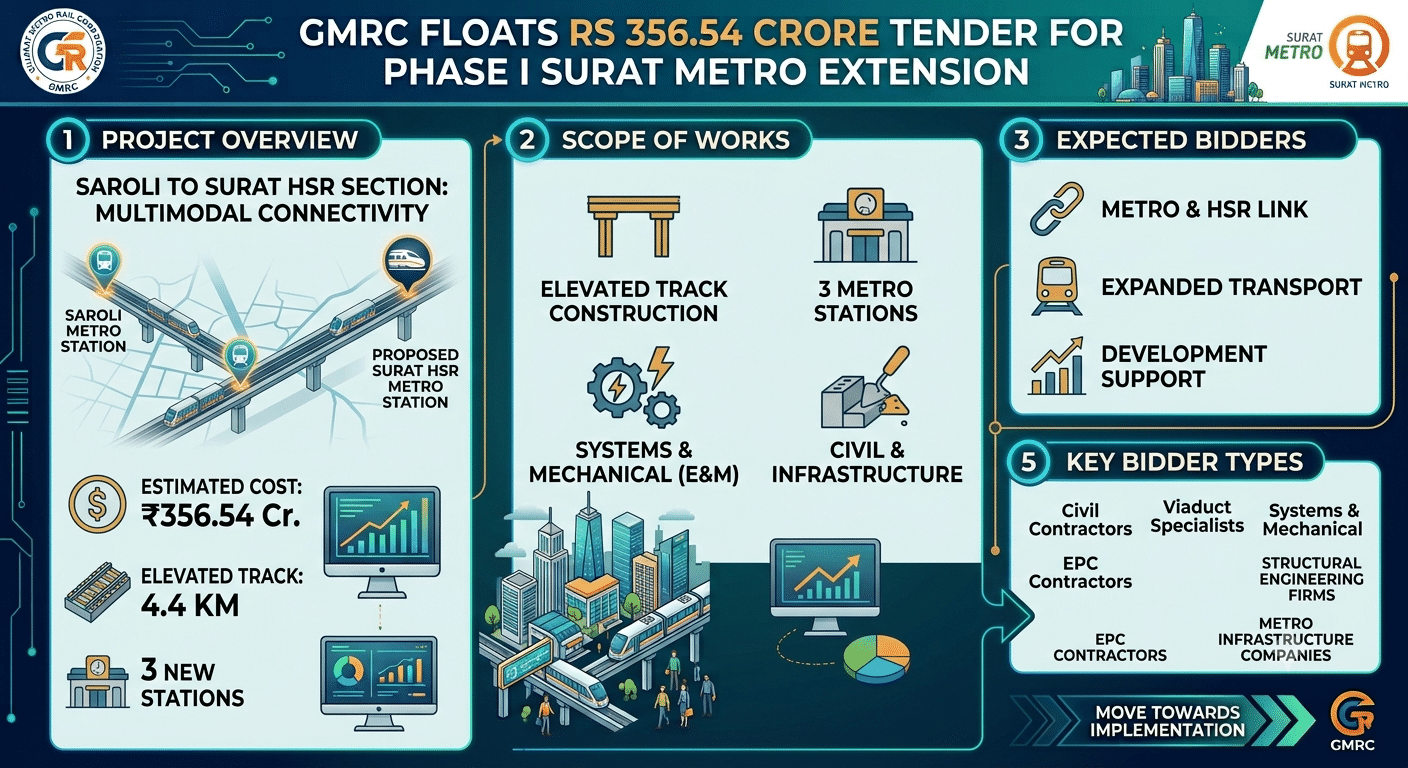
SURAT, GUJARAT — In a significant move to bolster the public transportation infrastructure of one of India’s fastest-growing urban centers, the Gujarat Metro Rail Corporation (GMRC) has officially invited tenders for the Phase I extension of the Surat Metro Rail Project. This specific package, valued at an estimated ₹356.54 crore, focuses on a critical 4.4-km elevated stretch that will bridge the gap between the existing Saroli area and the upcoming High-Speed Rail (HSR) infrastructure.
This development marks a pivotal step in Surat’s journey toward becoming a "smart city," integrating high-speed interstate travel with localized urban transit. The project is designed not only to alleviate the city’s burgeoning traffic woes but also to create a seamless multimodal transport hub that connects the Diamond City’s textile and diamond hubs with the rest of the nation via the Mumbai-Ahmedabad High-Speed Rail corridor.
Main Facts: The Scope and Scale of the ₹356.54 Crore Tender
The GMRC’s invitation for bids represents a cornerstone of the Surat Metro Phase I project. The tender specifically addresses the construction of an elevated viaduct and three strategically placed stations.
1. Technical Specifications and Route
The extension covers a total distance of 4.4 kilometers. This section is entirely elevated, designed to navigate the dense urban fabric of Surat without disrupting existing ground-level traffic. The route begins at the Saroli Metro Station and terminates at the proposed Surat HSR Metro Station.
2. The Three New Stations
While the names of all intermediate stops are finalized during the construction phase, the tender includes the civil and structural work for three stations. These stations are expected to serve as high-traffic nodes, catering to the massive daily influx of workers and traders associated with the Saroli textile markets.
3. Comprehensive Engineering Works
The ₹356.54 crore budget is not limited to the concrete viaducts. It encompasses:
- Civil Infrastructure: Piling, pier construction, and girder launching.
- Electrical and Mechanical (E&M) Works: Integration of power supply, lighting, and ventilation systems within the stations.
- Architectural Finishing: Station aesthetics, flooring, and commuter amenities.
- Integration: Coordination with existing utility lines and the Surat Municipal Corporation (SMC) road networks.
Chronology: The Evolution of Surat Metro Phase I
The journey of the Surat Metro has been a multi-year endeavor aimed at transforming the city’s mobility landscape.
- February 2019: The Union Cabinet, chaired by Prime Minister Narendra Modi, approved the Surat Metro Rail Project with two corridors covering a total length of 40.35 km.
- January 2021: Prime Minister Modi performed the Bhoomi Pujan (groundbreaking ceremony) for the project, signaling the start of active construction.
- 2022-2023: Major contracts were awarded for the underground sections of Corridor 1 (Sarthana to DREAM City) and the elevated sections of Corridor 2 (Bhesan to Saroli).
- September 2026: (Projected Date) GMRC invites bids for the Phase I extension (Saroli to HSR), representing the final "missing link" to the high-speed rail network.
- Expected Completion: While timelines vary, GMRC aims to have significant portions of Phase I operational by 2027-2028, aligning with the phased rollout of the Bullet Train project.
Supporting Data: Understanding the Impact
To understand why this ₹356.54 crore investment is vital, one must look at the demographic and economic data surrounding Surat.
Ridership and Demand
Surat is currently home to over 6 million people and is consistently ranked as one of the world’s fastest-growing cities. The Saroli-HSR corridor is expected to see a daily ridership of over 150,000 commuters within the first three years of operation. The proximity to the textile markets in Saroli means that a significant portion of this ridership will consist of business travelers and logistics personnel.
Financial Structure
The Surat Metro project is a joint venture between the Government of India and the Government of Gujarat, sharing the cost on a 50:50 basis. Additional funding has been secured through international agencies, including the Agence Française de Développement (AFD) and the German development bank KfW, ensuring that the project adheres to international standards of safety and sustainability.
The HSR Connection
The integration with the Mumbai-Ahmedabad High-Speed Rail (MAHSR) is perhaps the most significant data point. The HSR station in Surat is designed to be one of the busiest on the bullet train route. By connecting the Metro directly to the HSR terminal, GMRC is ensuring that a traveler from Mumbai can reach the heart of Surat’s business district in under 90 minutes without ever needing a private vehicle.
Official Responses and Strategic Vision
Government officials and GMRC representatives have highlighted that this tender is more than just a construction contract; it is a vision for "Gati Shakti"—the national master plan for multi-modal connectivity.
GMRC Spokesperson Statement:
"The invitation of bids for the Saroli to HSR extension is a milestone for Surat Metro Phase I. Our objective is to create a synchronized transit system where the Metro acts as the lifeline of the city, feeding into the national high-speed rail network. This 4.4-km stretch is technically demanding due to the existing infrastructure, but it is essential for the city’s future growth."
Urban Development Perspective:
Officials from the Surat Municipal Corporation have noted that the project is being executed with minimal environmental impact. The use of pre-cast segments for the viaduct will reduce on-site construction time and mitigate dust and noise pollution in the densely populated Saroli area.
Implications: Real Estate, Economy, and Urban Living
The announcement of the tender has sent ripples through various sectors of the city’s economy.
1. Real Estate Surge in the Saroli Corridor
Historically, metro connectivity has led to a 15-25% appreciation in property values within a 1-km radius of stations. Saroli, currently known for its industrial and wholesale textile character, is expected to see a shift toward commercial office spaces and premium residential high-rises. Developers are already eyeing land parcels near the proposed three stations, anticipating a surge in demand from professionals who value connectivity to the HSR station.
2. Economic Efficiency for the Textile Industry
Surat’s textile industry relies heavily on the movement of people and samples. The Saroli-HSR link will allow traders from Maharashtra and Northern Gujarat to reach the markets directly. This reduction in "travel friction" is expected to boost the city’s annual GDP by facilitating faster business transactions.
3. Multimodal Integration and Traffic Relief
Surat’s roads, particularly the arterial routes leading to the railway station and the outskirts, are heavily congested. The 4.4-km elevated metro will take thousands of cars and two-wheelers off the road. By providing a reliable, air-conditioned, and timely alternative, the GMRC is addressing the "last-mile connectivity" issue that has long plagued the city’s commuters.
4. Environmental Sustainability
The shift from fossil-fuel-based private transport to an electric metro system is a key component of Gujarat’s "Green Mobility" initiative. The Phase I extension is estimated to reduce carbon emissions by several thousand tons annually, contributing to Surat’s goal of becoming a more livable and breathable city.
Technical Challenges and Future Outlook
While the tender invitation is a positive step, the construction of the 4.4-km stretch will not be without challenges. The Saroli area is characterized by heavy heavy-vehicle traffic and narrow corridors in certain sections. GMRC will need to employ advanced traffic management systems and potentially work during night hours to minimize disruption.
Furthermore, the coordination with the National High-Speed Rail Corporation Limited (NHSRCL) will be critical. The "Surat HSR Metro Station" must be perfectly synced with the Bullet Train terminal to ensure that commuters can transition between the two modes of transport in under five minutes.
Looking Ahead
Once the bidding process is complete and the contract is awarded, construction is expected to begin within the next quarter. As Phase I nears completion, discussions for Phase II are already underway, which would further expand the network into the burgeoning residential zones of the city.
In conclusion, the ₹356.54 crore tender for the Saroli-Surat HSR extension is a testament to the city’s rapid evolution. It represents a synergy of local, state, and national interests, all aimed at positioning Surat as a premier destination for business and a model for modern urban mobility in India. For the residents of Surat, the "Metro Dream" is now one significant step closer to reality.
