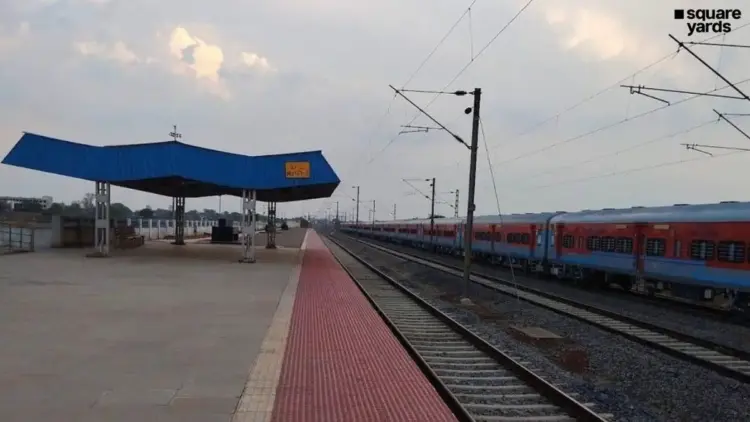
The blueprint for Amaravati, the ambitious capital of Andhra Pradesh, is undergoing a monumental transformation. At the heart of this "People’s Capital" vision lies a multi-billion-rupee railway infrastructure project designed to redefine regional connectivity and urban mobility in South India. With a proposed 1,500-acre mega-station complex and a strategic 57-km broad-gauge line, Amaravati is positioning itself to host one of the largest and most sophisticated railway hubs in the country.
This development is not merely a local transport upgrade; it is a cornerstone of the broader national strategy to integrate the capital region with major economic engines like Hyderabad, Chennai, and Bengaluru. As land acquisition nears completion and the Union Cabinet signals its full support, the project is poised to trigger a massive surge in real estate, logistics, and industrial activity across the Krishna and Guntur districts.
1. The Core Vision: A 1,500-Acre "Airport-on-Tracks"
The centerpiece of this infrastructure overhaul is the proposed Amaravati Railway Station. Spanning a staggering 1,500 acres, the project is designed to be more than just a transit point; it is envisioned as an "airport-like" transport hub.
Scale and Capacity
With 24 platforms and four dedicated passenger terminals, the station is being built to accommodate the future. For context, this scale rivals some of the busiest railway junctions in the world. The facility is projected to handle a daily footfall of over 3 lakh (300,000) passengers, catering to the anticipated population explosion of the capital region over the next two decades.
Modern Amenities and Smart Infrastructure
The "airport-like" designation refers to a suite of high-end facilities intended to eliminate the traditional chaos of Indian railway stations:
- Digital Ticketing and Automated Entry: Seamless, contactless entry systems to manage high volumes efficiently.
- Integrated Transport Services: Direct links to city bus networks, metro rail (proposed), and ride-sharing hubs.
- World-Class Lounges: Climate-controlled waiting areas with premium retail, dining, and business centers.
- Sustainability: The project aims to incorporate green building standards, utilizing solar power and advanced waste management systems.
The estimated cost for the station development alone stands at ₹2,245 crore, representing a significant capital injection into the region’s civil engineering and construction sectors.
2. The Lifeline: The 57-km Errupalem-Amaravati-Namburu Line
While the station serves as the heart, the new 57-km broad-gauge railway line serves as the primary artery. This line is essential for integrating Amaravati into the existing Indian Railways network, which currently bypasses the core capital area.
Strategic Connectivity
The route connects Errupalem (in Telangana) to Namburu (in Andhra Pradesh), cutting directly through the Amaravati region. This link is vital for several reasons:
- Direct Access: It provides the capital with its own dedicated rail link, reducing the current heavy reliance on road transport and the over-burdened Vijayawada Junction.
- Regional Integration: It strengthens the "Golden Triangle" of Vijayawada, Guntur, and Amaravati, allowing for seamless commuting between these urban centers.
- The Krishna River Bridge: A flagship component of this line is the construction of a 3.2-km railway bridge over the Krishna River. This bridge will be a technical marvel, designed to handle high-speed transit and heavy freight.
In October 2024, the Union Cabinet officially sanctioned ₹2,047 crore for this specific line, marking a definitive shift from planning to implementation.
3. Project Chronology and Implementation Status
The journey of the Amaravati railway project has moved from a conceptual stage to a high-priority federal initiative within a remarkably short window.
- October 2024: The Union Cabinet formally approved the 57-km Errupalem-Amaravati-Namburu line with a sanctioned budget of ₹2,047 crore.
- Current Status: Land acquisition is the primary focus. The Andhra Pradesh Capital Region Development Authority (APCRDA) has successfully identified and acquired approximately 80% of the land required for the 1,500-acre station campus.
- Work Commencement: Ground-level activities, including soil testing and site clearing, have begun in various sections along the 57-km stretch.
- Projected Timeline: Authorities have set an ambitious target of 2 to 3 years for the completion of the railway line and the initial phases of the mega-station.
It is important to note that while the railway line and the mega-station are symbiotic, they are funded under separate estimates: the line at ₹2,047 crore and the station at ₹2,245 crore, bringing the total reported investment to over ₹4,290 crore.
4. Supporting Data: Project at a Glance
To understand the magnitude of the project, the following data points summarize the technical and financial specifications:
| Project Component | Technical/Financial Detail |
|---|---|
| Total Campus Area | 1,500 Acres |
| Number of Platforms | 24 |
| Passenger Terminals | 4 |
| Daily Passenger Capacity | 3,00,000+ |
| Station Project Cost | ₹2,245 Crore |
| Railway Line Length | 57 km (Broad-Gauge) |
| Line Construction Cost | ₹2,047 Crore |
| Major Structure | 3.2 km bridge over Krishna River |
| Key Nodes | Errupalem, Amaravati, Namburu |
| Primary Beneficiaries | Amaravati, Vijayawada, Guntur |
5. Future Aspirations: A Hub for High-Speed Rail
One of the most exciting prospects of the Amaravati railway project is its potential to serve as a hub for India’s future Bullet Train network. The government has signaled that Amaravati is being considered as a vital stop for high-speed rail corridors connecting major South Indian metros.
Travel Time Reductions
If the proposed bullet train routes are realized, the impact on regional travel would be revolutionary:
- Amaravati to Hyderabad: ~70 minutes.
- Amaravati to Chennai: ~112 minutes.
- Amaravati to Bengaluru: ~120 minutes.
This connectivity would effectively turn the Southern states into a single economic zone, allowing professionals to commute between cities in less time than it currently takes to cross suburban Bengaluru or Hyderabad during rush hour.
6. Real Estate Implications: The "Infrastructure Multiplier"
Infrastructure projects of this scale historically lead to a significant appreciation in land and property values. In the Amaravati Capital Region, the "Railway Effect" is already being felt across key residential and commercial pockets.
Mangalagiri: The Administrative Corridor
Mangalagiri has emerged as a high-growth zone due to its proximity to the capital’s administrative core.
- Current Market: As of late 2024 (projecting into 2026 data), the average apartment price stands at ₹4,250 per sq. ft.
- Outlook: With the new rail link improving access for government employees and professionals, demand for gated communities and plotted developments is expected to rise sharply.
Tadepalli: The Premium Residential Hub
Positioned between Vijayawada and Amaravati, Tadepalli serves as a bridge between the old and the new.
- Current Market: Apartments are averaging ₹5,200 per sq. ft., while luxury villas have reached an average of ₹5,900 per sq. ft.
- Outlook: The locality’s existing urban facilities, combined with new rail connectivity, make it a top choice for high-net-worth individuals.
Vijayawada and Guntur: The Established Centers
The twin cities of Vijayawada and Guntur will see their roles as commercial hubs reinforced.
- Vijayawada Central: Prices are holding steady at ₹5,200 per sq. ft., while the East and West zones offer more affordable entries at ₹4,400 and ₹4,200 respectively.
- Guntur: The city averages ₹4,700 per sq. ft., but premium areas like Vidhya Nagar have seen spikes as high as ₹6,800 per sq. ft.
7. Logistics and Commercial Economic Impact
Beyond passenger travel, the Errupalem-Amaravati-Namburu line is a strategic asset for freight and logistics. The project is designed to integrate with the National Highway-65 (NH-65) and the Machilipatnam Port.
The Paritala Multi-Modal Hub
A proposed multi-modal logistics hub at Paritala is set to become the clearinghouse for goods moving through the region. By linking rail lines with port access and national highways, the project will:
- Support Industrial Growth: Provide factories in the Guntur-Vijayawada belt with cheaper, faster access to export markets.
- Warehousing Boom: Create opportunities for large-scale distribution centers, packaging units, and cold storage facilities.
- Employment Generation: Thousands of jobs are expected to be created in the transport, maintenance, and logistics sectors as the station and line become operational.
8. Official Responses and Strategic Significance
The Union Government and the State of Andhra Pradesh have expressed a unified front regarding the project’s completion. By categorizing this as a "Project of National Importance," the Cabinet has ensured that funding bottlenecks are minimized.
Official Sentiment:
Sources within the Ministry of Railways suggest that the Amaravati project is a "lighthouse project" for the Gati Shakti Master Plan. The goal is to demonstrate how a greenfield capital can be built with "multimodal integration" from day one, rather than retrofitting infrastructure into an already congested city.
The APCRDA has also emphasized that the 80% land acquisition mark is a major milestone, as land disputes are often the primary cause of delays in Indian infrastructure. The remaining 20% is expected to be secured through the Land Pooling Scheme (LPS), a model that has been central to Amaravati’s development.
Conclusion: The Path Forward
The proposed ₹4,300 crore railway infrastructure project is the strongest signal yet that the development of Amaravati is back on the fast track. By combining a massive 24-platform "airport-like" station with strategic regional rail links and future high-speed aspirations, the project is setting the stage for a new era of economic prosperity in Andhra Pradesh.
For residents, it means world-class mobility; for investors, it represents a golden opportunity in real estate and logistics; and for the state, it is the literal and metaphorical track toward becoming a modern, hyper-connected economy. As construction begins, the eyes of the nation will be on Amaravati to see if it can indeed deliver India’s most advanced transport ecosystem within the next three years.