

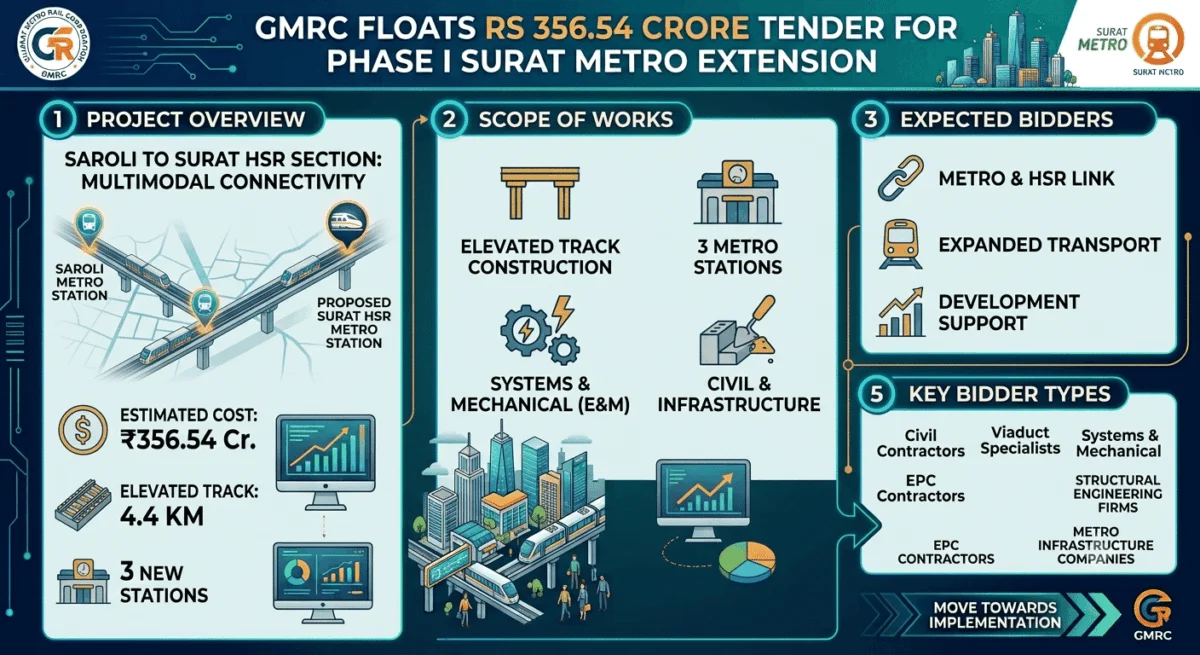
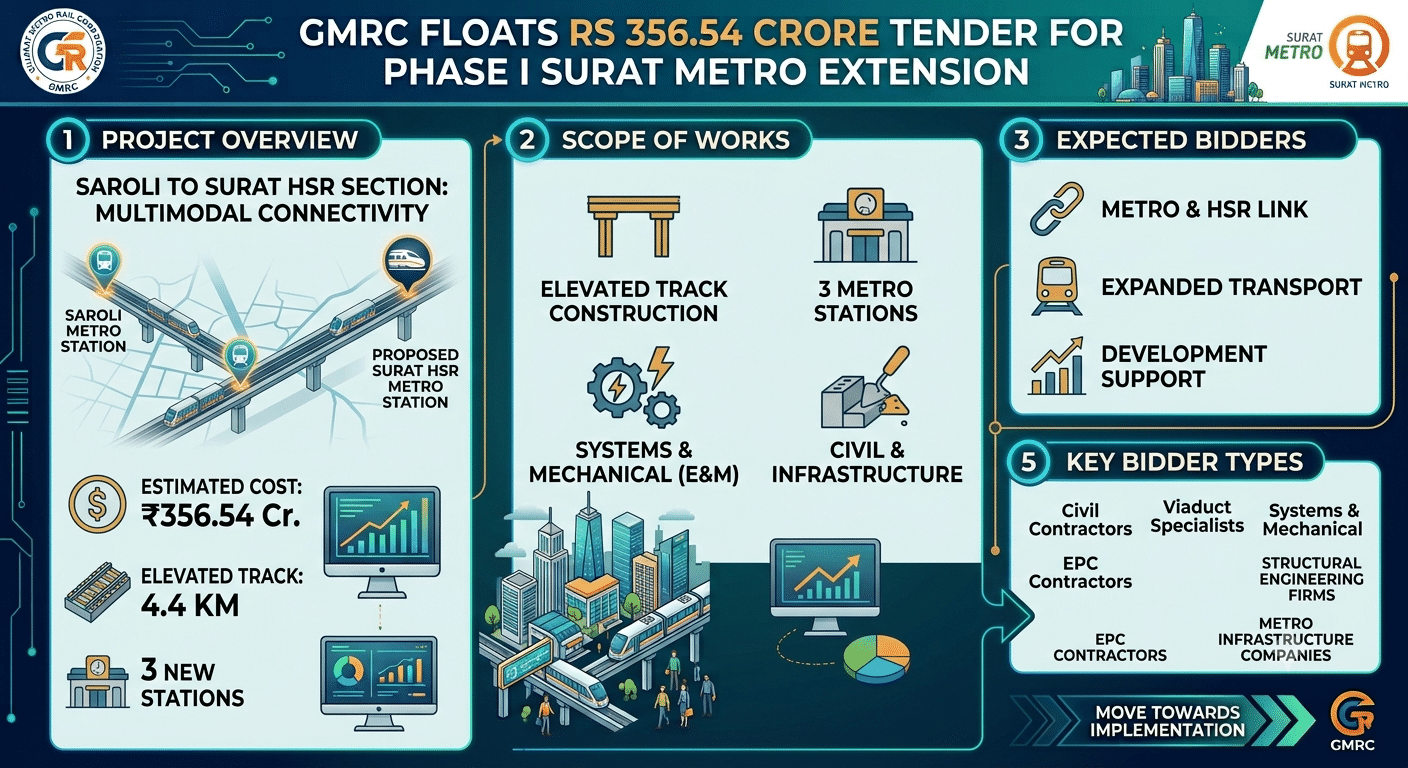
SURAT, GUJARAT — In a move set to redefine the transit landscape of India’s "Diamond City," the Gujarat Metro Rail Corporation (GMRC) has officially invited bids for a critical extension of the Surat Metro Phase I project. The tender, valued at an estimated ₹356.54 crore, focuses on the development of a 4.4-kilometer elevated viaduct and the construction of three strategic stations. This extension is designed to bridge the gap between the existing Saroli Metro Station and the highly anticipated Surat High-Speed Rail (HSR) Metro Station, effectively linking the city’s internal transit system with the national bullet train corridor.
As Surat continues its trajectory as one of the world’s fastest-growing cities, this infrastructure milestone represents more than just additional tracks; it signifies the integration of local, regional, and national transport networks.
1. Main Facts: Scope, Scale, and Specification
The GMRC’s latest tender is a comprehensive package that covers the design and construction of an elevated section that will serve as a vital artery for the city’s eastern expansion. The project, identified under the Phase I extension, is a cornerstone of Surat’s multi-modal transport strategy.
Technical Parameters of the Tender
The ₹356.54 crore investment is earmarked for several high-priority engineering tasks:
- Length and Elevation: A 4.4-km elevated viaduct will be constructed to ensure minimal disruption to the existing ground-level traffic while providing a high-speed transit alternative.
- Station Infrastructure: The contract includes the complete construction of three new metro stations. These stations will be equipped with modern amenities, including platform screen doors, advanced ticketing systems, and accessibility features for differently-abled passengers.
- E&M Integration: Beyond civil works, the tender encompasses Electrical and Mechanical (E&M) works. This includes power supply systems, fire safety infrastructure, ventilation, and lighting.
- Civil & Infrastructure Coordination: The winning contractor will be responsible for the relocation of existing utilities (water, sewage, and electricity lines) and the integration of the metro structure with the existing road network.
Strategic Location: The Saroli-HSR Link
The choice of the Saroli to Surat HSR Metro Station corridor is strategic. Saroli is a burgeoning commercial and textile hub, while the HSR station is the gateway to the Mumbai-Ahmedabad High-Speed Rail corridor. By connecting these two points, GMRC is ensuring that international business travelers and local commuters can transition seamlessly from a 320 km/h bullet train to a localized metro system.
2. Chronology: The Evolution of Surat Metro Phase I
The journey toward a comprehensive metro system in Surat has been a decade-long endeavor, marked by meticulous planning and phased execution.
- 2019: The Foundation: The Union Cabinet, chaired by Prime Minister Narendra Modi, approved the Surat Metro Rail Project Phase I in early 2019. The project was envisioned with two corridors covering a total of approximately 40.35 km.
- 2021: Groundbreaking: Construction officially commenced on the primary corridors. Despite the challenges posed by the global pandemic, the GMRC maintained momentum on the Dream City to Sarthana (Corridor 1) and Bhesan to Saroli (Corridor 2) routes.
- 2023-2024: Civil Progress: Major portions of the elevated and underground sections reached advanced stages of completion. During this period, the focus shifted toward ensuring that the metro would not just be a standalone system but would integrate with other transport modes.
- September 2026: The Extension Milestone: The invitation of bids for the ₹356.54 crore extension marks the transition from the core network to the "connectivity expansion" phase. This phase is specifically designed to synchronize with the progress of the National High-Speed Rail Corporation Limited (NHSRCL) project.
3. Supporting Data: The Economic and Engineering Rationale
The necessity for this extension is backed by robust demographic and economic data. Surat’s population is projected to exceed 8 million by the end of the decade, necessitating a transport system that can handle high-density throughput.
Traffic Relief and Environmental Impact
Currently, the road corridor between Saroli and the outskirts of the city experiences significant congestion due to the heavy movement of goods from the textile markets.
- Ridership Projections: The Phase I extension is expected to cater to an additional 40,000 to 50,000 daily commuters in its initial years.
- Carbon Footprint: By shifting commuters from private vehicles and diesel-operated rickshaws to the electric metro, the project is estimated to reduce carbon emissions by several thousand tons annually.
Financial Breakdown
The ₹356.54 crore estimate is part of the larger ₹12,020 crore budget allocated for Surat Metro Phase I. The funding is a collaborative effort between the Government of India and the Government of Gujarat, with significant loan assistance from international agencies like the Agence Française de Développement (AFD) and the German bank KfW.
4. Official Responses: A Vision for Integrated Mobility
While official statements from GMRC leadership emphasize the technical readiness of the project, the overarching sentiment from the state government highlights the "Double Engine" growth model.
A Senior GMRC Official noted:
"The invitation of this tender is a critical step in our mission to provide world-class mobility to the citizens of Surat. Our focus is not just on building a metro, but on creating a ‘Multi-Modal Integration’ (MMI) framework. The connection to the HSR station is a flagship component of this vision, ensuring that Surat remains at the forefront of India’s infrastructure revolution."
Urban Development Authorities Added:
"Surat is the first city in India to witness such a close alignment between a city metro and a high-speed rail hub. This extension will serve as a template for future urban planning in other Indian metros. We expect the bidding process to be highly competitive, attracting the best engineering firms in the country."
The tender is expected to attract giants such as Larsen & Toubro (L&T), Tata Projects, Afcons Infrastructure, and KEC International, all of whom have a significant footprint in India’s metro construction sector.
5. Implications: Transformative Effects on Surat’s Future
The extension of the metro from Saroli to the HSR station carries profound implications for the city’s real estate, economy, and social fabric.
Real Estate and the "Metro Effect"
Historically, metro corridors in Indian cities like Delhi and Ahmedabad have led to a 15–25% appreciation in property values within a 500-meter radius of the stations.
- Saroli’s Rise: Once considered a peripheral area, Saroli is now poised to become a prime commercial destination. The presence of the metro will likely lead to the development of new office spaces, retail malls, and high-rise residential complexes.
- Transit-Oriented Development (TOD): The Gujarat government is expected to implement TOD policies along this 4.4-km stretch, allowing for higher Floor Space Index (FSI) and encouraging denser, more walkable urban environments.
Boosting the Textile and Diamond Sectors
Surat’s economy relies heavily on its textile and diamond industries. Thousands of workers and traders travel daily to the markets near Saroli. The metro extension will significantly reduce travel time, lower logistics costs for small-scale entrepreneurs, and improve the quality of life for the workforce.
Synergy with the Bullet Train
The most significant implication is the synergy with the Mumbai-Ahmedabad High-Speed Rail. Travelers arriving from Mumbai or Ahmedabad via the bullet train will be able to reach the heart of Surat’s business districts within minutes via the metro, without ever stepping onto a congested city road. This seamless "hub-and-spoke" model is essential for a modern global city.
Engineering Challenges and Local Impact
The construction of a 4.4-km elevated viaduct in a busy city like Surat is not without challenges.
- Traffic Management: GMRC will need to coordinate closely with the Surat Municipal Corporation (SMC) to manage traffic diversions during the construction of the piers.
- Utility Shifting: The Saroli area has a complex network of underground utilities that will require careful mapping and relocation to avoid service disruptions to residents.
Conclusion: A City in Motion
The invitation of bids for the Saroli-Surat HSR extension is a testament to the city’s forward-looking approach. By investing ₹356.54 crore into this 4.4-km stretch, the GMRC is laying the tracks for a future where Surat is more connected, more sustainable, and more economically vibrant.
As the bidding process unfolds over the coming months, the focus will remain on selecting a partner capable of delivering this project within the strict timelines required to match the launch of the High-Speed Rail services. For the people of Surat, the dream of a seamless, world-class transit experience is now one step closer to reality. This project is not merely an extension of a railway line; it is an extension of the city’s ambitions on the national and global stage.
