

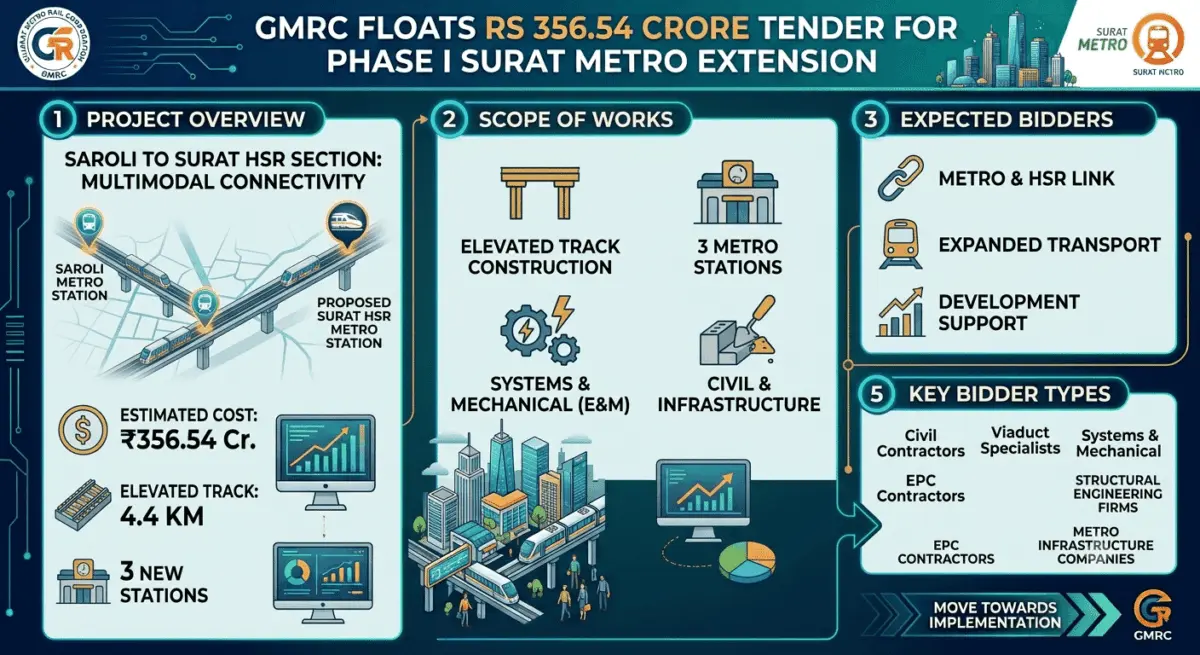
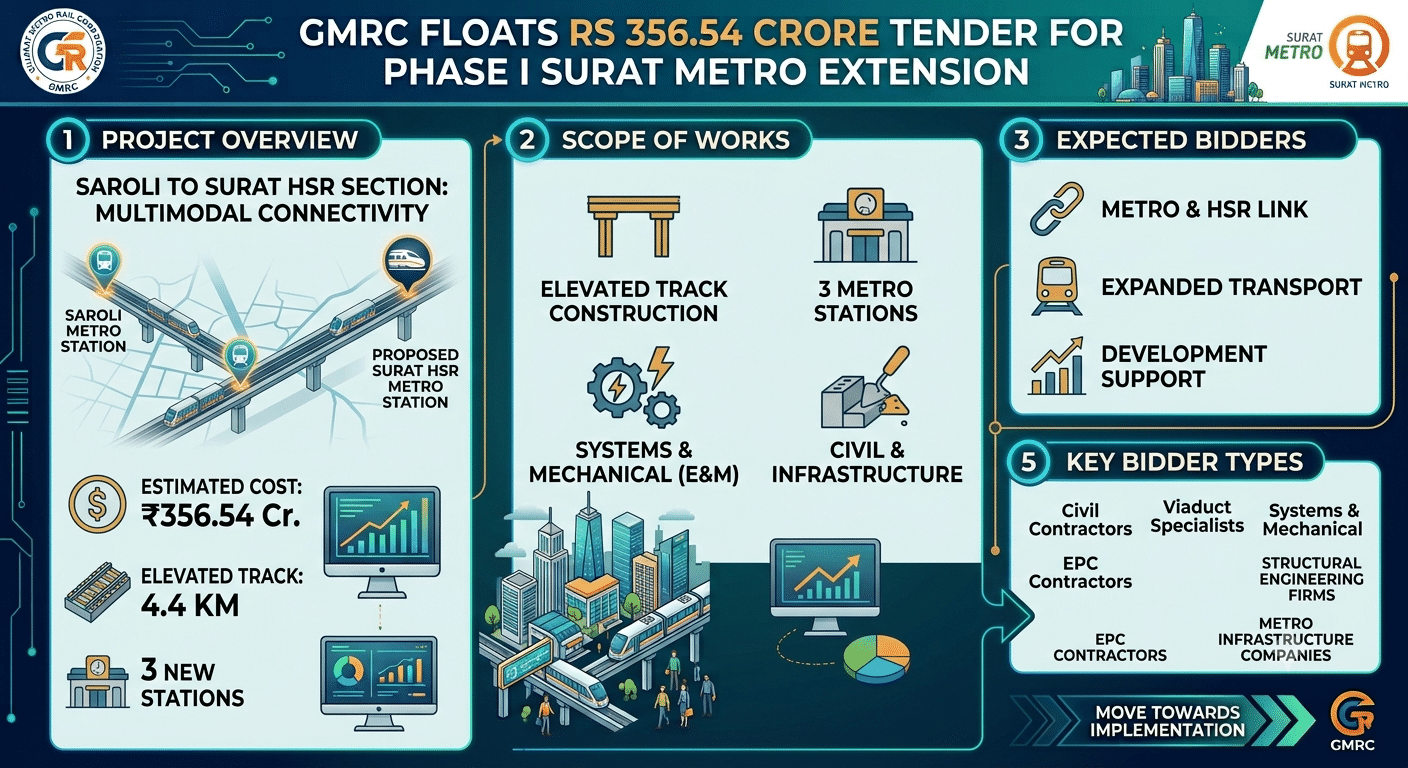
SURAT – In a significant move to bolster the urban transit infrastructure of India’s "Diamond City," the Gujarat Metro Rail Corporation (GMRC) has officially invited bids for the Phase I extension of the Surat Metro Rail Project. The tender, valued at an estimated ₹356.54 crore, focuses on a critical 4.4-kilometer elevated stretch that will bridge the gap between the Saroli area and the upcoming Surat High-Speed Rail (HSR) Metro Station.
This development marks a pivotal moment in Surat’s journey toward becoming a world-class smart city, ensuring that its local metro network integrates seamlessly with the national high-speed rail corridor.
1. Main Facts: The Scope of the ₹356.54 Crore Tender
The newly released tender (Package CS6) is a comprehensive contract that encompasses the design and construction of an elevated viaduct and three strategic metro stations. As Surat grapples with rapid urbanization and increasing traffic congestion, this extension is designed to provide a high-capacity, reliable alternative for thousands of daily commuters.
Technical Breakdown of the Project
The scope of work under this tender is multifaceted, reflecting the complexity of modern urban engineering:
- Viaduct Construction: The project involves the construction of a 4.4-km elevated viaduct. This structure will serve as the backbone of the extension, elevated above existing road networks to minimize land acquisition and disruption to ground-level traffic.
- Station Infrastructure: Three new elevated stations are planned between the existing Saroli Metro Station and the proposed Surat HSR Metro Station. These stations will be equipped with modern amenities, including automated fare collection systems, escalators, elevators, and passenger information systems.
- Electrical and Mechanical (E&M) Works: Beyond the civil structure, the tender includes comprehensive E&M works. This covers lighting, ventilation, fire protection systems, and power supply infrastructure essential for the safe operation of the metro.
- Civil and Infrastructure Integration: The winning contractor will be responsible for the integration of the metro structure with existing utilities, including the relocation of water pipelines, electrical cables, and telecommunication lines, as well as the restoration of roads affected by construction.
2. Chronology: The Evolution of Surat Metro Phase I
To understand the significance of this 4.4-km extension, one must look at the broader timeline of the Surat Metro Rail Project. Phase I was envisioned as a comprehensive solution to the city’s mobility challenges, divided into two primary corridors.
- February 2019: The Union Cabinet, chaired by Prime Minister Narendra Modi, approved the Surat Metro Rail Project Phase I. The project was designed with two corridors covering a total distance of 40.35 km.
- January 2021: Construction officially commenced on the Phase I corridors. Corridor 1 (Sarthana to Dream City) and Corridor 2 (Bhesan to Saroli) began taking shape with various civil contracts awarded to major national and international infrastructure firms.
- 2022–2024: Significant progress was made on the underground sections and the elevated viaducts of the primary corridors. Funding was secured through a mix of Government of India equity, Government of Gujarat equity, and soft loans from international agencies like the Agence Française de Développement (AFD) and KfW (Germany).
- September 2026: GMRC issues the current tender for the Saroli to Surat HSR extension. This extension was conceptualized to ensure that the metro system does not terminate abruptly but rather connects to the National High-Speed Rail Corporation Limited’s (NHSRCL) Bullet Train station, creating a multimodal transport hub.
3. Supporting Data: Financing and Regional Impact
The Surat Metro Phase I project is one of the most capital-intensive infrastructure undertakings in Gujarat’s history. The total cost for Phase I was initially estimated at approximately ₹12,020 crore.
Financial and Operational Metrics
- Tender Value: ₹356.54 Crore (specifically for the 4.4-km Saroli-HSR stretch).
- Projected Ridership: Upon full completion of Phase I, the Surat Metro is expected to cater to an estimated 4.5 lakh passengers per day, with projections rising to 8 lakh by 2041.
- Economic Hubs: The extension directly serves the Saroli area, a burgeoning textile and commercial hub. By connecting this to the HSR station, the project links the city’s commercial heart to the Mumbai-Ahmedabad High-Speed Rail corridor.
- Environmental Benefit: The shift from private vehicles to metro transit is expected to reduce CO2 emissions by several thousand tons annually, contributing to Surat’s "Green City" initiatives.
Bidding and Participation
The GMRC expects a high level of competition for this tender. Eligible bidders are expected to include:
- Tier-1 civil engineering firms with experience in pre-cast segmental viaducts.
- Joint Ventures (JVs) between Indian infrastructure giants and international technical consultants.
- EPC (Engineering, Procurement, and Construction) specialists with a track record in urban rail projects.
4. Official Responses: A Vision for Multimodal Connectivity
While the GMRC has maintained a focus on the technical execution of the tender, officials from the Gujarat government have frequently highlighted the strategic importance of "multimodal integration."
A senior GMRC official, speaking on the condition of anonymity, stated:
"The Saroli to Surat HSR extension is not just about adding kilometers to the metro; it is about creating a seamless transition between different speeds of travel. A passenger arriving from Mumbai on the Bullet Train should be able to step onto the Surat Metro and reach their business destination in Saroli or the Diamond Bourse within minutes. This tender is the final piece of that connectivity puzzle."
Furthermore, state urban development authorities have emphasized that the project is being monitored at the highest levels to ensure that the construction timelines align with the expected operational date of the Mumbai-Ahmedabad High-Speed Rail project. The goal is to avoid "infrastructure lag," where one system is ready but the connecting system is delayed.
5. Implications: Transformative Effects on Surat
The extension of the metro from Saroli to the HSR station carries profound implications for the city’s economy, real estate, and urban planning.
Real Estate and Transit-Oriented Development (TOD)
The "Metro Effect" is already visible in Surat. With the announcement of the Saroli-HSR extension, real estate analysts predict a 15-20% appreciation in property values in the immediate vicinity of the three new stations.
- Commercial Growth: Saroli is known for its massive textile markets. Improved connectivity will allow traders from across India—who arrive via the HSR—to access these markets without navigating the city’s surface traffic.
- Residential Demand: The areas surrounding the new metro stations are likely to see a surge in "Transit-Oriented Development." This involves high-density residential complexes that allow residents to live within walking distance of the metro, reducing the need for car ownership.
Integration with the Bullet Train
The most significant implication is the synergy with the Mumbai-Ahmedabad High-Speed Rail (MAHSR). The Surat HSR station is poised to be one of the busiest on the Bullet Train route. By extending the metro to this specific location, GMRC is ensuring that Surat remains competitive with other major metros like Ahmedabad and Mumbai. It positions the city as a major node in the Western Economic Corridor.
Engineering and Urban Challenges
The construction of a 4.4-km elevated section in a developing area like Saroli is not without challenges. The GMRC will need to manage:
- Utility Shifting: The Saroli corridor is dense with underground utilities that must be mapped and moved without disrupting city services.
- Traffic Management: As an elevated project, construction will take place over busy roads. Implementing a robust traffic diversion plan will be essential to maintain the city’s pulse during the construction phase.
- Synchronized Timelines: The contractor will need to coordinate closely with NHSRCL officials to ensure the metro station interface at the HSR terminal is architecturally and functionally compatible.
Conclusion: A Future-Ready Surat
The invitation of bids for the ₹356.54 crore Saroli-Surat HSR extension is a testament to the Gujarat government’s commitment to proactive infrastructure planning. By the time the Phase I extension is completed, Surat will possess a transit network that is not only localized but also globally integrated.
For the residents of Surat, this project promises a future with less time spent in traffic and more time contributing to the city’s vibrant economy. For the construction industry, it represents a high-stakes opportunity to contribute to one of India’s most prestigious urban mobility projects. As the bidding process unfolds, all eyes will be on the GMRC to see which engineering powerhouse will take on the task of building this critical link in Surat’s modern history.
