

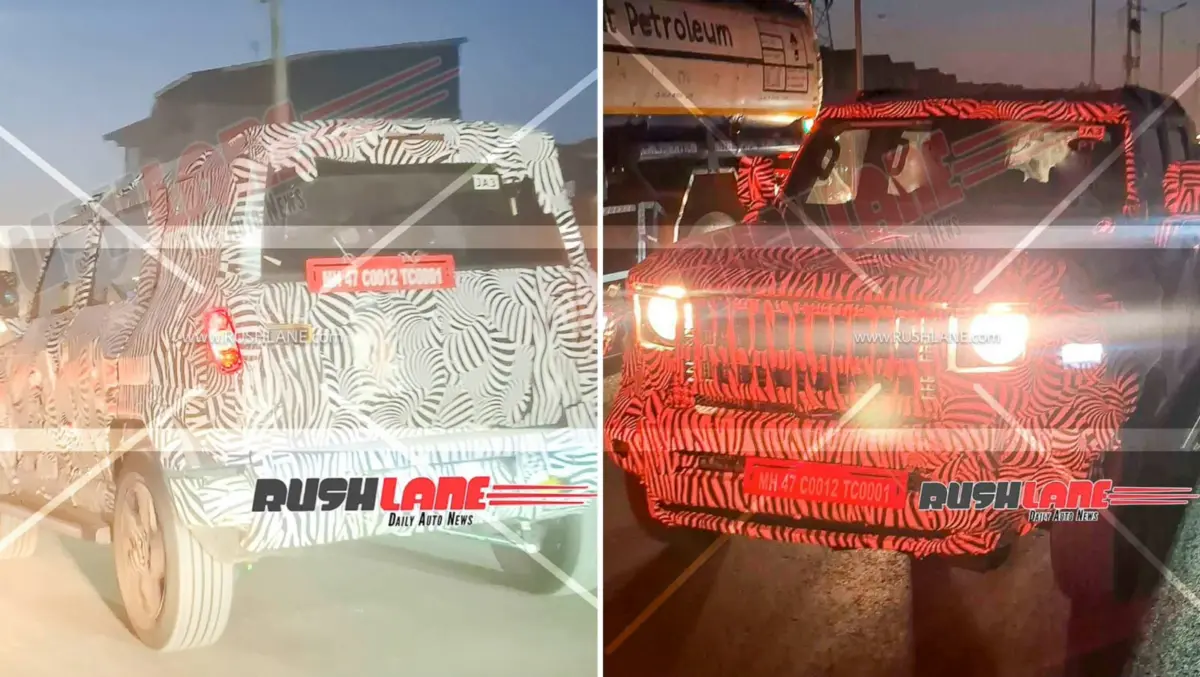
The Indian automotive landscape is currently witnessing a transition that was once deemed unthinkable by purists: the electrification of the rugged, internal combustion-driven off-road segment. At the heart of this revolution is Mahindra & Mahindra, a company that has built its legacy on the back of sturdy diesel engines and go-anywhere 4×4 systems. Recently, the project codenamed the "Thar.e"—now increasingly aligned with the "Vision T" concept—took a monumental leap from the showroom floor to the asphalt. For the first time, a heavily camouflaged five-door electric SUV, believed to be the production-intent Mahindra Thar Electric, has been spotted undergoing rigorous testing on public roads.
This sighting marks a pivotal moment in Mahindra’s "Born Electric" strategy, signaling that the futuristic concepts showcased in Cape Town and London are rapidly maturing into road-legal realities. As the prototype navigates the complexities of real-world traffic, it reveals a fascinating blend of heritage-inspired boxiness and next-generation electric vehicle (EV) architecture.

I. Main Facts: Deconstructing the Spied Prototype
The latest spy shots offer a comprehensive look at the vehicle’s proportions and design language, confirming that Mahindra is staying remarkably true to the Vision T concept unveiled in August 2025.
Exterior Design and Proportions
The test mule retains the unmistakable silhouette of a lifestyle off-roader but with a distinct "cyber-mechanical" twist. The front fascia is dominated by a broad, closed-off grille featuring vertical elements arranged in a two-level pattern—a modern reinterpretation of the classic seven-slot grille. Flanking this are squarish headlamp housings that appear to integrate advanced LED technology, providing a high-tech signature even through the heavy camouflage.

The vehicle’s "clamshell" bonnet is notably flat, leading into an upright windscreen that emphasizes its aerodynamic defiance in favor of traditional ruggedness. One of the most striking features is the width; the flared, squared-off wheel arches give the SUV a planted, aggressive stance. Despite the futuristic aspirations, practical elements like large, rectangular outside rearview mirrors (ORVMs) and flat side steps remain, though the latter appear more production-ready and less "structural" than those seen on the 2023 Thar.e concept.
Wheel and Tire Configuration
Observations from the sighting suggest that the prototype is riding on substantial wheels, likely in the 19 to 20-inch range. While the concepts featured aggressive, knobby off-road tires, this specific test unit was shod with more road-oriented rubber. This indicates that Mahindra is currently focusing on calibrating the on-road dynamics, NVH (Noise, Vibration, and Harshness) levels, and range efficiency before moving into extreme off-road validation.

Rear Profile and Suspension Departure
The rear of the vehicle features a broad, upright tailgate and a massive rear window, ensuring excellent visibility—a necessity for off-roading. Interestingly, the prototype lacked an externally mounted spare wheel. While the Thar.e and Vision T concepts prominently featured a rear-mounted spare, its absence on this mule may be temporary, or Mahindra could be testing a different tailgate load-bearing configuration.
Perhaps the most significant technical revelation from the underbody shots is the presence of independent rear suspension. This marks a radical departure from the live-axle setup found in the current internal combustion engine (ICE) Thar and even the Thar Roxx. For an electric vehicle, an independent setup allows for better packaging of the rear motor and battery tray while significantly enhancing ride quality and high-speed stability on tarmac.

II. Chronology: The Evolution of a Legend
The journey to an electric Thar has been a multi-year saga of international reveals and strategic pivots.
- August 2023 (Cape Town, South Africa): Mahindra stuns the global audience by unveiling the Thar.e concept. Built on a customized version of the INGLO (Indian Global) platform, dubbed INGLO-P1, it featured a modular wheelbase and a radical, minimalist design.
- August 2025 (Annual Global Event): The design evolves into the Vision T concept. This version refined the aesthetics, moving away from the "Lego-block" look of the Thar.e toward a more sophisticated, multi-energy design language. It was introduced as part of the NU_IQ concept family, a sub-brand focused on high-tech, lifestyle electric mobility.
- August 2026 (Launch of the Scorpio Lifestyler): The Scorpio N-based pickup, first seen as a concept alongside the Thar.e, makes its production debut as the Scorpio Lifestyler. This launch is crucial as it established the new interior design language and infotainment hardware that the Thar Electric is expected to share.
- October 2026 (Current Sighting): The first production-intent test mule of the 5-door Thar Electric is spotted on Indian roads, moving the project from the "conceptual" phase to "active development."
III. Supporting Data: Platform and Tech Specs
While Mahindra has remained tight-lipped about the specific output of the spied prototype, we can draw data from the INGLO platform’s stated capabilities and the vehicle’s visible components.

The INGLO-P1 Architecture
The Thar Electric is not a mere "engine-swapped" version of the current Thar. It is built on a dedicated EV skateboard platform. This allows for:
- Flat Floorboard: Removing the transmission tunnel allows for a cavernous interior in a five-door format.
- Battery Capacity: The platform is designed to house battery packs ranging from 60 kWh to 80 kWh. Given the Thar’s aerodynamic profile and weight, a larger battery will be essential to provide a real-world range of 400+ km.
- Dual-Motor AWD: Unlike the mechanical 4×4 systems of the past, the Thar EV will likely utilize a dual-motor setup (one on each axle). This provides "torque-on-demand" and allows for precise wheel-speed control, potentially making it more capable in technical off-road scenarios than its ICE counterparts.
Interior and Infotainment
Spy shots of the cabin reveal a digital instrument cluster and robust grab handles on the A-pillars. Market analysts expect the production version to borrow the 12-inch portrait infotainment system recently debuted in the Scorpio Lifestyler. This system includes specialized "off-road pages" providing real-world data on pitch, roll, compass heading, and motor temperature.

IV. Official Responses and Corporate Strategy
Mahindra & Mahindra’s leadership has consistently framed the Thar Electric as a "global product." During the Vision T unveiling, the company emphasized that their new "Born Electric" range is designed to meet stringent international safety and performance standards, eyeing markets in Europe, Australia, and South Africa.
Regarding the timeline, Mahindra’s official roadmap for the NU_IQ product rollout is scheduled to begin in 2027. While the company has not confirmed a specific date for the Thar Electric, the commencement of public road testing in late 2026 suggests a late 2027 or early 2028 launch.

The company has also recently secured design patents for both the Vision T (the SUV spied here) and the Vision SXT (a more open-bodied, "lifestyle" variant). This patent activity confirms that the design seen on the test mule is indeed the final direction intended for the consumer market.
V. Implications: A Shifting Competitive Landscape
The emergence of the Thar Electric has profound implications for the Indian automotive market and the global lifestyle SUV segment.

1. The Death of the "EVs are for Cities" Myth
For years, the narrative in India has been that electric vehicles are suited only for urban commutes. By electrifying the Thar—a symbol of rugged exploration—Mahindra is challenging this perception. If the Thar EV can prove its mettle in the Himalayas or the deserts of Rajasthan, it will act as a "halo" product that legitimizes EVs for the masses.
2. New Competition: The JSW-MG and Chery Factor
Mahindra will not have the playground to itself. The spy shots coincide with the arrival of new players in the lifestyle EV space:

- JSW Motors: In partnership with MG, JSW is preparing the "Combat" SUV, based on the Jetour T2. This vehicle offers a plug-in hybrid (PHEV) powertrain, which some buyers may prefer over a pure battery electric vehicle (BEV) for long-distance touring.
- Chery/iCAR: The iCAR V23, a compact but hyper-rugged electric SUV from the Chery stable, has also been spotted testing in India.
These rivals feature the same "box-office" styling as the Thar but often come with more tech-heavy interiors. Mahindra’s advantage lies in its deep-rooted brand equity and an existing service network that understands the needs of 4×4 owners.
3. Mechanical vs. Digital Off-Roading
The shift to independent rear suspension and dual-motor AWD represents a philosophical shift. While purists may mourn the loss of the "thump" of a diesel engine and the physical engagement of a manual transfer case, the "digital" off-roading offered by the Thar EV provides benefits like instant torque at zero RPM—perfect for rock crawling—and a lower center of gravity due to the floor-mounted battery, which reduces the risk of rollovers.

Conclusion
The sighting of the Mahindra Thar Electric prototype is more than just a standard "spy shot" story; it is a glimpse into the future of one of India’s most beloved automotive brands. By merging the iconic, defiant aesthetic of the Thar with the sophisticated INGLO electric architecture, Mahindra is attempting to capture lightning in a bottle.
As testing continues through 2027, the industry will be watching closely to see if this "Vision T" can maintain its rugged soul while embracing a silent, emissions-free future. One thing is certain: the road to 2028 just got a lot more interesting.
