

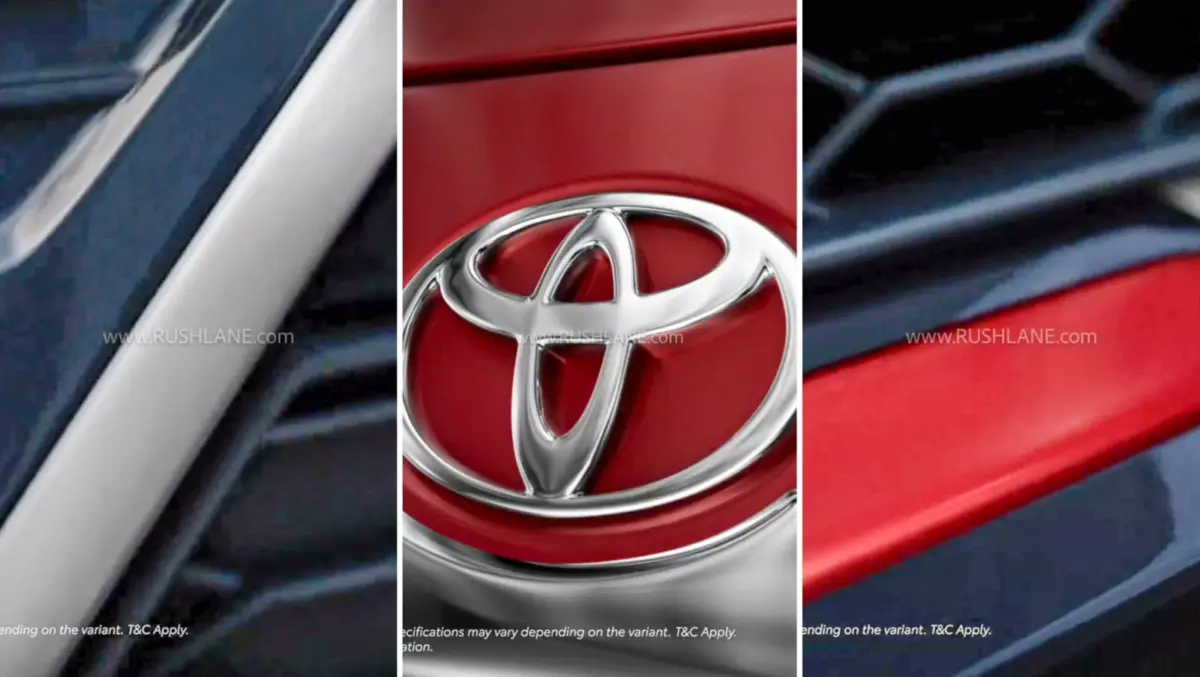
The Indian premium hatchback segment is bracing for a significant refresh as Toyota Kirloskar Motor (TKM) prepares to unveil the latest iteration of the Toyota Glanza. Following weeks of speculation and spy shots, Toyota has officially released the first set of teaser images for the Glanza facelift, confirming a launch date of October 14. This update represents a pivotal moment for the model, which has served as a cornerstone of the Toyota-Suzuki global partnership in India.
The teaser campaign offers a calculated glimpse into the vehicle’s updated aesthetics, suggesting a departure from the current styling toward a more aggressive and modern front-end design. Beyond the cosmetic enhancements, the facelift is expected to bring a suite of technological upgrades and a fundamental shift in its powertrain philosophy, mirroring the changes recently seen in its platform sibling, the Maruti Suzuki Baleno.
Main Facts: The Anatomy of the Facelift
The primary focus of the released teasers is the Glanza’s revised "face." Toyota has traditionally attempted to distinguish the Glanza from the Baleno through unique bumper designs and grille layouts, and the upcoming facelift continues this trend with even more distinct visual markers.
Visual Revisions
The teaser images highlight a new front grille characterized by a black honeycomb mesh pattern. This is framed by a thick, silver-finished surround that curves elegantly around the lower corners of the grille. Positioned prominently on the bonnet is the Toyota logo, set against a red body-colored panel. A metallic-finish trim piece runs beneath the logo, adding a touch of premium flair.

The lower section of the front fascia reveals a redesigned bumper with contrasting elements. A red body-colored strip separates the main grille from the darker, more rugged-looking lower bumper trim. Additionally, the teasers show a glimpse of a new lamp housing, suggesting that the fog lamp enclosures and air intakes have been reshaped to provide a wider, more planted stance.
Feature Enhancements
The Glanza facelift is poised to become one of the most feature-rich offerings in its class. To maintain competitiveness against the Hyundai i20 and the Tata Altroz, Toyota is expected to integrate several high-end amenities:
- Ventilated Front Seats: A much-requested feature in the Indian climate, likely to be offered in the top-spec trims.
- Wireless Charging: A dedicated pad with active cooling to prevent smartphone overheating during long drives.
- Audio Upgrades: Integration of premium Clarion speakers for an enhanced acoustic experience.
- ADAS Level 2: Perhaps the most significant addition, the facelift is rumored to include Advanced Driver Assistance Systems such as Automatic Emergency Braking (AEB), Lane-Keep Assist, and Adaptive Cruise Control.
Mechanical Transition
Under the hood, the Glanza is expected to transition from the long-standing 1.2-litre four-cylinder K-Series engine to the new 1.2-litre three-cylinder Z-Series petrol engine. This engine, which debuted with the new Swift and Dzire, prioritizes thermal efficiency and low-end torque, aiming to provide superior fuel economy figures in real-world driving conditions.
Chronology: The Evolution of the Toyota Glanza
The journey of the Glanza is a testament to the evolving dynamics of the Indian automotive industry and the strategic alliance between Toyota and Suzuki.

- March 2017: Toyota and Suzuki sign a memorandum of understanding to explore a business partnership, focusing on environmental technologies, safety, and mutual supply of products.
- June 2019: The first Toyota Glanza is launched in India. At this stage, the car was a "badge-engineered" version of the Maruti Baleno, with minimal changes beyond the badges and the grille.
- March 2022: Toyota launches the second-generation Glanza (based on the heavily updated Baleno). This version saw Toyota investing more in visual differentiation, giving the Glanza a unique front bumper, headlights, and alloy wheels to create a "Toyota-specific" identity.
- Early 2024: Rumors begin to circulate regarding a mid-cycle refresh for both the Baleno and the Glanza to incorporate newer safety tech and the Z-Series engine.
- October 10, 2026 (per source data): Toyota India releases the first official teasers across social media platforms, confirming the October 14 launch.
Supporting Data: Technical Specifications and Market Positioning
To understand the impact of the Glanza facelift, one must look at the technical shifts occurring within the platform. The move to the Z-Series engine is a calculated risk that trades the inherent smoothness of a four-cylinder engine for the efficiency of a three-cylinder setup.
The Z-Series Engine Profile
The outgoing 1.2L K12N engine was lauded for its refined power delivery. However, the new 1.2L Z12E engine is designed for the modern era of stringent emission norms (BS6 Phase II and beyond).
- Configuration: 3-Cylinder, Naturally Aspirated.
- Power/Torque: Expected to produce approximately 82 PS and 112 Nm of torque.
- Efficiency: The primary goal is to exceed the 22-23 km/l mileage mark (MT), potentially reaching up to 25 km/l in optimized conditions.
- Transmission: A 5-speed manual will remain standard, while the 5-speed AMT (Automated Manual Transmission) will cater to the automatic buyers. Toyota is also expected to offer a factory-fitted CNG variant, possibly with an AMT option, which would be a first for the Glanza.
Safety and ADAS
The inclusion of Level 2 ADAS is a strategic move. Currently, the premium hatchback segment is seeing a slow but steady adoption of safety tech. By offering Lane-Keep Assist and Adaptive Cruise Control, the Glanza targets the "tech-savvy" demographic that might otherwise consider sub-compact SUVs. This move is supported by the "Heartect" platform’s continuous evolution to meet higher crash-test standards.
Comparative Market Data
| Feature | Toyota Glanza (Current) | Toyota Glanza (2024 Facelift) | Hyundai i20 |
|---|---|---|---|
| Engine | 1.2L 4-Cyl K-Series | 1.2L 3-Cyl Z-Series | 1.2L 4-Cyl Kappa |
| ADAS | No | Yes (Level 2) | No |
| Ventilated Seats | No | Yes | No |
| 360-degree Camera | Yes | Yes (Improved) | No |
Official Responses: Toyota’s Strategic Messaging
Toyota India’s official communication regarding the facelift has been centered on the concept of "The Cool New Glanza." On social media, the company stated, "A whole new vibe is about to hit the road. Get ready to make your move."

Industry analysts suggest that Toyota’s marketing strategy for the Glanza differs significantly from Maruti Suzuki’s approach to the Baleno. While Maruti focuses on "Nexa Blue" and "Liquid Flow" design, Toyota emphasizes "Awesome" ownership experiences, longer warranty periods (typically 3 years/1,00,000 km), and a more premium service experience.
A TKM spokesperson (in previous interactions regarding the model) noted that the Glanza has been instrumental in bringing younger customers into the Toyota family. Over 60% of Glanza buyers are first-time Toyota owners, making this facelift crucial for maintaining brand loyalty and introducing a new generation to the brand’s reliability standards.
Implications: The Future of the Premium Hatchback
The launch of the Glanza facelift carries several implications for the manufacturer and the broader market.
Impact on the Toyota-Suzuki Partnership
The Glanza remains the most successful cross-badged product in the partnership. Its success paved the way for the Urban Cruiser Hyryder and the Rumion. The facelift demonstrates that Toyota is not merely "selling a Suzuki" but is actively involved in tailoring the product’s feature set and aesthetic to fit the Toyota brand identity.

Cannibalization vs. Market Growth
While the Glanza and Baleno compete for the same set of buyers, the presence of both models has effectively squeezed out competitors. Together, they command over 50% of the premium hatchback market share. The facelifted Glanza, with its ADAS and ventilated seats, might attract buyers who were previously looking at the Hyundai i20 N-Line or even entry-level compact SUVs like the Tata Punch or Hyundai Exter.
Pricing Strategy
With the addition of ADAS, ventilated seats, and a new engine, a price hike is inevitable. The current Glanza is priced between ₹6.86 lakh and ₹10.00 lakh (ex-showroom). The facelift is expected to see a premium of ₹25,000 to ₹60,000 depending on the variant. This positioning will test the price elasticity of the premium hatchback consumer, especially as the top-end models will venture into the ₹11 lakh territory.
The Efficiency vs. Refinement Debate
The shift to a three-cylinder engine is a gamble. Indian consumers traditionally associate three-cylinder engines with vibrations and noise (NVH). Toyota’s challenge will be to prove that the Z-Series engine offers enough refinement to justify the switch, backed by the undeniable benefit of lower running costs and higher fuel efficiency.
Conclusion
The October 14 launch of the Toyota Glanza facelift is more than just a seasonal update; it is a strategic repositioning of a vital model. By blending Suzuki’s expertise in efficient small-car engineering with Toyota’s reputation for premium features and safety, the new Glanza aims to redefine what a premium hatchback can offer in 2024 and beyond. As the teasers continue to roll out, the automotive industry awaits to see if these "vibe" changes translate into a market-leading performance.
